• Annual Report 2022-23 now available

    Our Annual Report 2022-23 is now available.

    The report outlines our progress throughout the 2022-23 year to assure the quality of higher education in Australia.

    The report provides an account of our performance against measures and targets set out in our 2022-26 Corporate Plan and the 2022-23 Portfolio Budget Statements.

    In August, we published our 2023-27 Corporate Plan, which outlines our priorities for the coming years.

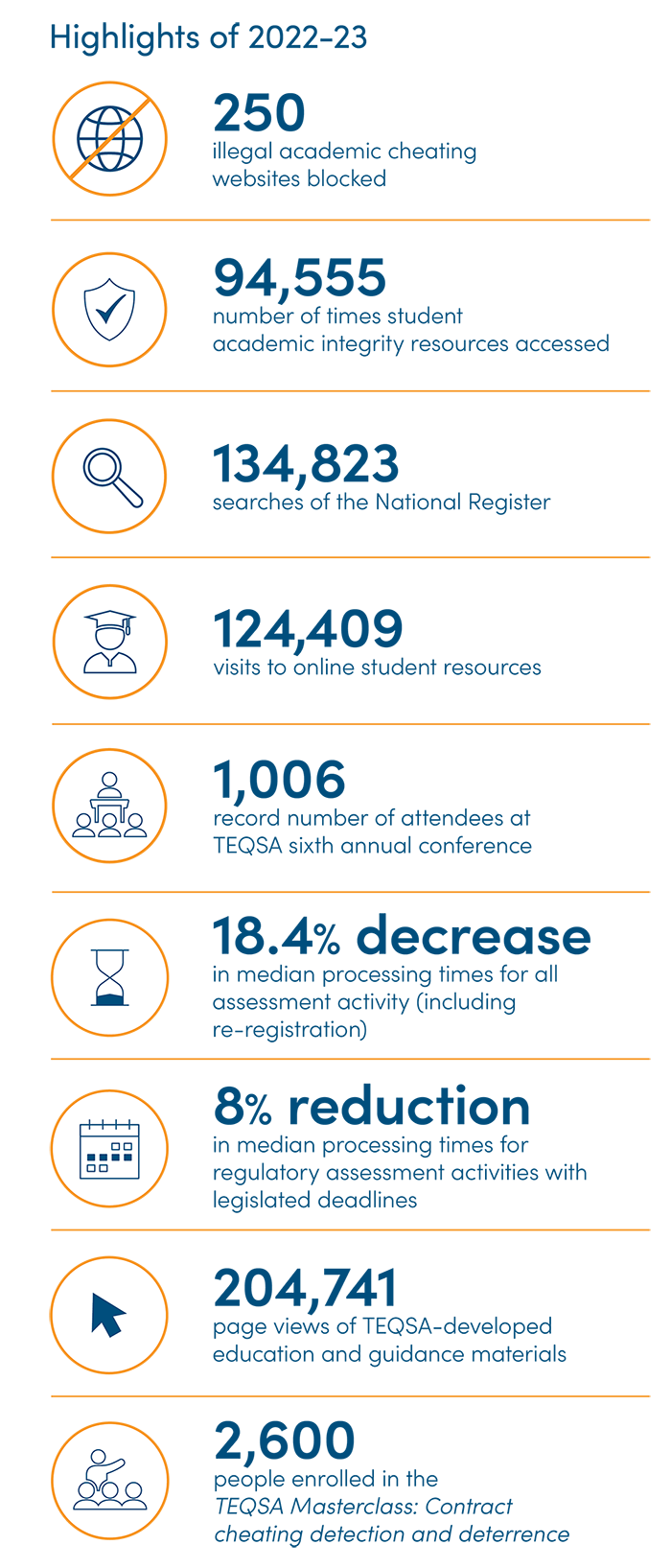
    Highlights of 2022-23


    Date
    Last updated:
    Featured image
    Student photo
  • How to apply for a job at TEQSA

    Our recruitment and selection processes are fair and transparent, providing you with an opportunity to demonstrate your skills, abilities, and experience relevant to the job.

    If you have a disability and need an adjustment to be made to the assessment process, please don’t hesitate to let the nominated contact person or recruitment team know so that we can accommodate your needs.

    Eligibility to work with us

    TEQSA requires Australian citizenship as a condition of engagement.

    Successful applicants must also undergo and satisfy a National Police Check (NPC) and be able to obtain and maintain an Australian Government Security Vetting Agency (AGSVA) clearance to Baseline/Negative Vetting Level 1 status, supported by TEQSA.

    TEQSA supports workplace diversity and values the contribution of people from diverse backgrounds. In particular, applications are encouraged from Aboriginal and/or Torres Strait Islander people, people with disability, and people with cultural and linguistic diversity.

    Is this the right job for me?

    Before applying for a particular job:

    • read the job advertisement carefully, in particular the How to apply section which contains specific information about what is required from you
    • review the Candidate Information Pack (CIP) to gain a broad understanding of the role
    • determine if you possess the key requirements of the role (our ideal candidate and qualifications and experience sections of the CIP) and consider if you are the right person for the job.

    If, at any stage during the application process, you need clarification or more information about the position, please call the contact person listed on the advertisement.

    Applying for jobs at TEQSA

    When applying for jobs, you must follow the How to Apply instructions as outlined in the job advertisement and the Candidate Information Pack. You will also need to provide a copy of your current resume.

    For assistance with preparing your pitch, you may wish to refer to Australian Public Service Work Level Standards relevant to the job classification level and read Cracking the code: How to apply for jobs in the Australian Public Service.

    Merit

    Our selection processes are merit-based. We use a competitive selection process and assess a candidate's suitability based on their skills, experience, knowledge, and the attributes required for the role. We also assess personal qualities such as honesty, integrity, and cultural fit.

    Assessment

    Usually, a selection panel of 2 or 3 people assess the merit of each application. The methods they use may include:

    • written applications (resume and cover letter/pitch)
    • behavioural interviews
    • written tasks
    • referee comments.

    We choose the type of assessment to suit the job type and the specific business environment.

    The process

    Our most commonly used process is to:

    • review your online application
    • shortlist candidates
    • use a next-stage assessment process, such as interviews and/or written tasks
    • contact referees
    • create a merit pool or list
    • notify candidates about the process outcome (including placement in the pool)
    • select the best candidate when we have a vacancy to fill
    • contact the successful candidate with a job offer.

    Please note: creating, using and sharing merit lists is a common practice in the Australian Public Service (APS) for similar vacancies. This means that if you are in our merit pool, we may contact you about a job opportunity in another agency. Merit pools are valid up to 18 months from the advertised vacancy date.

    Applying for our Temporary (Non-ongoing) Employment Registers

    From time-to-time, TEQSA requires people across a range of classification levels and business areas to fill short-term vacancies caused by staff movements or to assist with a temporary increase in workload. To help us achieve this, we maintain two registers of interested applicants for use by managers to fill temporary (non-ongoing) roles up to a maximum period of 18 months.

    Opportunities vary across classification levels and may be full-time or part-time for a specified term or a specified task based on TEQSA’s needs. Candidates may register interest in temporary employment at TEQSA by completing an application for the General or Regulatory Operations register.

    Applying or becoming active on our registers does not guarantee an offer of employment. Applicants will only be contacted if a vacancy arises that matches their skills, qualifications and/or experience.

    Our Temporary Employment Registers are advertised along with other TEQSA roles on our online job portal.

    Your privacy

    Remember to read our privacy policy. The policy describes how privacy principles are applied, how and why data is collected and how it is stored. It also outlines circumstances when your information can be disclosed.
     

    Last updated:

    Related links

  • Leading voices to share sector insights at the 2023 TEQSA Conference

    TEQSA is delighted to welcome leading experts to share their insights into current issues facing higher education and opportunities to reshape the sector into the future at the upcoming 7th annual TEQSA conference.

    On 23 November, TEQSA will bring together leading voices, including Minister for Education, The Hon Jason Clare MP, and the Australian Universities Accord Panel’s Professor Mary O’Kane AC. We‘re also proud to present a program with strong student representation, including President of the National Union of Students, Bailey Riley, and the Accord Reference Group’s Rural Youth Ambassador, Tayla Roberts, to bring valuable insight into the student experience.

    TEQSA’s conference is Australia’s only truly sector-focused event. It seeks to inform and challenge collective thinking to support the sector to navigate the challenges we face and seize the opportunities. The day’s program includes discussions on the Australian Universities Accord, reforming assessment in the age of artificial intelligence and current issues for regulation in higher education.

    Attendees are invited to attend a Welcome Reception with drinks, canapes, exclusive access to THE LUME and the opportunity to network with peers.

    The event will be held at the Melbourne Convention and Exhibition Centre on Thursday 23 November and in-person and virtual registration are available on the TEQSA Conference website.

    Date
    Last updated:
    Featured image
    TEQSA 2023 Conference
  • Cheating websites blocked

    Since August 2022, TEQSA has worked to disrupt almost 290 commercial academic cheating websites and 841 social media accounts, to protect the integrity of Australia’s higher education sector.

    Australia’s anti-cheating laws make it an offence to provide or advertise academic cheating services in higher education.

    Recently, TEQSA blocked an additional 37 websites under protocols with major ISPs. Additionally, we’ve worked with social media companies to continue removing posts and profiles that advertise academic cheating services.

    A list of blocked illegal cheating websites is available. TEQSA also has a number of resources available to support higher education students, academics and professional staff to manage the risk to academic integrity. These resources include:

    Date
    Last updated:
    Featured image
    Keyboard
  • Assessment reform for the age of artificial intelligence

    TEQSA has published guiding principles and propositions to support the sector in considering the risks and opportunities of generative artificial intelligence (genAI).

    The paper, Assessment Reform for the Age of Artificial Intelligence (Assessment Reform Guiding Principles), draws on the combined guidance of leading Australian experts in artificial intelligence, assessment design and academic integrity in higher education. 

    The Assessment Reform Guiding Principles are provided to support staff and institutions to reflect on the integrity of their assessment regime and opportunities to incorporate genAI into their educational program. They are offered to help inform decision-making and action into the future and are not intended to be prescriptive.

    Following consultation in October, the final Assessment Reform Guiding Principles were launched by a panel of the lead authors at the TEQSA Conference on 23 November 2023.

    In October, TEQSA’s Chief Commissioner, Professor Peter Coaldrake, wrote to all higher education providers noting the significant risk genAI presents to academic integrity and advising TEQSA’s intention to seek assurance from providers that plans are in place to address this issue. All registered higher education providers are encouraged to review Professor Coaldrake’s letter.

    If you have an enquiry about the Assessment Reform Guiding Principles, please email integrityunit@teqsa.gov.au
     

    Date
    Last updated:
    Featured image
    Artificial intelligence AI
  • Fees and charges updated from 1 January 2024

    We’ve released our Cost Recovery Implementation Statement (CRIS) November 2023, which outlines our fees and charges for regulatory activity from 1 January 2024 onwards. 

    This updated version of the CRIS was developed following a review of how TEQSA’s new cost recovery model operated over the first 8 months of 2023, and important feedback gathered from our consultation with the higher education sector in September.

    Date
    Last updated:
    Featured image
    Students at desk
  • Guidance note: Facilities and infrastructure

    Body

    Documents

    Providers should note that Guidance Notes are intended to provide guidance only. The definitive instruments for regulatory purposes remain the TEQSA Act and the Higher Education Standards Framework, as amended from time to time. 

    What do Facilities and Infrastructure encompass?

    In the context of the Higher Education Standards Framework (Threshold Standards) 2021 (Threshold Standards) facilities and infrastructure refer to the resources used for educational and research purposes.

    This Guidance Note will use the terms ‘facilities’ and ‘infrastructure’ interchangeably. However, if we were to define each separately:

    • ‘facilities’ refers to the learning environments, including both physical and digital learning environments, intended to promote and facilitate the learning outcomes and educational activities of students and staff.
    • ‘infrastructure’ refers to both physical and digital resources such as classrooms, lecture theatres, internet, e-learning/digital platforms and laboratories used by students and staff. 

    The primary obligations around facilities and infrastructure are found in Standard 2.1 of the Threshold Standards. The purpose of the relevant standards is to ensure a provider’s facilities and infrastructure are suitable for their educational and research activities.

    The specific learning resources used for a particular course of study are dealt with in Standard 3.3 of the Threshold Standards and are only considered briefly as part of this guidance note. Additional information about these resources is in the Learning Resources and Educational Support Guidance Note.

    Information about facilities and infrastructure related to placements and collaborative training arrangements, such as work integrated learning, are dealt with in greater detail in the Guidance Notes on Delivery with other parties and Work-integrated learning (WIL).

    What TEQSA will look for

    TEQSA considers relevant standards from the Threshold Standards in the context of facilities and infrastructure, among which most notably are:

    Part A: Standards for higher education providers

    Key considerations

    2.1.1 – 2.1.3: Facilities and Infrastructure

    • facilities and infrastructure are fit for their educational and research purposes
    • secure access to digital information and communication services is continuously available for all users
    • facilities are adaptable and can support both students and staff with additional needs
    • the learning environment supports academic interactions among students outside of formal teaching.

    2.3: Wellbeing and Safety

    • providers have a critical-incident policy and procedures covering potential risks associated with facilities such as fires, bomb threats, and hazardous building materials (e.g. asbestos)
    • facilities and infrastructure are accessible to those with accessibility needs
    • students and staff are provided information on the actions they can take to enhance safety on campus and online.

    3.3.2 and 3.3.4: Learning Resources and Educational Support

    • all users have timely access and training in the use of e-learning management systems, where such systems are adopted
    • students have access to learning support services consistent with the requirements of their course of study, their learning environment, and the needs of different student cohorts.

    5.4.2: Delivery with Other Parties

    • providers remain accountable for ensuring the delivery of parts of their course(s) through third party arrangements in Australia or overseas comply with the Threshold Standards, including the safety, security and adequacy of accommodation and opportunities for work-integrated learning
    • where facilities are shared by several providers (e.g. Study Hubs), an agreement exists to make explicit the roles and responsibilities of the parties to ensure compliance with the Threshold Standards.

    6.2.1(a)(i): Corporate Monitoring and Accountability

    • providers remain compliant with other legislative requirements, including ensuring facilities comply with legislation protecting students and staff against workplace health and safety risks
    • business continuity plans have been developed to mitigate potential disadvantage to students through changes to a provider’s operations. 
    7.3.3: Information Management
    • providers’ information systems maintain secure and confidential records
    • students and staff are made aware of providers cyber awareness strategies, including information about privacy, confidentiality, and the handling of data (including personal information)
    • procedures and policies are in place to address cyber security risks.


    Facilities and infrastructure are fit for purpose

    In the context of course design and learning outcomes, there is an expectation facilities and infrastructure are fit for the purposes of:

    • facilitating the educational and research activities of students and staff
    • promoting learning outcomes
    • safely accommodating the number of students and staff who need to use the resources.

    To demonstrate compliance with 2.1 of the Threshold Standards, providers should show their facilities and infrastructure facilitate and promote learning and research in a safe environment.

    This requirement extends to facilities where external placements are undertaken, such as community-based learning, fieldwork, and collaborative research environments where students may complete onsite training as part of a provider’s delivery arrangement with another party.

    In circumstances where arrangements have been made with third parties to deliver domestic or international fieldwork or clinical placements, providers are accountable for all aspects of course delivery and support, including monitoring, compliance and student wellbeing and safety. Providers should therefore implement practices and processes for assuring the facilities and infrastructure of third parties remain at expected standards.

    Access to digital information and communication services

    Standard 2.1.2 of the Threshold Standards requires providers to ensure its students and staff have continuous and secure access to adequate digital information and communication services.

    An exception to this requirement involves reasonable outages to a service where a provider has no direct control over the facilities and infrastructure. The provider’s response to the possibility of such events should be addressed in a risk management strategy or business continuity plan.

    TEQSA expects a provider to have adequate IT infrastructure and software resources to support student learning. This may include providing e-learning facilities, data storage of digital records/data collections, videoconferencing capabilities and email. Resources should be made available to all users, subject to normal after-hours limitations.

    A provider’s IT infrastructure should also support multiple demands, such as:

    • multiple instances of simultaneous videocalls
    • interactive digital learning platforms
    • the online submission of assessments
    • other high-traffic digital activities such as streaming.

    To protect its IT infrastructure, providers are encouraged to consider contemporary security controls and implement regular reviews to ensure their effectiveness, including:

    • offering anti-virus software to students and staff using personal devices
    • complex passwords, firewalls, and multifactor authentication. 

    Where providers offer online and hybrid learning, they must ensure their digital facilities and infrastructure (and those offered through third-parties) are accessible to students off campus, including to students studying internationally.

    Further information about facilities and infrastructure relating to record management system is included in the Information Management guidance note (under development).

    Supportive, safe, and inclusive learning environment

    The Threshold Standards require a provider to have a learning environment that allows students to interact academically outside of formal teaching.

    In offering such interactive spaces, providers should consider whether they offer adequate safety and a supportive learning environment for diverse student cohorts. Providers should also review their arrangements over time to ensure they meet the changing needs of student cohorts.

    TEQSA also recognises that recreational and social facilities are important for supporting interactions amongst students outside of formal learning (e.g. university clubs). However, the Threshold Standards do not introduce requirements specific to such facilities.

    Relevant Australian legislation

    Where it applies to a provider, any newly constructed education and training facilities must now have a certificate of approval under the Building Code of Australia (BCA). The BCA is contained in chapters 1 and 2 of the National Construction Code (NCC), and has been recognised in legislation in all states and territories.

    The BCA requirements should be read in conjunction with any other relevant national and state-based planning and building codes.

    Other relevant planning and building codes place obligations on providers to ensure their buildings are adequate for occupation and for their intended use. TEQSA may request documentation such as proof of occupancy when reviewing the capacity of facilities against student projections to determine if facilities are adequate.

    National and state-based equal opportunity and anti-discrimination legislation apply to student cohorts. Providers should ensure they are compliant with their legal obligations and where appropriate provide facilities such as prayer rooms.

    Obligations applying to providers of education to overseas students

    Where it applies to a provider, TEQSA considers the National Code of Practice for Providers of Education and Training to Overseas Students 2018 (National Code) and the Education Services for Overseas Students Act 2000 (ESOS Act).

    Key sections of National Code relevant to Facilities and Infrastructure are:

    • 6.7 – providers must ensure its staff are aware of the providers’ obligations under the ESOS framework. This includes being aware of obligations related to the adequacy of facilities.
    • 11.2.5 – the provider and any partner they engage to deliver a course or courses to overseas students has adequate staff and education resources. This includes facilities, equipment, learning and library resources and premises (as are needed) to deliver the course to the overseas students enrolled with the provider.
    • 11.2.6 – the number of overseas students proposed by the provider for the location, reflects the appropriateness of staff, resources, and facilities for the delivery of the course.

    Identified issues

    Within the context of the Threshold Standards, TEQSA has identified a range of issues which are indicative of risks to compliance for facilities and infrastructure.

    Fitness for purpose

    • facilities and infrastructure are not capable of supporting the number of students enrolled (e.g. students being unable to access laboratory equipment to complete course work outside of normal hours, and insufficient facilities for teaching staff to carry out their duties)
    • third parties delivering parts of a provider’s course, or offering affiliated accommodation services, lack suitable facilities and infrastructure for the student to achieve the learning outcomes of their course of study
    • providers are not cognisant of the facility and infrastructure requirements of their students when outsourcing to third parties. 

    Access to and security of digital information and communication services

    • there are inadequate digital information or communication services (e.g. infrastructure is not capable of supporting students studying remotely)
    • the provider does not seek to minimise system and service outages and downtimes
    • there is inadequate security on the provider’s digital information and communication services, leaving students and staff data vulnerable to cyber-attacks
    • student data is not collected, stored, used, disclosed, and disposed of within the requirements of relevant local, Commonwealth and applicable international legislation, or in accordance with relevant policies of the provider.

    Learning environment

    • the provider does not have learning environments where students can study and collaborate
    • the provider does not promote a safe environment or advise students and staff on steps they can take to stay safe and secure on campus, online and in third party accommodation services.

    Related resources


    Version #

    Date

    Key changes

    1.0

    30 November 2023


    Subtitle
    Version 1.0
    Stakeholder
    Publication type
  • #TEQSA23 session recordings now available

    Full-length recordings are now available of every session from the #TEQSA23 conference where a wealth of ideas and knowledge were shared about reshaping higher education.

    Session 1

    • Chair and introduction: Professor Peter Coaldrake AO, Chief Commissioner, TEQSA
    • Minister’s welcome address (The Hon Jason Clare MP, Minister for Education)
    • Panel: The shape of things to come - reflections from the Australian Universities Accord (Professor Mary O’Kane AC, Associate Professor David Perry, Tayla Roberts)

    Session 2

    • Chair: Adrienne Nieuwenhuis, Commissioner, TEQSA
    • Panel: Current issues for regulation in the higher education sector
      (Dr Mary Russell, Acting Chief Executive Officer, TEQSA (presenter); Saxon Rice, CEO, Australian Skills Quality Authority; Professor Theo Farrell, Deputy Vice-Chancellor, University of Wollongong; Bailey Riley, President, National Union of Students; Dr Saraid Billiards, CEO, Association of Australian Medical Research Institutes)

    Session 3

    • Chair: Stephen Somogyi, Commissioner, TEQSA 
    • Panel: Assessment reform for the age of artificial intelligence
      (Dr Helen Gniel, Director, Higher Education Integrity Unit, TEQSA (speaker and panel chair); Associate Professor Jason Lodge, The University of Queensland; Professor Rowena Harper, Deputy Vice-Chancellor (Education), Edith Cowan University; Leo Shchurov, Computer Science student, University of Technology Sydney; Raphaella Revis, Law and IT student, University of Technology Sydney)

    Session 4

    • Chair: Professor Joan Cooper, Commissioner, TEQSA 
    • Presentation: Skills for the future: what the data tells us (David Turvey, Acting Commissioner, Jobs and Skills Australia)
    • Presentation: Latest insights from QILT with a focus on student employability data (Lisa Bolton, Director, QILT Research and Strategy)
    • Presentation: Higher education: Looking forward (Professor Marnie Hughes-Warrington AO, Standing Acting Vice Chancellor and Deputy Vice Chancellor Research and Enterprise, University of South Australia)
    Date
    Last updated:
    Featured image
    TEQSA 2023 Conference