• Financial reporting

    As an Australian Government-controlled not-for-profit entity, TEQSA is required to publish certain financial documents.

    You can access current financial statements in the most recent annual report.

    TEQSA legal services expenditure

    TEQSA legal services expenditure for 2025–26

    • External Legal Services expenditure: $479,975
    • Internal Legal Services expenditure: $1,200,209
    • Total (External + Internal) expenditure: $1,680,184

    TEQSA legal services expenditure for 2024–25

    • External Legal Services expenditure: $428,759
    • Internal Legal Services expenditure: $760,672
    • Total (External + Internal) expenditure: $1,189,431

    TEQSA legal services expenditure for 2023–24

    • External Legal Services expenditure: $386,417
    • Internal Legal Services expenditure: $835,039
    • Total (External + Internal) expenditure: $1,221,456

    TEQSA legal services expenditure for 2022–23

    • External Legal Services expenditure: $371,831
    • Internal Legal Services expenditure: $707,021
    • Total (External + Internal) expenditure: $1,078,852

    TEQSA legal services expenditure for 2021–22:

    • External Legal Services expenditure: $453,105
    • Internal Legal Services expenditure: $695,127
    • Total (External + Internal) expenditure: $1,148,232

    TEQSA legal services expenditure for 2020–21:

    • External Legal Services expenditure: $392,738
    • Internal Legal Services expenditure: $733,271
    • Total (External + Internal) expenditure: $1,126,009

    TEQSA legal services expenditure for 2019–20:

    • External Legal Services expenditure: $194,149
    • Internal Legal Services expenditure: $695,426
    • Total (External + Internal) expenditure: $889,575

    TEQSA legal services expenditure for 2018–19:

    • External Legal Services expenditure: $337,359
    • Internal Legal Services expenditure: $657,430
    • Total (External + Internal) expenditure: $994,789

    TEQSA legal services expenditure for 2017–18:

    • External Legal Services expenditure: $420,135
    • Internal Legal Services expenditure: $618,686
    • Total (External + Internal) expenditure: $1,038,821

    TEQSA legal services expenditure for 2016–17:

    • External Legal Services expenditure: $259,118
    • Internal Legal Services expenditure: $503,358
    • Total (External + Internal) expenditure: $762,476

    TEQSA legal services expenditure for 2015–16:

    • External Legal Services expenditure: $114,082
    • Internal Legal Services expenditure: $558,490
    • Total (External + Internal) expenditure: $672,572

    TEQSA legal services expenditure for 2014–15:

    • External Legal Services expenditure: $130,010
    • Internal Legal Services expenditure: $417,772
    • Total (External + Internal) expenditure: $547,782

    TEQSA legal services expenditure for 2013–14:

    • External Legal Services expenditure: $59,997
    • Internal Legal Services expenditure: $463,004
    • Total (External + Internal) expenditure: $523,001

    TEQSA legal services expenditure for 2012–13:

    • External Legal Services expenditure: $79,613
    • Internal Legal Services expenditure: $472,972
    • Total (External + Internal) expenditure: $552,585

     TEQSA legal services expenditure for 2011–12:

    • External legal services expenditure: $48,552
    • Internal legal services expenditure*: $263,529
    • Total Legal Services expenditure: $312,081

    * Internal expenditure includes direct and indirect costs related to TEQSA’s internal legal services.

    Executive Remuneration Reporting

    Executive Remuneration Reporting is now published in our annual report.

    2017-18 Executive Remuneration Reporting

    The following tables outline the remuneration of substantive TEQSA executives employed during the 2016-17 and 2017-18 financial years.

    Table A (2017-18)

    Remuneration paid to executives during the reporting period 2017-18

    Total Remuneration Executives No. Average Reportable Salary Average Contributed Superannuation Average Allowances Average Bonus Paid Average Total Remuneration
        $ $ $ $ $
    $200,000 and less 8 133,403  19,820 - - 153,223
    $250,001 to $275,000 1 238,718 22,678 - - 261,396
    $400,001 to $425,000 1 424,741 - - - 424,741
    Total number of executives 10          

    Published on 31 July 2018

    Table B (2017-18)

    Remuneration paid to other highly paid staff in reporting period 2017-18

    TEQSA did not have other highly paid staff with reportable remuneration of $200,001 or more in the reporting period 2017-18.

    Table A (2016-17)

    Remuneration paid to executives during the reporting period 2016-17

    Total Remuneration Executives No. Average Reportable Salary Average Contributed Superannuation Average Allowances Average Bonus Paid Average Total Remuneration
        $ $ $ $ $
    $200,000 and less 6 144,609 21,389 - - 165,998
    $200,001 to $225,000 1 173,108 32,649 - - 205,757
    $225,001 to $250,000 1 208,839 19,840 - - 228,679
    $375,001 to $400,000 1 380,299 9,962 - - 390,261
    Total number of executives 9          

    Table B (2016-17)

    Remuneration paid to other highly paid staff in reporting period 2016-17

    TEQSA did not have other highly paid staff with reportable remuneration of $200,001 or more in the reporting period 2016-17.

    Key requirements/definitions

    The 'reportable salary' column is prepared on a cash basis using reportable salary as defined as the sum of:

    1. gross payments (including bonuses)
    2. reportable fringe benefits (net amount)
    3. reportable employer superannuation

    as reported in an individual's payment summary.

    The 'contributed superannuation' column is prepared on a cash basis using contributed superannuation as defined as follows:

    • for individuals that are in a defined contribution scheme (e.g. PSSap), "contributed superannuation" should include the defined contribution amounts. This amount is typically located on the individual's payslips
    • for individuals that are in a defined benefit scheme (e.g. PSS and CSS), "contributed superannuation" should include the Notional Employer Contribution Rate (NECR) amount, Employer Productivity Superannuation Contribution (also known as the Productivity Component) and any Additional Lump Sum Contribution paid during the financial reporting period.

    This information is reported under Executive Remuneration Reporting Guidelines set out by the Department of Prime Minister and Cabinet.

    Last updated:

    Related links

  • Updated application forms for course accreditation

    Updated application forms to accredit or renew accreditation of a higher education course of study are now available in the Provider Portal for registered providers without self-accrediting authority.

    The application forms have been updated to reflect the current processes and revised evidence requirements set out in the following application guides, published on 15 July 2025:

    The temporary transitionary measures put in place to support providers to finalise and submit applications using a Confirmed Evidence Table have now ceased. Effective 1 November 2025, all applications to accredit or renew accreditation of a course should be prepared in accordance with the updated application guides and submitted using the updated application forms.

    If you have any questions about preparing an application, please contact us at providerenquiries@teqsa.gov.au.
     

    Date
    Last updated:
    Featured image
    In-Situ_692@0.5.jpg
  • Regulatory decision concluded

    TEQSA has concluded its compliance assessment of the Australian National University.

    A report on the regulatory decision is published on the National Register.

    Date
    Last updated:
    Featured image
    Keyboard
  • Registrations are open for the TEQSA 2026 Conference

    Early-bird registrations for the annual TEQSA Conference are now open.

    This year’s conference theme is: ‘Leading forward: continuity through change’

    • Date: Tuesday 17 November and Wednesday 18 November
    • Time: 10:00am to 3:30pm (AEDT)
    • Format: Online

    Tickets provide access to the full conference program during the live-streamed event.

    The program promises a thought-provoking, insightful perspective of matters impacting the higher education sector at a time of transformation.

    The wholly virtual conference will bring together higher education leaders, practitioners and sector stakeholders to explore emerging issues, regulatory developments and sector priorities. 

    The virtual format was chosen in response to uncertainty regarding global fuel security and geopolitical tension in early 2026. The decision to hold the conference online considered various factors including operational and financial risk, accessibility and cost of travel and accommodation for participants, and the responsible stewardship of public resources.

    As with past years, the 2026 conference offers an interactive program, which will include live discussion and sector engagement opportunities. 

    We encourage you to take advantage of the early bird ticket offer, which is now available through the conference website: www.teqsaconference.org.au.

    We look forward to you joining us at this year’s conference, which promises to be an event which will stimulate discussion and generate new ideas. 

    Date
    Last updated:
    Featured image
    TEQSA 2026 Conference logo
  • TEQSA Talks webinar set for 8 October

    Our next TEQSA Talks webinar will be held on Thursday 8 October 2026, from 2:00 to 3:00pm (AEDT), with a focus on implementation of the Threshold Standards amendments and the targeted guidance TEQSA will provide to help prepare for the changes.

    The TEQSA Talks webinar series provides up-to-date, practical information and regulatory insights to support Australia’s higher education providers to meet their regulatory obligations, strengthen their practice and continue to deliver quality outcomes for students. Interested sector stakeholders are also encouraged to participate.

    Can't make it? TEQSA Talks webinars are recorded, and recordings are published on our website.

    Date
    Last updated:
    Featured image
    TEQSA Talks logo for news section (stacked)
  • Unsuccessful applications

    TEQSA registers all providers of higher education in Australia.

    We consider if applicants meet the Higher Education Standards Framework (Threshold Standards) 2021.

    If we approve an application, we publish that decision on the National Register.

    If we reject to an application, we share that decision on this page.


    Applicant’s name Date of decision Decision type Details
    OneGlobe Institute of Higher Education Pty Ltd 19 August 2026
    1. Application for registration
    2. Application for accreditation of:
      • Master of Business Administration 
      • Graduate Diploma in Business Administration
      • Graduate Certificate in Business Administration
    View more information on OneGlobe Institute of Higher Education's application outcome
    Opulence Institute of Higher Education Pty Ltd 19 August 2026
    1. Application for registration
    2. Application for accreditation of Bachelor of Business (Accounting)
    3. Application for accreditation of Bachelor of Information Technology
    View more information on Opulence Institute of Higher Education's application outcome
    Vanhoo Education Institute (t/a Zenith Innovation Institute) 1 April 2026
    1. Application for registration
    2. Application for accreditation of:
      • Bachelor of Information Technology (Cybersecurity)
      • Master of Business Administration (Cybersecurity Management)
      • Graduate Certificate in Business Administration (Cybersecurity Management)
    View more information on Vanhoo Education Institute's application outcome
    Guru-Kool Pty Ltd t/a Adelaide Institute of Sciences 10 December 2025
    1. Application for registration
    2. Application for accreditation of:
      • Bachelor of Human Services
      • Master of Community Services
      • Master of Business Administration
      • Graduate Diploma in Business Administration
      • Graduate Certificate in Business Administration
    View more information on Guru-Kool's application outcome
    New Medical Education Australia Pty Ltd 19 June 2025
    1. Application for registration
    2. Application for accreditation of:
      • Doctor of Medicine
    View more information on New Medical Education Australia's application outcome
    Virtu Design Institute Pty Ltd 11 June 2025
    1. Application for registration
    2. Application for accreditation of:
      • Master of Social Entrepreneurship
      • Graduate Diploma of Social Entrepreneurship
    View more information on Virtu Design Institute's application outcome
    Veda Education Pty Ltd 25 June 2025
    1. Application for registration
    2. Application for accreditation of:
      • Bachelor of Information Technology and
      • Diploma of Information Technology
    View more information on Veda Education's application outcome
    Queen Anne School of Management Pty Ltd 5 February 2025
    1. Application for registration
    2. Application for accreditation of:
      • Bachelor of Business
    View more information on Queen Anne School of Management's application outcome
    Armstrong Institute Pty Limited 19 June 2024
    1. Application for registration
    2. Application for accreditation of:
      • Master of Business Administration (IT)
      • Graduate Certificate of Business Administration and Information Technology
      • Graduate Diploma of Business Administration and Information Technology  
    View more information on Armstrong Institute's application outcome
    AIM Insitute of Higher Education Pty Ltd 27 November 2023
    1. Application for registration
    2. Application for accreditation of Diploma in Business Information Systems
    3. Application for Associate Degree in Business Information Systems
    4. Application for Bachelor of Business Information Systems
    View more information on AIM Insitute of Higher Education's application outcome
    NewLaw Academy Pty Ltd 5 June 2023
    1. Application for registration
    2. Application for accreditation of Graduate Certificate of Legal Practice
    View more information on NewLaw Academy's application outcome
    Southeast Education Pty Ltd 10 May 2021
    1. Application for registration
    2. Applications for accreditation of a Bachelor of Accounting and a Bachelor of Information Technology
    View more information on Southeast Education's application outcome
    SSBI International Pty Ltd 6 August 2020
    1. Application for registration
    2. Application for accreditation of a Bachelor of Commerce and an Associate Degree in Commerce
    View more information on SSBI International's application outcome
    Syme Business School Pty Ltd 8 May 2019
    1. Application for registration
    2. Application for accreditation of Graduate Diploma in Management Accounting
    View more information on Syme Business School's application outcome
    National Institute of Integrative Medicine Ltd 9 May 2018
    1. Application for registration
    2. Application for accreditation of Master of Integrative Medicine (Research)
    View more information on National Institute of Integrative Medicine's application outcome
    Rosary Tertiary Institute Australia Pty Ltd 28 March 2018
    1. Application for registration
    2. Application for accreditation of Bachelor of Education (Secondary)
    View more information on Rosary Tertiary Institute's application outcome
    National Business and Technology Institute Pty Ltd 8 February 2018
    1. Application for registration
    2. Application for accreditation of Bachelor of Business (Innovation) and Diploma of Business (Innovation)
    View more information on the National Business and Technology Institute's application outcome
    Last updated:
  • Compliance and enforcement policy

    Body

    Documents

    Purpose

    TEQSA regulates all registered providers that offer higher education qualifications in or from Australia. TEQSA’s regulatory functions and powers are set out in the TEQSA’s legislative framework that includes:

    TEQSA also regulates some standalone ELICOS and Foundation providers.

    TEQSA also has powers under the TEQSA Act to take action against other types of regulated entities, including unregistered entities that offer or confer higher education awards when not registered to do so, and entities that advertise or offer contract cheating services.

    These functions and powers enable TEQSA to undertake compliance and enforcement action to protect student interests and the quality, integrity and reputation of Australia's higher education sector.

    This policy sets out:

    • the scope of TEQSA’s compliance function and enforcement powers
    • the principles that guide TEQSA’s compliance and enforcement activities
    • TEQSA’s general approach to identifying and addressing non-compliance, including how TEQSA may use its powers.

    This policy sits within TEQSA’s Compliance Monitoring Framework.

    Scope

    This policy applies to all compliance and enforcement activities undertaken in response to suspected or identified non-compliance.

    Principles

    TEQSA has discretion in how it exercises its range of powers to address non-compliance. TEQSA uses its discretion to prioritise and allocate resources to address the greatest risks.

    Compliance and enforcement activities are prioritised for action based on TEQSA’s compliance priorities as set by the TEQSA Commission, with resources targeted toward specific issues or behaviours that pose the greatest risk of harm to students and the quality, integrity and reputation of the higher education sector.

    TEQSA is guided by 3 basic principles set out in the TEQSA Act when exercising our compliance function or using our enforcement powers:

    1. regulatory necessity
    2. reflecting risk
    3. proportionate regulation.

    TEQSA’s Compliance Monitoring Framework sets out these and other overarching principles that guide TEQSA’s compliance and enforcement activities.

    In determining the most appropriate compliance and enforcement action to take, TEQSA considers:

    • the severity and scale of the potential or actual harm
    • the likelihood of harm occurring or reoccurring
    • the regulated entity’s regulatory history as set in section 15(1a) of the TEQSA Act
    • the ability of the entity to adequately mitigate the specific risks
    • whether the burden associated with a particular response is greater than reasonably necessary
    • the culpability of those offending, such as whether it was accidental or wilful
    • the wider relevance of the event, such as serious public concern and potential impacts on the broader sector.

    Identifying and assessing non-compliance

    TEQSA becomes aware of potential non-compliance through a range of sources including:

    • voluntary disclosure by the regulated entity
    • cyclical assessments for renewal of TEQSA and CRICOS registration or course accreditation
    • sector-wide thematic analyses
    • monitoring of compliance with conditions imposed on TEQSA or CRICOS registration or course accreditation
    • intelligence gained from media monitoring or from other sources, including other government departments
    • the assessment of concerns from students, the community or other providers.

    All information in relation to potential non-compliance is subject to triaging to ensure we  prioritise the concern and determine next steps. As part of this preliminary assessment, TEQSA may make further enquiries to ensure it has enough information to understand and assess the suspected non-compliance.

    Compliance assessments and investigations

    If a concern is assessed as warranting further consideration, TEQSA will commence an assessment of compliance. This is a detailed examination of a regulated entity’s compliance with the TEQSA Act, the ESOS Act or the relevant standards.1

    TEQSA takes care only to commence compliance assessments where there is a reasonable basis to a concern about non-compliance with the Threshold Standards.

    Where an assessment of a possible contravention of the TEQSA Act or ESOS Act may lead to court proceedings, this may take the form of an investigation. An investigation is undertaken in accordance with the Australian Government Investigations Standards for the purpose of gathering admissible evidence to support court proceedings.

    TEQSA will notify a regulated entity that a compliance assessment or investigation has commenced and will describe the nature of the concerns and the scope of the assessment.

    Evidence to support a compliance assessment or investigation may be obtained through a number of mechanisms including, but not limited, to:

    • Statutory and non-statutory requests for information. TEQSA may seek information voluntarily or may rely on statutory powers to require the production of information.
    • Provider visits. These are conducted by consent and with advance notice. They serve a range of functions, including engagement, observation, information gathering and inspection.
    • Searches of premises. TEQSA may need to gain access to premises, either with the consent of the occupier or under a warrant. Where access to premises is necessary, TEQSA will primarily seek to enter with consent where necessary. A warrant will only be considered in limited circumstances, for example, where a regulated entity has demonstrated serious, deliberate or ongoing non-compliance. 
    • Monitoring and investigation powers. TEQSA can enter premises either with the consent of the occupier or with a warrant. Whilst on the premises TEQSA, in using its monitoring or investigation powers, and depending whether it enters the premises with the consent of the occupier or a warrant, TEQSA may search the premises or anything on the premises, examine or observe any activities conducted on the premises, inspect and / or make copies of documents on the premises, take photographs of the premises or things on the premises and seize evidential material.

    The TEQSA and ESOS Acts, supported by the enforcement framework provided in the Regulatory Powers Act, detail how statutory powers are to be exercised, including the obligations of authorised officers, and the rights and responsibilities of occupiers.

    Compliance assessments and investigations may:

    • inform an application-based assessment where there is a concurrent or impending assessment
    • result in enforcement action being undertaken, for example, where non-compliance has been established
    • conclude with no further action being taken, for example, where TEQSA is satisfied that a provider is meeting the Standards identified as part of a compliance assessment.

    When TEQSA has completed a compliance assessment or investigation, TEQSA will notify the regulated entity of the outcome of that assessment. TEQSA endeavours to clearly explain its concerns, the actions required or decisions taken, and the reasons for these.

    Responding to non-compliance

    TEQSA will calibrate its treatment of compliance and enforcement matters on an escalation basis, where minor issues are dealt with using less serious administrative resolutions and serious matters or non-compliances are dealt with using more serious enforcement powers.

    Tools available under the TEQSA, ESOS and Regulatory Powers Acts

    TEQSA has a range of compliance and enforcement tools to help achieve compliance, build capability for self-assurance, and address non-compliance.

    Informal resolution

    In some matters, TEQSA may decide not to pursue further action but may instead provide regulatory guidance to promote self-assurance, build capability and prevent broader non-compliance. This may be appropriate in instances of minor and/or technical non-compliance, or where the regulated entity has promptly corrected a possible contravention and implemented measures to prevent recurrence. Guidance may include the provision of information or tools to support regulated entities to gain a better understanding of their obligations, and to encourage rectification and future compliance.

    Warning letter

    TEQSA may issue a warning letter where it reasonably believes a regulated entity has not complied with TEQSA’s legislative framework. A warning letter is not a formal enforcement power under the TEQSA Act. A warning letter places the regulated entity on notice about TEQSA’s concerns and the possibility of future action should the conduct continue or re-emerge. It provides the entity with the opportunity to address compliance issues itself. This may be appropriate where TEQSA has confidence that the entity is willing and able to address the concerns and the risks to students and the quality and reputation of the sector are low.

    Voluntary undertaking

    A voluntary undertaking is an action plan that empowers regulated providers to take greater responsibility for their own regulatory compliance in developing and agreeing upon tailored solutions to address concerns. A voluntary undertaking does not involve the use of formal enforcement power under the TEQSA Act. It involves an agreement developed in partnership between a regulated provider and TEQSA. In a voluntary undertaking, the regulated entity commits to take specific action, or cease specific conduct, to address identified non-compliances within a specified timeframe.

    Conditions

    Under section 32 and section 53 of the TEQSA Act and section 10B and section 83 of the ESOS Act, TEQSA may impose conditions on a regulated entity’s registration or accreditation to mitigate a material risk associated with its operations. A condition can direct a regulated entity to act or not to do a particular act to address non-compliance or to prevent non-compliance.

    Conditions may be imposed:

    • where the nature and circumstances of the non-compliance presents a moderate to significant risk
    • where TEQSA is not confident that a provider is meeting its obligations or managing risks effectively
    • when lower level informal responses have not been successful
    • where targeted action is needed to address the non-compliance.

    Common conditions include requirements to not accept enrolments beyond a set maximum cap and to provide TEQSA with specific information on a determined regular basis.

    Conditions are imposed for specific periods of time. Regulated entities can request TEQSA remove or vary conditions prior to the expiration pursuant to the relevant statutory regime (TEQSA Act or ESOS Act) under which the conditions were imposed.

    Enforceable undertakings

    An enforceable undertaking is a written undertaking made by a regulated entity. An enforceable undertaking is accepted and enforced pursuant to Part 6 of the Regulatory Powers Act. Under an enforceable undertaking, a regulated entity commits to take particular action or refrain from taking particular action to ensure it meets relevant legislative obligations.

    TEQSA may seek enforcement of an enforceable undertaking in a court if an entity has breached or failed to comply with an enforceable undertaking.

    Injunctions

    Pursuant to Part 7 of the Regulatory Powers Act, TEQSA can apply to a court for an injunction restraining a person (including a regulated entity) from engaging in conduct that contravenes a provision of the TEQSA Act. TEQSA can also apply for an injunction requiring a person to do something in relation to compliance with the TEQSA Act.

    Generally, injunctions will only be sought where the conduct, or proposed conduct, that contravenes the TEQSA Act is of a serious and persistent nature, or where urgent action is required such as where there is an immediate or direct risk to students’ welfare. An injunction may also be sought where less serious enforcement measures have been ineffective.

    Shortened registration or accreditation period

    TEQSA may shorten the registration or accreditation of a regulated entity where the provider has failed to meet the Threshold Standards or breached a condition imposed on its registration or course accreditation.

    Cancellation of registration

    TEQSA can cancel a provider’s registration if a provider has failed to meet Threshold Standards or breached a condition of its registration. Cancellation of a registered provider’s registration is a serious action and will only be exercised in the most serious cases.

    TEQSA is required to give the regulated entity and relevant Ministers written notice of, and a reasonable opportunity to respond to, the reasons for proposing cancellation.

    Civil and criminal sanctions

    Civil and criminal sanctions are one of the most serious enforcement actions TEQSA might undertake and may be considered in cases involving deliberate and/or repeated non-compliance. 

    TEQSA can apply for orders imposing pecuniary penalties under Part 4 of the Regulatory Powers Act where a regulated entity has contravened a civil penalty provision of the TEQSA Act. The TEQSA and ESOS Acts also have several offence provisions (including offences covering the same conduct as most civil penalty provisions in the TEQSA Act).

    Infringement notice

    TEQSA may issue an infringement notice under Part 5 of the Regulatory Powers Act where TEQSA believes on reasonable grounds that a person has contravened a civil penalty provision of the TEQSA Act or certain provisions of the ESOS Act (see s 132 of the ESOS Act). 

    Tools available under the ESOS Act only

    Suspension of registration under the ESOS Act

    TEQSA may suspend the registration of a CRICOS provider for a broad range of reasons specified under section 83 of the ESOS Act, including non-compliance with the ESOS Act and National Code.

    Suspension of registration will only be exercised where there is evidence of non-compliance and urgent action is required to address or prevent the non-compliance.

    Publication of compliance and enforcement decisions

    TEQSA publishes compliance and enforcement decisions made under the TEQSA Act related to regulated entities on the National Register. TEQSA may also publish some decisions, such as the decision to enter a Voluntary Undertaking, on the TEQSA website. Further information about TEQSA’s approach to public reporting, including information about the content and timing of publication of reports is available on TEQSA’s website.

    Internal and external review

    Some decisions made by TEQSA are reviewable. TEQSA’s procedures for internal and external review are on the TEQSA website. When communicating a compliance decision, TEQSA will outline the availability of internal or external review rights.

    Complaints about TEQSA’s compliance and enforcement actions

    Complaints about TEQSA’s actions can be made in writing via TEQSA’s complaints handling process. Information about how to make a complaint is available on the TEQSA website.

    Contact

    Any enquiries about this policy can be directed to: compliance@teqsa.gov.au.

    Notes

    1. Note that s59 of the TEQSA Act specifically refers to reviews or examinations of compliance with the Threshold Standards. 

    Stakeholder
    Publication type
  • Our leadership and organisation

    TEQSA Commission

    Our Commissioners are appointed by the Commonwealth Minister for Education based on their expertise in higher education quality assurance and regulatory practice. Commissioners are responsible for making regulatory decisions, setting strategic directions, monitoring risk in the sector and deciding on matters relating to the development of our quality assurance and regulatory functions. The Commissioners are TEQSA's accountable authority.

    TEQSA's Commissioners also inform the higher education sector about our work and the responsibilities of higher education providers under the Australian Government’s regulatory system. Our Commissioners are:

    Professor Kerri-Lee Krause (Chief Commissioner)

    Photo of Kerri-Lee Krause

    Professor Krause PhD GAICD PFHEA commenced as TEQSA’s Chief Commissioner on 7 April 2025. 
     

    She is an experienced Board Chair and brings extensive higher education leadership and knowledge to TEQSA, with more than 30 years’ experience in public universities and independent institutions. Formerly Chair of the Higher Education Standards Panel advising the Minister for Education, Professor Krause combines regulatory and governance expertise with a deep commitment to quality, integrity and transparency. Her university executive leadership has focused on leading systemic organisational reform through enhancing the quality of university learning, teaching and student experiences, particularly among diverse student cohorts. Professor Krause’s most recent book, Learner-centred leadership in higher education, is a practical guide on strategic higher education leadership practices with learners at the heart. 
     

    Prior to joining TEQSA, she was Vice-Chancellor of Avondale University, where she successfully led Avondale’s transition from University College to University, applying lessons learned over many years of leading sector-level quality enhancement and university-wide organisational renewal and strategic improvement. She also held the role of Honorary Professorial Fellow at the University of Melbourne’s Centre for the Study of Higher Education. 
     

    Other executive leadership roles have included Deputy Vice-Chancellor Academic at Western Sydney University and La Trobe University and Provost at Victoria University where she led the introduction of the block model curriculum initiative and workforce renewal spanning the higher education and TAFE sectors. As Deputy Vice-Chancellor at the University of Melbourne, she led the Student Life executive portfolio, partnering with students, heads of student residential halls and colleagues across the university to enhance the quality of student engagement, safety and wellbeing. 
     

    Professor Krause is internationally recognised for her contributions to higher education policy research and practice, including research on the evolving nature of higher education curricula, learners, academic work and implications for leadership, quality, standards and university governance.

    Adrienne Nieuwenhuis (Commissioner)

    Photo of Adrienne Nieuwenhuis (Commissioner)

    Prior to her appointment to TEQSA, Adrienne held senior positions at the University of South Australia, most recently as the Director of the Office of Vice Chancellor, and in state government as the Director Quality, Tertiary Education, Science and Research in the South Australian Department of Further Education, Employment, Science and Technology. While in this role, Adrienne worked closely with the Australian Government in the establishment of the national regulatory systems for both higher education and VET.
     

    Adrienne was an inaugural member of the Higher Education Standards Panel (2011–14) and the National Skills Standards Council (2011–13). She was reappointed to the Higher Education Standards Panel for a further three-year term in 2018. 
     

    Adrienne also has extensive experience across the tertiary education sector, including membership of the South Australian Skills Commission (2013–2025) and member of the Australian Industry and Skills Committee (2019–2022). In 2022 she was appointed to the National Vocational Education and Training Regulator Advisory Council and in 2024 was appointed to the Commonwealth’s Initial Teacher Education Quality Assurance Oversight Board. 
     

    Adrienne has over 30 years’ experience in tertiary education, regulation, and public administration, management and governance. She has been a member of various state and federal committees and working parties associated with both VET and higher education and public policy. 
     

    In recognition of her contributions to tertiary education Adrienne was awarded a Lifetime Achievement Award at the 2025 South Australian Training Awards. 
     

    Adrienne holds an honours degree in science and a master’s degree in tertiary education policy and administration.

    Emeritus Professor Elizabeth More AM, FAICD (Commissioner)

    Photo of Elizabeth More (Commissioner)

    Professor More was appointed to the TEQSA Commission in February 2025.
     

    Prior to her appointment to the TEQSA Commission, Professor More held a number of senior academic and leadership roles in higher education. Most recently, Elizabeth has been Chair of the Academic Board of the SP Jain School of Global Management, Board Chair of Nexus Education, and on the Council and Academic Board of Kings Own Institute. Previously, she was the Chief Academic Advisor/Director of Research at Study Group and a member of its senior leadership team. She has also served as Deputy Vice-Chancellor at Macquarie and Canberra universities and Director of the Macquarie University Graduate School of Management (MGSM), Managing Director of MGSM Pty Ltd; Chair of the Academic Senate at Macquarie University; Foundation Executive Dean of the Faculty of Business at the Australian Catholic University; Professor of Management and MBA and Research Director at MGSM; and Academic Director of Macquarie University’s city campus. She was also the Dean of the Faculty of Business, Management and Wellness, incorporating the Australian Institute of Management (AIM) School of Business and the Australasian College of Health and Wellness.
     

    A past president of the Australian and New Zealand Academy of Management, and of the Australian Communication Association, Elizabeth also has extensive experience in governance, and consulting to both private and public sector organisations. Before becoming a university academic, she worked as a classical ballet dancer in theatre and television, and in the advertising industry.
     

    In addition to being a member of the 2019 Australian Qualifications Framework review panel, Professor More has been on the editorial boards of the Journal of Global Responsibility, Asia-Pacific Journal of Business Administration, Australian Journal of Communication, Journal of Communication Management, Journal of International Communication, Knowledge and Process Management, and the Journal of Corporation Transformation.
     

    Professor More’s academic achievements were acknowledged in the Queen’s Birthday 2005 Honours List, when she received the award of Member of the Order of Australia (AM) for service to education, particularly in the fields of communication, management and organisational change. Her most recent research presentations and publications have been focused on change management in the non-profit sector, highlighting the implementation of the National Disability Insurance Scheme. Her latest publication with co-editors Associate Professor David Rosenbaum and Mark Orr, Journeys through the Disability and Mental Health Nonprofit Sector – The Theory and Practice of Leadership, will be published in April 2025 by Springer UK. Her academic qualifications include a Bachelor of Arts (Hons) (UNSW), Graduate Diploma in Management (Central Queensland University), Masters of Commercial Law (Deakin University), and a PhD (UNSW).
     

    Her recent work in the nonprofit sector has been as Chair of Flourish Australia, a Director of the Symphony for Life Foundation, and member of the Australian Institute of Company Directors’ NFP Chairs’ Forum.

    Stephen Somogyi (Commissioner)

    Photo of Stephen Somogyi (Commissioner)

    Steve Somogyi was appointed a TEQSA Commissioner in November 2021. He has extensive global experience in the financial services, health care, higher education and prudential regulation sectors and has chaired boards and audit and risk committees.
     

    Steve served as the Chief Operating Officer at RMIT University for 10 years from July 2006 until July 2016. He then became a Strategic Adviser to Monash University, Victoria University, the University of Melbourne, the University of Adelaide, Siemens, Queensland Investment Corporation and Energy Trade.
     

    He has chaired complex projects including the Queen Street Precinct project to improve student experience for Victoria University. He also helped create the Net Zero Program for Monash to achieve energy savings and zero net carbon emissions by 2030 and developed a strategic approach to the Higher Education and Health Care sectors for the Siemens Smart Cities Business Unit.
     

    He was a member of the Expert Review Group for the Australian Council for Educational Research.
     

    Steve has held a range of senior roles in government and industry at the Australian Prudential Regulation Authority, Trowbridge Consulting, Mayne Nickless, Bonlac Foods, IOOF and the CPI Group. He worked at National Mutual for 27 years and ended his career there as Chief Finance Executive and Chief Actuary.
     

    His work on boards includes serving as a Commission Member of the Safety, Rehabilitation and Compensation Commission, former Chair of Guild Group, Director of UniSuper including Chair of the Audit, Risk and Compliance Committee, former Chair of Higher Ed Services, Chair of Course-Loop and former Director of Study Loans.
     

    Earning a Master of Science in High Energy Physics from the University of Melbourne and a Master of Science in Management (Sloan Fellow) from Massachusetts Institute of Technology, Steve is a Fellow of the Institute of Actuaries of Australia, of the Australian Institute of Company Directors and of the Financial Services Institute of Australia.

    Chief Executive Officer

    Dr Mary Russell, CEO

    Photo of Mary Russell (CEO)

    Dr Mary Russell is CEO at TEQSA. She was appointed to the role in May 2024, having led TEQSA as acting CEO since June 2023.
     

    Mary joined TEQSA as the Executive Director of Regulatory Operations in 2022. In this role she led the regulatory teams which manage higher education provider registration, course accreditation, compliance and regulatory risk assessments.
     

    Before joining TEQSA, Mary was Assistant Ombudsman for Dispute Resolution at the Telecommunications Industry Ombudsman. She held executive roles at the Australian Health Practitioner Regulation Agency (AHPRA) for six years, including as State Manager for Victoria, National Manager of Notifications and National Manager of Regulatory Risk Strategy. While at AHPRA, she led the development and implementation of a risk-based approach to managing concerns about the performance and conduct of health practitioners.
     

    Mary has served as chair and member of regulatory boards, concurrently with roles as a health practitioner and a tertiary educator. She has extensive experience of university teaching, curriculum development and delivery, and has completed her PhD in Health Sciences.

    Executive Leadership Team

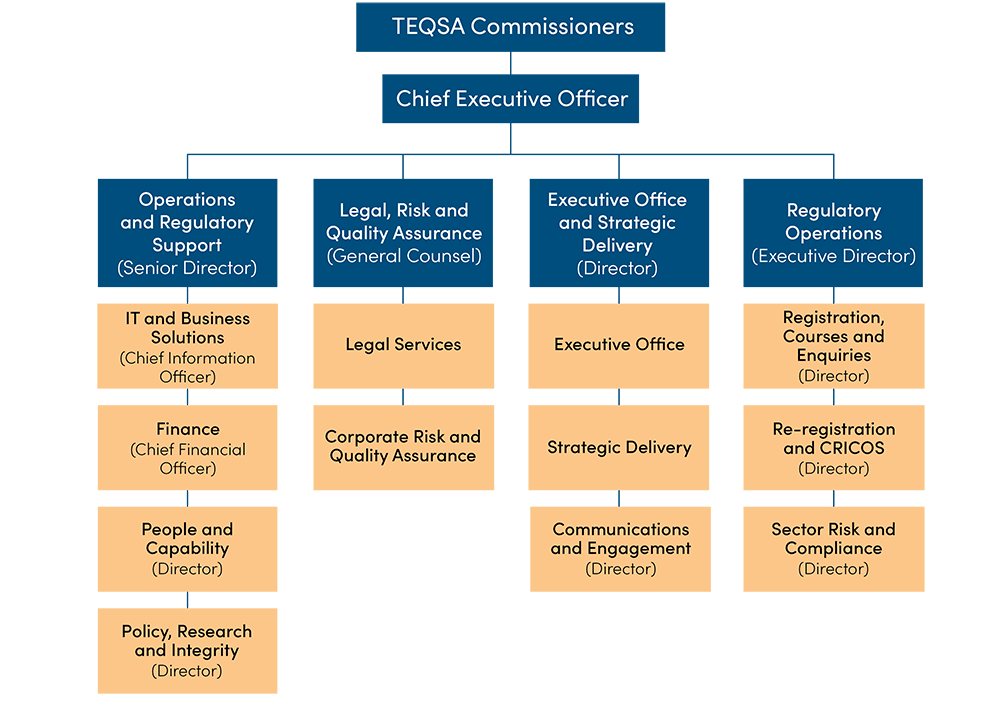
    The Commission is supported by an Executive Leadership Team (ELT) comprising the Chief Executive Officer, Executive Director of Regulatory Operations and senior managers. ELT is responsible for the management of our regulatory business, corporate processes and people.

    Organisation structure

    TEQSA organisation chart

    Audit and Risk Committee

    We have established an Audit and Risk Committee in compliance with the Public Governance, Performance and Accountability Act 2013 and PGPA Rule.

    Higher Education Standards Panel

    The Higher Education Standards Panel (HESP) is an expert statutory advisory body, established under the Tertiary Education Quality and Standards Agency Act 2011 (TEQSA Act), with responsibility related to the standards for delivery of higher education in Australia.

    HESP is independent of TEQSA.

    Last updated:
  • Cost recovery for regulatory activity - frequently asked questions

    The following information aims to answer common questions from providers about TEQSA’s implementation of cost recovery for regulatory activities.

    “You”, “I”, “my” and "your" means you as a registered higher education provider.

    “Us”, “we” and “our” means us as the Tertiary Education Quality and Standards Agency (TEQSA).

    What is cost recovery?

    Cost recovery involves the Australian Government charging the non-government sector some or all of the efficient costs of a specific government activity.

    The characteristics of a government activity will determine the type of cost recovery charge used.

    Further information about the Australian Government’s cost recovery guidelines is located on the Department of Finance website.

    What are TEQSA’s fees and charges?

    An updated version of TEQSA’s Cost Recovery Implementation Statement (CRIS), detailing the fees and charges that will apply from 1 January 2026, is now available.

    TEQSA recovers its costs via:

    1. A registered higher education provider charge (RHEP charge)
    As a condition of registration, each registered higher education provider is required to pay the registered higher education provider charge (RHEP charge). The RHEP charge is the sum of a base component, that all providers pay, and a compliance component that providers pay to cover the cost of certain compliance activities (if any) undertaken in relation to them in the preceding calendar year.

    2. Application fees
    Set fees are payable by providers for each application they make to TEQSA, such as applications for registration, re-registration, accreditation and re-accreditation.

    What does TEQSA do with the money it receives from cost recovery?

    TEQSA is not the recipient of the recovered costs. All fees and charges are directed to the Commonwealth’s Consolidated Revenue Fund.

    Cost recovery changes in 2026

    What will providers be required to pay in 2026?

    When TEQSA’s increased cost recovery model was adopted, it allowed for a 3-year phase-in period. In the first year (2023), providers paid 20% of the Registered Higher Education Provider (RHEP) charge. In 2024, providers paid 50% of the RHEP charge. From 2025 onwards, providers will be invoiced for the full RHEP charge.

    What does the RHEP charge cover?

    The RHEP charge reflects the costs of TEQSA’s regulatory and quality assurance activities that are not recoverable from application-based fees. This includes a component for activities that are not specific to individual institutions, including guidance and education, sector communications and national and international engagement. It also includes a compliance component for activities undertaken specific to an institution including for compliance assessments, conditions imposed under the TEQSA or ESOS Acts, compliance undertakings and investigations.

    Changes have been made to the RHEP charge for 2026. These changes reflect an increase in TEQSA’s total regulatory costs attributable to TEQSA’s new provider case management system and increases to TEQSA’s employee expenditure and increases in operational expenditure.

    Why does TEQSA use 2024 EFTSL data to calculate the 2026 RHEP charge?

    TEQSA uses the most current data EFTSL data available to us, which is supplied by the Department of Education.

    When will TEQSA’s updated 2026 fees and charges schedule take effect?

    The 2026 fees and charges schedule will take effect from 1 January 2026. TEQSA has published an updated Cost Recovery Implementation Statement following consultation with the sector. TEQSA has not increased any application-based fees or compliance charges. The changes relates to the RHEP charge, as detailed in the CRIS.

    Will there be any change to the discounts offered to small providers?

    TEQSA is not proposing any changes to the existing application fee discounts of up to 70% for small providers.

    Registered higher education provider (RHEP) charge

    What is the RHEP charge and how often do I have to pay it?

    The annual RHEP charge is payable by all registered providers as a condition of their registration.

    TEQSA will send providers an invoice relating to the RHEP charge annually. Please refer to the Registered Higher Education Provider (RHEP) charge page for more information.

    Will my RHEP charge be more than last year?

    There are several factors that may result in your Registered Higher Education Provider (RHEP) charge being higher in 2026 than 2025 even if your institution’s equivalent full-time student load has decreased.

    These factors include:

    Updates to calculation of the base component

    • All providers will incur an increase in the RHEP charge compared to 2025. From 1 January 2026, TEQSA has increased the proportion of the base component of the RHEP charge. The total RHEP charge has been divided equally across all providers, with the component that is based on EFTSL being divided proportionately. This change ensures that TEQSA’s regulatory costs are fairly recovered to reflect costs associated with TEQSA’s new case management system and increases to TEQSA’s operational expenditure.

    Base component of the RHEP charge

    What is the timeline for the phase-in of the base component of the RHEP charge?

    The phased introduction of the base component of the RHEP charge for all providers began on 1 January 2023.

    Under the phase-in approach, the base component of the charge will be 50% of the full amount from 1 January 2024 and then 100% from 1 January 2025.

    Why can’t TEQSA roll compliance costs into the base component of the RHEP charge?

    The base component recovers TEQSA’s costs in relation to activities that cannot be attributed to a single provider such as costs relating to risk and compliance activity that applies across the sector.

    The costs recovered via the compliance component of the RHEP charge arise from concerns about an individual provider. The relevant provider will be required to pay the charges associated with compliance activities undertaken by TEQSA. A principal consideration here is that individual providers subject to investigations and compliance assessments, rather than all providers, should bear the costs of these specific activities.

    Are providers charged for 'investigations' prompted by false allegations?

    TEQSA will only commence an investigation or compliance assessment where our preliminary assessment has confirmed there is a reasonable basis for a substantive concern. Investigations (which are rare) and compliance assessments will not be commenced without a proper basis.

    As cost recovery is based on activity undertaken, the cost is payable even when the outcome of the assessment is not to take regulatory action.

    Will providers be charged a fixed rate regardless of the duration, nature or level of intensity of reporting required by that condition?

    Providers pay a fixed rate charge in relation to any conditions that applied to the provider’s registration, or the accreditation of a course of study, in the previous calendar year. The rate recovered in relation to conditions monitoring will not differ based on the duration, nature or level of intensity of those conditions or when those conditions were imposed.

    Is there a separate charge for the annual compliance program if a provider is selected to be part of it?

    No. The RHEP charge includes a base component that all providers have to pay. The base component recovers TEQSA’s costs in relation to activities that cannot be attributed to a single provider (such as costs relating to risk and compliance activity that applies across the sector).

    A provider’s RHEP charge will only include additional amounts, as part of the compliance component of the charge, for a compliance assessment or investigation where TEQSA’s preliminary assessment of an allegation or complaint has confirmed there is a reasonable basis for a substantive concern. Investigations (which are rare) and compliance assessments will not be commenced without a proper basis.

    Is there an expected length of time for a compliance assessment or investigation to be completed?

    TEQSA will only commence an investigation or compliance assessment where our preliminary assessment has confirmed there is a reasonable basis for a substantive concern. Investigations (which are rare) and compliance assessments will not be commenced without a proper basis.

    It is not possible to provide an accurate estimate on the amount of time it will take to complete a compliance assessment. However, TEQSA charges a set fee per compliance assessment that does not vary based on the amount of time the assessment takes.

    While an investigation is charged based on time spent, TEQSA conducts investigations rarely so it is not possible to provide an estimate of how long an investigation is likely to take. Further, the answer to this question will always depend upon the particular investigation.

    Application fees

    Providers pay a set fee for each application they make to TEQSA, such as applications for registration, re-registration, accreditation and re-accreditation.

    Are there discounts for smaller providers on the fees for applications?

    Discounts of up to 70% apply to the fees associated with course accreditation and re-accreditation for providers with less than 5,000 EFTSL (equivalent full time student load).

    Are providers that are currently self-accrediting required to pay just the registration renewal fee or fees for both registration renewal and self-accreditation?

    No. If a provider is already self-accrediting or is not seeking self-accrediting authority, it will only need to pay the registration renewal fee. If a provider is applying for registration renewal and is seeking self-accrediting authority, it will need to pay a fee for both the registration renewal and self-accreditation.

    What is the definition of a ‘nested set’ of courses for the purposes of cost recovery?

    For the purposes of cost recovery, a nested set of courses means a set of courses consisting of:

    • one primary course of study and
    • one or more related courses of study.

    A ‘related course’ is a course of study:

    • entirely made up of units taken from the primary course study, and
    • offered by the same registered higher education provider.

    General information

    Do providers have to pay for answers to simple requests to TEQSA?

    We do not charge for answers to simple requests and inquiries. Activities we do charge for are outlined in the Application fees page of our website.

    Will there be consultation about any changes to fees and charges?

    TEQSA will always consult with the sector on any proposed changes to its fees and charges.

    The Australian Government Cost Recovery Policy requires TEQSA to develop and implement an ongoing engagement strategy in consultation with stakeholders.

    Following consultation with the sector, TEQSA has published the updated version of the CRIS to take effect from 1 January 2026.

    Who should I speak with if I have questions about changes to TEQSA’s fees and charges?

    If the information you are seeking is not currently addressed on our website, please email your enquiry to providerenquiries@teqsa.gov.au and we will respond promptly.

    Can providers speak to a TEQSA representative about cost recovery in relation to their specific circumstances?

    In the first instance, please refer to our website for comprehensive resources and answers to frequently asked questions.

    If the information you are seeking is not currently addressed on our website, please email your enquiry to providerenquiries@teqsa.gov.au and we will respond promptly.

    My question is not covered here, what can I do?

    TEQSA will update the FAQs on our website as required. If the answer to your question is not covered here, please send an email to providerenquiries@teqsa.gov.au and we will respond promptly.

    Last updated:

    Related links