Content under review
The content on this page is currently being reviewed to reflect changes in the Higher Education Standards Framework (Threshold Standards) 2021 due to amendments published on 13 July 2026.
This overview summarises the intent of the Higher Education Standards Framework (Threshold Standards) 2021 (HES Framework) and outlines key aspects of TEQSA's approach to regulation. The HES Framework replaced the Higher Education Standards Framework (Threshold Standards) 2015 for regulatory purposes on 1 July 2021.
This overview is not part of the HES Framework and simply provides a contextual overview. Together with the Tertiary Education Quality and Standards Agency Act 2011, the TEQSA Quality of Research Determination 2021 (to be finalised) and the TEQSA Fit and Proper Person Determination 2018, the HES Framework is the definitive set of requirements for Australian higher education providers. In seeking to interpret the Standards, providers should read the HES Framework in the first instance.
Context of the HES Framework
As illustrated below, the HES Framework has been structured to align with the student experience or ‘student life cycle’ i.e. as they progress from prospective students through to the award of a qualification. The HES Framework is also grounded in the core characteristics of the provision of higher education. As such, the Standards are intended to be useful to higher education providers as a framework for internal monitoring of the quality of their higher education activities.
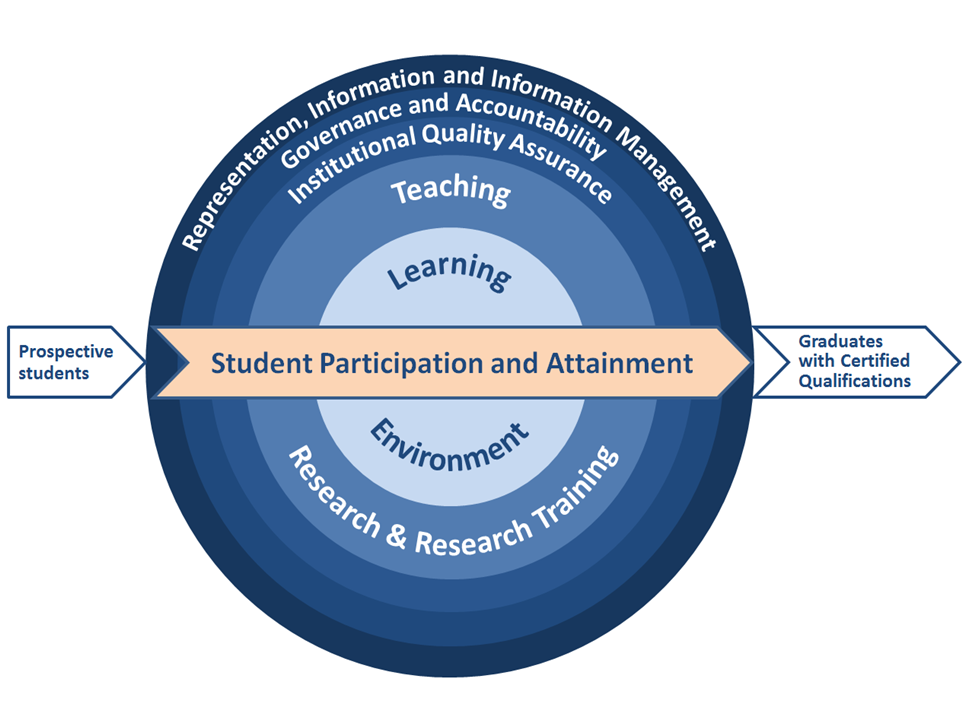
The Standards within Part A of the HES Framework encompass the matters that a higher education provider would ordinarily be expected to address in the course of understanding, monitoring and managing its higher education activities and any associated risks, and apply at all times. This is expected to make the various Standards easier to apply for the purposes of providers’ own internal monitoring, reporting and governance activities, as well as for TEQSA’s regulatory processes.
As a result of their grounding in the nature of a provider’s mission and operations, it is expected that we will more readily be able to use internal reports and information produced during the normal course of a provider’s business, or published on provider websites, as evidence when assessing compliance with the Standards.
In turn, this will see a reduction, over time, in any regulatory burden on higher education providers that might be attributable to our administration of the Standards.
Additionally, the Standards:
- set out the requirements that a higher education provider must meet – and continue to meet – to be registered by TEQSA to operate in Australia as a provider of higher education. The Standards provide the basis for the regulation of registered higher education providers
- ensure that the requirements for entry into the higher education sector are set sufficiently high to underpin and protect the quality and reputation of the sector as a whole
- establish a baseline for operational quality and integrity from which all providers can continue to build excellence and diversity
- serve other broader purposes including the provision of:
- an articulation of the expectations for provision of higher education in Australia as:
- a guide to the quality of educational experiences that students should expect
- a reference for international comparisons
- a reference for other interested parties
- a model framework which higher education providers can apply themselves for the internal monitoring, quality assurance and quality improvement of their higher education activities.
Introduction to the HES Framework
Regulatory Principles
Our regulatory approach will continue to be guided by the provisions of the Tertiary Education Quality and Standards Agency Act 2011 (TEQSA Act) as amended from time to time, including the objects (Section 3) and the three basic principles for regulation (Section 13):
- the principle of regulatory necessity
- the principle of reflecting risk, and
- the principle of proportionate regulation.
Form of the HES Framework
The HES Framework consists of two parts:
- Part A – Standards for Higher Education (which represent the minimum acceptable requirements for the provision of higher education in or from Australia)
- Part B – Criteria for Higher Education Providers (which enable categorisation of different types of providers and whether a provider is responsible for self-accreditation of a course(s) of study it delivers).
This overview does not include commentary on Part B. Guidance on aspects of Part B can be found in the Application Guide for registration in any university category and in the Guidance Note on Scholarship.
The first Domain (Student Participation and Attainment) covers the education-related experiences of students from admission through to attainment of certified qualification(s) (or part thereof, such as completion of units of study). The Standards for Student Participation and Attainment focus primarily on a course of study, but apply equally to the completion of units of study.
The remainder of the Domains focus on the actions taken by the higher education provider to achieve the educational outcomes expected for students. The second Domain (Learning Environment) focuses on the nature and quality of the learning environment provided, whether physical, on or off campus, virtual or blended. The Standards for Teaching and for Research and Research Training (Domains 3 and 4) focus on the applicable academic activities of the higher education provider that guide and facilitate student learning and, in the case of research and research training, contribute to new knowledge as well.
Domains 5 and 6 focus on the mechanisms that are established by the higher education provider to assure itself of the quality of the higher education it provides (Institutional Quality Assurance), and to maintain effective governance of its operations (both Academic and Corporate Governance). Domain 7 (Representation, Information and Information Management) encompasses the higher education provider’s representation of itself and its courses to prospective students and others, the provision of information to prospective and enrolled students to enable informed participation in their educational experience, and the information management systems that support the higher education provider’s higher education operations.
The Standards in Part A do not seek to encompass all areas of a provider’s activities, such as societal contributions through community engagement. Nor do the Standards seek to directly address some aspects of the experience of students that are not proximate to the provider or realistically under the control of the provider, such as long-term career outcomes.
Standards statements
Each ‘Domain’ of the Standards is segmented into ‘Sections’ and these Sections in turn contain a number of ‘Standards statements’. These Standards statements are the actual ‘Standards’; the headings of the Domains and Sections are taxonomic only.
The Standards statements in each Section form a related set, although each Standards statement is a stand-alone statement. In some Standards statements the words ‘include’ or ‘including’ precede an elaboration of the Standards statement. The elaboration that follows ‘include’ or ‘including’ is an essential component of the Standards statement, but it does not preclude additional forms of elaboration being used by higher education providers if they choose to do so.
Threshold Standards
For the purpose of defining the Threshold Standards under Section 58 of the TEQSA Act, the applicable Standards are those that are defined in the HES Framework.
Application of the Standards for internal purposes by higher education providers
The Standards set out in Part A of the HES Framework are grounded in the core characteristics of the provision of higher education. As a consequence of this foundation, the Standards are intended to be useful to higher education providers as a framework for internal monitoring of the quality of their higher education activities. The Standards encompass the matters that a higher education provider would ordinarily be expected to address in the course of directing and monitoring its higher education activities and managing any associated risks. Each Standards statement addresses an underlying area of risk(s) to be managed. This may be a risk to the sustainability and viability of the provider, to the quality of education provided, to the experiences of students in relation to a higher education provider, to the quality of learning outcomes on graduation, to the reputation of higher education in Australia or a combination of these.
From the standpoint of internal use by higher education providers, the Standards focus on aspects of a higher education provider’s operations in different but inter-related ways. Domain 1 (Student Participation and Attainment) focuses primarily on the educational experience for students, while Domains 2 to 4 (Learning Environment, Teaching, Research and Research Training) focus on the academic activities of the provider and the environments in which they occur. Together, Domains 2 to 4 address a variety of risks to the quality of higher education and the experiences of students in specific ways.
Domains 5 and 6 (Institutional Quality Assurance, and Governance and Accountability) are more overarching in nature and draw in part on the other more specific Domains in the Threshold Standards. These Domains encompass the ways in which a higher education provider and its governing and academic bodies would ordinarily maintain oversight of its higher education operations and be able to assure itself, in the normal course of its business and governance activities, that the requirements of the Standards for Higher Education are being met.
As a consequence of their overarching focus, the Domains of Governance and Accountability and Institutional Quality Assurance are seen to be the primary locus for internal monitoring of a higher education provider’s activities. Any concerns identified by a higher education provider in seeking to meet the Standards for Institutional Quality Assurance and Governance and Accountability would be expected to cause deeper examination of their compliance with the Standards for Higher Education overall, guided by the risks that have been identified.
Applicability of the Standards to particular higher education providers or categories of higher education provider
Under the TEQSA Act, it is an obligation of registration that all registered higher education providers meet and continue to meet the Standards of the HES Framework. The Standards are applicable to all registered higher education providers where the provider engages in the activities encompassed by the Standards, irrespective of the category of provider. The Standards for Higher Education (Part A) also cover all modes of participation and delivery, sites of delivery and all categories of students.
Some parts of the Standards for Higher Education will not apply to particular higher education providers that do not engage in specific activities. For example, Standards related to delivery arrangements between a registered higher education provider and other parties will not be applicable where such arrangements do not exist. Similarly, the Research Standards are not applicable to higher education providers that do not undertake research. However, if research training is conducted, the Standards for Research and for Research Training are both applicable.
Except where particular higher education providers do not engage in all of the higher education activities encompassed by the Standards, such as not undertaking research training, all registered providers are required by the TEQSA Act to meet the Standards for Higher Education in their entirety. We will need to be satisfied that this is the case. The methods used to assure that providers are meeting the Standards will vary from case to case, according to risk. We will provide advice about our approach periodically, directly to providers and through our website.
Application of the Standards to higher education providers in different stages of development
The Standards for Higher Education have been drafted to represent the characteristics of provision of higher education by a higher education provider that is an established ‘going concern’. Such a provider would, for example, already have had several cohorts of students graduate from its course(s) of study. Review and improvement activities would also be expected to have been established as part of the provider’s own internal oversight and quality assurance of its higher education operations. Review activities would include mechanisms to provide evidence of achievement of specified expected learning outcomes and student success, and processes for external referencing against other higher education providers or other courses of study.
To the extent that a higher education provider has not yet reached this level of operational maturity, the provider will need to demonstrate to us that its progress to date in meeting the Standards and its capacity and timetable for meeting the Standards in the future are consistent with the provider’s present stage of development. Some Standards may not be fully applicable at an early stage of a provider’s development, especially when first applying for registration as a higher education provider. For example, a provider launching its first higher education course would be expected to have all arrangements in place for the course to meet the Standards for delivery, but not be expected to have surveyed its students or implemented a course review cycle. However, it should have made provision for such a cycle of feedback and monitoring in its framework of policies procedures and planned practices.
We will apply the HES Framework taking account of an individual provider’s stage of development.
Applicants who have never been registered as a higher education provider are advised to consider carefully beforehand whether they are ready to apply. In particular, they should not consider applying unless they meet the minimum requirements for potential higher education providers, outlined on our Before applying to become a higher education provider. The full set of evidence required at the point of application is outlined in the Application Guides for prospective higher education providers. If an applicant does not provide the full set of evidence required for us to conduct an assessment, we may decide that the application is invalid, and may not proceed to a substantive assessment.
When an established provider applies for renewal of its registration, or for course accreditation or renewal of course accreditation, we will use a differentiated model of assessment (known as the ‘core+’ model), as explained in the Application Guides for registered higher education providers. The breadth and depth of assessment will be varied on a case-by-case basis. All applicants will be required to submit minimum evidence relating to a set of core Standards. Some providers will be asked to submit evidence against other selected Standards, with reference to risk and regulatory track record.
Applications of the different types of Standards
Some of the Standards are more overarching in nature. For example, the Standards relating to governance and internal quality assurance pertain to the governing body’s ability to oversee compliance with all of the other Standards. There is also interdependency among the Standards; for example the Standards on quality assurance ensure the provision of information to support decision making as required by the governance Standards. The different types of Standards in the HES Framework present opportunities for us to ascertain the extent of a provider’s compliance with the Standards in different ways. For example, the Standards in Domain 7 require considerable information to be publicly accessible. As a result, we may be able to form a prima facie view about many of a provider’s operations on the basis of this publicly accessible material without asking for further information.
Similarly, in an established provider, the internal mechanisms for governance, accountability and quality assurance encompassed by Domains 5 and 6 should produce significant evidence of compliance with the overall Standards in the ordinary course of managing and monitoring the provider’s affairs. The evidence produced in meeting the overarching Standards of Domains 5 and 6 as part of internal monitoring offers significant opportunities for TEQSA (and for the higher education provider) to gain confidence in the provider’s operations. The more we can be confident that an established provider is effectively reviewing its own operations and taking actions to correct variations in quality and implement improvements, the less need we will have to undertake further investigation. We can confine investigations to undertaking a secondary review of the outputs of the provider’s own reviews, where these are comprehensive and reliable, and externally validated.
The Standards also differ in the types of evidence required to demonstrate that they have been met. In some cases, the evidence required will be straightforward (e.g. a state of affairs exists or it does not) while in other cases judgment will be required (e.g. the appropriateness of a set of learning outcomes). In the case of judgments, we may refer to authoritative views put by the provider and/or draw on the opinions of others e.g. an external expert, especially where academic judgment is required.
Appropriateness and effectiveness of a provider’s approaches
Where Standards statements specify the existence of a policy and/or procedure, it is implied that such a policy or procedure should be fit for its intended purpose and effective in its implementation. This avoids multiple repetitious references to appropriateness and effectiveness of individual policies/procedures throughout the Standards. However, the intent of fitness for and achievement of an intended purpose remains, whether or not it is stated explicitly, and we will want to see relevant evidence that a provider’s approaches not only exist but are appropriate to their purpose and effective in achieving that purpose. For example, if a provider uses course advisory committees to gather external input into course design, we will want to see that such external advice is indeed gathered and considered in the design of the course. Similarly, if a review is undertaken of an aspect of a provider’s operations, e.g. of a course of study, we will expect to see the findings of the review considered and actions arising in response.
References to peer review in Standards
Various Standards in the HES Framework contemplate external referencing, benchmarking and other forms of external review, including peer review. Where peer review is expressed or implied, it is intended as peer review initiated by the provider for internal quality assurance purposes, rather than peer review processes that may be initiated or conducted by TEQSA or another external body, such as a professional accrediting body. External review of a course does not remove the need for providers to undertake their own rigorous review with external input.
Reference points
For some Sections of the Standards, we have suggested ‘Reference points’ in this overview. Reference points are significant codes or frameworks that may be helpful to higher education providers in considering how particular Standards may be met or demonstrated. The items listed as Reference points are generally developed and maintained by peak national bodies and agencies. Use of Reference points by higher education providers is not mandatory; neither the Standards nor TEQSA require a provider to consult the Reference points or to comply with practices advocated within the Reference points in general (however some requirements may otherwise be mandatory, within for example the Australian Qualifications Framework (AQF) or the National Code of Practice for Registration Authorities and Providers of Education and Training to Overseas Students 2018 (The National Code).
However, in recommending the Reference points, we believe they contain material that is likely to benefit all providers in considering how they might address related Standards. Reference points are intended to augment other resources developed for providers such as our guidance notes. Various materials that may be suitable as Reference points may also be available to individual providers by virtue of their membership of professional bodies or the like. Reference points are only recommended if they are available in the public domain.
Meaning of ‘staff’
Some of the Standards refer to ‘staff’. For the purpose of regulation, TEQSA takes ‘staff’ to mean people carrying out roles that are relevant to the meaning of the Standard, even if the people concerned are not actually an employee of the provider e.g. an honorary sessional teacher, or workplace supervisors with responsibilities to the provider.
