• Guidance notes

    The Higher Education Standards Framework (Threshold Standards) 2021 (HES Framework) has applied since 1 July 2021.  

    From a regulatory perspective, all applications made: 

    • before 1 July 2021 will be assessed against the HES Framework 2015
    • on or after 1 July 2021 will be assessed against the HES Framework 2021.

    Guidance notes

    Guidance notes are concise documents designed to provide high-level, principles-based guidance on interpretation and application of specific standards of the Higher Education Standards Framework (Threshold Standards) 2021. They also draw attention to other interrelated standards and highlight potential risks to compliance.
     

    TEQSA is working to enhance its suite of guidance notes and will keep providers updated on our progress through our monthly e-News (subscribe here) and our social media channels.
     

    We recognise and value the importance of drawing on knowledge of lived experience in the higher education sector.
     

    Please view our Consultation page to learn more about present opportunities to provide feedback.

    The resources published on this page are not instructional or ‘how to’ documents for compliance with the new HES Framework.

    TEQSA publishes guidance notes to provide greater clarity for providers in the interpretation and application of selected standards. Guidance notes draw on our regulatory experience and knowledge of experts in the higher education sector.

    Guidance notes usually focus on a single topic (such as academic leadership, for example). The guidance note typically outlines:

    • the nature of the topic
    • the relevant standards in the Higher Education Standards Framework (HESF) that relate to the topic
    • the underlying intent of those standards
    • the risks to the quality of education if the topic is not addressed sufficiently by a provider
    • the evidence that TEQSA is likely to look for to be satisfied that the requirements of the HESF are being met.   

    Comments and feedback on guidance notes can be emailed to standards@teqsa.gov.au.

    Current guidance notes

    Guidance note Last updated
    Academic Governance 30 November 2023
    Academic and Research Integrity  2 February 2024
    Academic Leadership (beta version) 18 June 2019
    Academic Monitoring, Review and Improvement 19 March 2024
    Academic Quality Assurance 11 October 2017
    Admissions (coursework) 4 May 2022
    Changes in a Course of Study that may lead to Accreditation as a New Course 6 March 2017
    Corporate Governance 26 August 2019
    Course Design (including Learning Outcomes and Assessment) 11 October 2017
    Credit and Recognition of Prior Learning 7 July 2023
    Delivery with Other Parties 7 July 2023
    Determining Professional Equivalence – [full title: Determining Equivalence of Professional Experience and Academic Qualifications] 11 October 2017
    Diversity and Equity 11 October 2017
    Facilities and infrastructure 30 November 2023
    Financial Assessment 11 April 2019
    Financial Standing  11 April 2019
    Grievance and Complaint Handling 22 February 2019
    Joint and Dual Awards 11 October 2017
    Learning resources and educational support 11 June 2025
    Monitoring and Analysis of Student Performance (beta version) 6 January 2020
    Nested Courses  13 August 2019
    Research and Research Training 11 December 2024
    Research Requirements for Australian Universities 30 April 2024
    Scholarship 4 May 2022
    Staffing 11 June 2025
    Technology-Enhanced Learning  11 April 2019
    TEQSA and the Australian Qualifications Framework 27 August 2019
    Transnational Higher Education - Inbound [full title: Transnational Higher Education into Australia (including international providers seeking to offer higher education in Australia)] 11 October 2017
    Varying a Period of Registration or Accreditation 26 August 2019
    Wellbeing and Safety 8 January 2018
    Work-Integrated Learning 4 May 2022

    Statements of Regulatory Expectations

    A Statement of Regulatory Expectations (SRE) is a regulatory tool TEQSA uses to address systemic ongoing or acute emerging risks to compliance with the Higher Education Standards Framework (Threshold Standards) 2021.

    Good practice notes

    Guide to determining the fitness and propriety of a person

    This guidance sets out the principles and considerations that TEQSA will have regard to when assessing fitness and propriety for the purposes of the TEQSA Act. 

    Independent Experts engaged by providers 

    This document provides guidance to providers on selecting a suitable independent expert to conduct a review or seek expert advice as part of their internal quality assurance processes.

    Glossary of terms

    Last updated:
  • HESF Domain 1: Student participation and attainment

    Content under review

    The content on this page is currently being reviewed to reflect changes in the Higher Education Standards Framework (Threshold Standards) 2021 due to amendments published on 13 July 2026


    Scope and intent of the Domain

    This Domain (Sections 1.1-1.5) of the Higher Education Standards Framework (Threshold Standards) 2021 (HES Framework) encompasses:

    • the basis for admission of students to a course of study, including requirements for adequate academic preparation for the course and formal explicit contractual arrangements between the provider and students
    • assessment of credit granted for prior learning is consistent with the credit and recognition of prior learning policy in the Australian Qualifications Framework (AQF)
    • assurance that any credit granted for prior learning does not disadvantage the student concerned or compromise the integrity of the course of study
    • orientation to a course of study, support for transition to a course of study, early feedback on student performance, detection and support for students at risk of unsatisfactory progress and monitoring of success rates at cohort level
    • equivalence of opportunities for success irrespective of a student’s background or mode of participation
    • specification, assessment, achievement and external referencing of expected learning outcomes
    • legitimate issuing and certification of qualifications. 

    Our commentary

    1.1 Admission

    TEQSA will need to be satisfied that students who are admitted are equipped to succeed in their chosen course of study (e.g. level of academic preparation, learning skills, proficiency in English) and that ill-prepared students are not knowingly admitted. Factors taken into account in selection (such as prior qualifications or the use of the Australian Tertiary Admission Rank [ATAR]), and all information needed by students before applying for a course must be disclosed transparently (see also Domain 7 – Representation, Information and Information Management). Students must be able to readily access all information needed for them to estimate realistic prospects for admission to each course. 

    Prospective students must be made aware of any inherent requirements for undertaking a course, or parts of a course, that may affect those students in special circumstances or with special needs (such as a particular type of practicum), especially where a course of study leads to a qualification that may lead to registration as a professional practitioner by a registering authority. On a related topic, where a course must be accredited by a professional body as a requirement of professional registration of graduates (particularly where registration is required by law), this accreditation must be obtained and sustained, as required by Standard 3.1.5. Information about the current accreditation status must be made available to prospective and current students, as required by Section 7.2.

    Where individual students or cohorts are initially at some known risk of not succeeding (e.g. those engaged in an initiative that is targeting an educationally disadvantaged group of students), such risks need to be not only identified but also managed, for example, by targeted support. Relevant evidence at the provider level will include organisational policies and procedures, while at the course level, specific selection criteria should be included in course documentation.

    We will also need to be satisfied that the provider’s arrangements with students are based on adequate disclosure and informed choice, particularly on key matters such as fees and charges, specific obligations placed on students, arrangements and implications for withdrawal from enrolment and particular obligations for international students where applicable. Providers seeking help in assessing overseas qualifications may refer to the Australian Government’s Country Education Profiles, available on a subscription basis.

    Reference points

    • Australian Council of Graduate Research Inc., Australian Graduate Research Good Practice Principles.
    • Australian Government, Country Education Profiles.
    • Australian Government, National Code of Practice for Registration Authorities and Providers of Education and Training to Overseas Students 2018.

    1.2 Credit and Recognition of Prior Learning

    TEQSA supports granting of credit for prior learning, and will need to be satisfied that this is guided by institutionally approved policies and evidence-based procedures that are applied transparently and consistently, with explicit (written) outcomes for credit decisions provided to students. The relevant policy framework is required by Section 7.2. We expect providers to take a positive attitude to the award of credit wherever practicable, but we must also be satisfied that the granting of credit will not disadvantage students (e.g. by admitting students who are insufficiently prepared to undertake the level of higher education required) or diminish the integrity of the qualification awarded. This could occur, for example, where the award of credit would result in a disproportionate amount of the program representing levels of education/experience below that of the qualification offered, such as a Masters degree program comprising, in effect, predominantly undergraduate content.

    Reference point

    • Australian Qualifications Framework Council, Australian Qualifications Framework Pathways Policy.

    1.3 Orientation and Progression

    TEQSA expects a provider to be able to demonstrate that students are not only assisted in their transition into their course of study but also that the arrangements for transition are sensitive to the needs of particular cohorts of students, including:

    • students enrolled in different modes of participation (for example, online-only)
    • students with special needs
    • international students, where applicable.

    Early assessment of progress, early detection of students at risk of poor progress and targeted support programs are given high priority by the Standards for all courses of study (this includes research training where offered).

    The Standards also require a registered provider to be able to demonstrate and internally report rates of retention, progression and completion for all cohorts of students over time (as a basis for detailed analysis and improvement, as also required in Domain 5) and we will expect to see reports containing the relevant data and analyses (typically in relation to Domain 5, in the case of registered providers) including analysis of the factors that might be driving any variations. New applicants should be able to demonstrate that they have made provision for such monitoring and reporting.

    Reference points

    • Australian Council of Graduate Research Inc., Australian Graduate Research Good Practice Principles.
    • Australian Government, National Code of Practice for Registration Authorities and Providers of Education and Training to Overseas Students 2018.

    1.4 Learning Outcomes and Assessment

    The Standards in this Section present detailed requirements for the specification and assessment of learning outcomes and include a requirement for credible external referencing of the outcomes against national and international comparators, for example, by comparing the provider’s learning outcomes and methods of assessment with those of comparable programs at a reputable Australian higher education provider and (for learning outcomes) an international higher education provider. TEQSA will need to be satisfied that the processes of course accreditation employed by self-accrediting providers meet these Standards and, in the case of non-self-accrediting providers, the providers will need to demonstrate to our satisfaction that the requirements of the Standards have been met for each course. In practice, learning outcomes and methods of assessment are likely to be considered in conjunction with the overall design of the course of study (see Domain 3 [and Domain 4 if research training is undertaken]).

    In particular, we will seek to confirm that the specified learning outcomes are consistent with the Australian Qualifications Framework (AQF) level of the higher education qualification offered and that student achievement of the course learning outcomes is credibly assessed, whether through:

    • aggregations of assessments at unit level
    • specific assessments of general course learning outcomes such as a capstone unit
    • a combination of both.

    To demonstrate that the course is designed in a way that these Standards are met will require at a minimum, some form of mapping of where expected course learning outcomes are taught, practised and assessed and how they are aligned with unit learning outcomes and assessment. We may engage external discipline experts to assist in its deliberations about learning outcomes and assessment and may also have regard to an accreditation of the course of study by a professional body where applicable. The expected learning outcomes for research training (1.4.5–1.4.7) only apply where research training is offered through higher degrees by research.

    Reference points

    • Australian Council of Graduate Research Inc., Australian Graduate Research Good Practice Principles.
    • Australian Qualifications Framework Council, Australian Qualifications Framework Second Edition January 2013.
    • Learning outcomes statements developed for the field of education or discipline by discipline communities or professional bodies.
    • The requirements for professional accreditation of the course of study and registration of graduates where applicable.

    1.5 Qualifications and Certification

    The Standards in this Section provide detailed specifications for the issuance of qualifications, the way they are certified and secured and the records of attainment that are available to students. The issuance of qualifications links to the corporate responsibility of the provider to issue qualifications legitimately (see Paragraph 6.2.1h). TEQSA has a particular interest in the onus the Standards in this Section place on the provider to ensure that any qualification awarded within the Australian Qualification Framework (AQF) is positioned at a level that corresponds with the level of the AQF it purports to meet.

    Once a provider has demonstrated that it is able to manage the issue of qualifications competently and legitimately, we may give less emphasis to the administrative process but will remain concerned that course(s) of study are appropriate to the level of qualification issued (see also 1.4.1). In the case of self-accrediting providers, we will need to be satisfied about the adequacy of internal approval processes to meet this requirement, and may test selected course documentation in a sample of courses.

    Providers should take steps to ensure the security of digital records and certification of qualifications.

    Reference points

    • Australian Government (November 2013), Guidelines for the Presentation of the Australian Higher Education Graduation Statement.

    Relevant guidance notes

    The following guidance notes can be accessed at our Guidance notes page, or from the links below:

    Last updated:
  • HESF Domain 2: Learning environment

    Content under review

    The content on this page is currently being reviewed to reflect changes in the Higher Education Standards Framework (Threshold Standards) 2021 due to amendments published on 13 July 2026


    Scope and intent of the Domain

    This Domain (Sections 2.1-2.4) of the Higher Education Standards Framework (Threshold Standards) 2021 (HES Framework) encompasses:

    • the nature, access to and fitness for purpose of the learning environment under the control of the provider (without presupposing any particular model of participation or delivery), diversity of participation and the wellbeing of staff and students
    • access to effective mechanisms to address students’ grievances should they arise.

    Much of the background material to demonstrate that these Standards are met must be publicly accessible (see Domain 7).

    Our commentary

    2.1 Facilities and Infrastructure

    This Section focuses on a provider demonstrating that there are sufficient facilities and infrastructure for delivery of a provider’s course(s) of study and that they are appropriate for their intended educational purpose. This includes necessary access to secured ICT facilities and systems. Specific facilities and resources for particular course(s) of study are covered at Domain 3 (e.g. Section 3.3).

    These Standards are intended to apply to any mode of delivery and participation, rather than presuppose any particular model. The onus is on the provider to demonstrate to TEQSA that its facilities and infrastructure support students to achieve the expected learning outcomes. Irrespective of the chosen mode of delivery, the Standards require a provider to offer opportunities for students (including international students) to interact outside of formal teaching, for example, group work, team building, informal learning. This does not mandate physical spaces; interaction via ICT may be suitable in various settings.

    2.2 Diversity and Equity

    This Section focuses primarily on the creation of equivalent opportunities for academic success regardless of students’ backgrounds, within a relevant policy framework, and within the context of the provider’s mission. Providers may wish to link this requirement to their admission requirements (see Section 1.1) and transition support arrangements (see Section 1.3). Providers should note that the Standards require providers to monitor the participation and success of any identified groups (such as an identified equity group) and use that information to improve academic and support strategies for such groups.

    The requirement to give ‘specific consideration to the recruitment, admission, participation and completion of Aboriginal and Torres Strait Islander peoples’ means that this particular group must be specifically referred to in the policy and monitoring frameworks.

    Reference points

    • Australian Disability Clearinghouse on Education and Training (1998), Students with Disabilities: Code of Practice for Australian Tertiary Institutions.
    • Australian Government, Disability Standards for Education 2005.
    • Universities Australia (October 2011), National Best Practice Framework for Indigenous Cultural Competency in Australian Universities.

    2.3 Wellbeing and Safety

    This Section encompasses a series of general and specific facets of a provider’s operations that are aimed at the promotion of safety and wellbeing. TEQSA will expect providers to tailor their response to these Standards according to the scale, scope and nature of their circumstances and offerings. In the case of online or blended learning, the requirement for a safe environment also applies to security of internet communications and to policies and procedures related to online harassment.

    2.4 Student Grievances and Complaints

    This Section seeks to ensure that students have access to mechanisms that resolve grievances effectively, at reasonable cost and with appropriate protection for complainants from breach of confidentiality or reprisal. This should be formulated within the policy framework, and students should be able to easily access a facility to lodge a complaint. Complaints-handling mechanisms are required to be publicly documented (see Domain 7). These Standards distinguish formal complaints from informal grievances, and records of the incidents and resolution of formal requirements must be kept, including time taken to reach a resolution (see institutional accountability at 6.2.1.j). While the Standards require policies and procedures to provide for students to access independent professional advice, TEQSA does not take this to require providing for students to access legal advice.

    As part of its regulation of Australia’s higher education sector, we monitor the compliance of higher education providers with the Tertiary Education Quality and Standards Agency Act 2011 (TEQSA Act) and the Higher Education Standards Framework (Threshold Standards) 2015 (HES Framework). As stated on our Complaints page, we have a defined approach for handling complaints. We will pursue any reliable information that indicates that a provider might not meet any of the Standards and will maintain confidentiality in regards to the informant. We receive complaints on a range of matters relating to providers, including the provider’s compliance with HES Framework and TEQSA Act, and in relation to possible false or misleading statements about a provider’s registration and accreditation status. 

    TEQSA is not empowered to intervene in disputes about marks for an individual student’s assessment, but will expect the provider’s policy and procedures to be followed where a student lodges a complaint or appeal. These policies and procedures should explicitly make provision for review by an appropriate independent third party if internal processes fail to resolve any grievance, and should specify indicative time frames for resolution of complaints.

    Third party complaint-handling bodies for all students at public providers and international students at private providers are outlined on our Complaints page. Domestic students at private providers can contact the Australian Competition and Consumer Commission (ACCC). The Overseas Students Ombudsman (OSO) investigates complaints from international students on student visas about private providers that relate to administrative decisions made by the provider, but not about broader educational quality issues. All students at public higher education providers have an avenue of appeal to the relevant Commonwealth, State or Territory Ombudsman, who can also investigate administrative decisions. 

    Providers are required to make available to their students specific avenues of appeal to independent third parties for matters not within the jurisdiction of the ACCC or an ombudsman.

    We may seek further information from a provider if we have reason to believe that a complaint or a pattern of complaints indicates that they might not be meeting one or more of the Standards.

    Reference points

    • Australian Council of Graduate Research Inc., Australian Graduate Research Good Practice Principles.
    • Australian Government, National Code of Practice for Registration Authorities and Providers of Education and Training to Overseas Students 2018, Part B, Standard 10.
    • Standards Australia (2014), Australian Standard AS ISO 10002-2014, Guidelines for complaint management in organisations.

    Relevant guidance notes

    The following guidance notes can be accessed at our Guidance notes page, or from the links below:

    Last updated:
  • HESF Domain 3: Teaching

    Content under review

    The content on this page is currently being reviewed to reflect changes in the Higher Education Standards Framework (Threshold Standards) 2021 due to amendments published on 13 July 2026


    Scope and intent of the Domain

    This Domain (Sections 3.1-3.3) of the Higher Education Standards Framework (Threshold Standards) 2021 (HES Framework) encompasses:

    • specific requirements for the specification of the course design and requirements for engagement with advanced knowledge and inquiry, current knowledge, theoretical frameworks and concepts, related scholarship and emerging ideas
    • coherent achievement of learning outcomes and professional accreditation of a course of study if applicable
    • sufficiency of staffing, capability of teaching staff, student access to staff
    • the nature, appropriateness, quality and level of access to learning resources that are specific to the course of study. 

    Our commentary

    3.1 Course Design

    TEQSA expects not only that the provider’s specification of a course design (and its documentation) will comply with the requirements of Standard 3.1.1 (see also Public accessibility in Section 7.2), but also that sufficient detail of the conceptual underpinning of the course design (Standards 3.1.2–3.1.4) will be available for an expert in a relevant subject area to form a view on whether these Standards are met. We expect these requirements would be evident in the course proposal approved by the provider’s internal academic governance body/processes. In relation to Standard 3.1.5, we will require evidence from the relevant professional accrediting body where applicable and where available. This may involve some coordination with the professional body in relation to new providers/courses of study, where a provider may not be eligible to attain professional accreditation at the outset.

    3.2 Staffing

    This Section requires, and TEQSA will expect, a provider to demonstrate sufficient staffing to meet the educational, academic support, administrative and access needs of the student cohorts undertaking a course of study. This includes an overall staffing profile sufficient to provide collective academic leadership necessary to lead intellectual enquiry at the level required by the course of study. In particular, the Standards specify that academic teaching staff must be qualified to at least one level of qualification (Australian Qualifications Framework [AQF] level or equivalent) higher than the course of study being taught, or have equivalent relevant academic or professional or practice-based experience and expertise, except for staff who are supervising doctoral degrees who must themselves have a doctoral degree or equivalent research experience (see Standard 3.2.3). The Standards for research (Section 4.1) and research training (Section 4.2) also require staff to have relevant qualifications and experience. Staff who have leadership/oversight roles or teach significant components of a course of study must meet certain specified capabilities and qualifications as outlined in the Standards, including requirements for continuing scholarship that informs their teaching.

    These requirements include knowledge of contemporary developments in the field they are teaching (which is informed by continuing scholarly activity), skills in teaching, learning and assessment relevant to the needs of the student cohorts involved, and a qualification at least one level higher than is awarded for the course of study, or equivalent experience.

    Exceptions to these requirements are possible (Standard 3.2.4) in certain circumstances, such as teaching a specialised component of a course of study, provided the staff members who do not fully meet the requirements of the Standards are supervised by staff who do meet the Standard. We will need to be satisfied that the qualifications and experience of staff collectively and individually meet the requirements of the Standards.

    Staff who hold academic leadership roles at any level need to have experience and qualifications at a level necessary for their responsibilities. Academic leaders at higher levels have an important role in guiding the development of a higher education learning environment within their scope of responsibility, including the development of advanced inquiry at the appropriate course level and staff scholarship.

    TEQSA has found academic leadership to be a critical success factor, especially for applicants seeking to enter higher education for the first time.

    Unusually high reliance on casual staff poses risks for the quality of the student experience, and we will investigate where high reliance on casual staff is combined with data indicating lower student outcomes. We do not set a threshold for the ratio of ongoing staff to casual staff, except for the purpose of risk assessment. Findings are made after considering contextual factors including qualifications, experience and depth of scholarship in academic leaders and the nature of the field.

    3.3 Learning Resources and Educational Support

    This Section focuses on both the quality of and access to learning resources that are specific to the learning needs of a course of study and its level. TEQSA will expect a provider to demonstrate that the learning resources provided and recommended are appropriate to the level of the course of study, consistent with the expected learning outcomes and modes of participation, and accessible when needed (including for individuals with special needs).

    The Standard does not specify the form in which information resources are made available (whether physical books and journals or electronic databases), but they must be accessible by all students regardless of mode of delivery or location, and whether the course is delivered directly by the registered provider or by a third party. The quality of learning resources may be assessed in part by an external expert in the subject area and the resources will need to be specified in detail sufficient for such an expert to form a view on their quality and appropriateness. We do not regard sole reliance on other parties with whom the provider has no relationship (such as a municipal library) to provide resources as acceptable. We may require more or less information on learning management systems employed by a provider depending on our familiarity with the provider.

    Relevant guidance notes

    The following guidance notes can be accessed at our Guidance notes page, or from the links below:

    Last updated:
  • Register for TEQSA Talks on 27 August

    The TEQSA Talks webinar series provides up-to-date, practical information and regulatory insights to support Australia’s higher education providers to meet their regulatory obligations, strengthen their practice and continue to deliver quality outcomes for students. Interested sector stakeholders are also encouraged to participate.

    Our next webinar will be held on Thursday 27 August with a focus on the recent amendments to the Threshold Standards. We will step through a high-level implementation roadmap, including key milestones and what providers can expect as we move toward implementation of the changes.

    The webinar will also help clarify the respective roles and responsibilities of TEQSA and providers, and outline targeted guidance and support that TEQSA will provide to help understand and prepare for the changes.

    Registration is free, and available via our website.

    Can't make it? TEQSA Talks webinars are recorded, and recordings are published on our website.

    Date
    Last updated:
    Featured image
    TEQSA Talks logo for news section (stacked)
  • Contextual overview of the HES Framework 2021

    Content under review

    The content on this page is currently being reviewed to reflect changes in the Higher Education Standards Framework (Threshold Standards) 2021 due to amendments published on 13 July 2026


    This overview summarises the intent of the Higher Education Standards Framework (Threshold Standards) 2021 (HES Framework) and outlines key aspects of TEQSA's approach to regulation. The HES Framework replaced the Higher Education Standards Framework (Threshold Standards) 2015 for regulatory purposes on 1 July 2021.

    This overview is not part of the HES Framework and simply provides a contextual overview. Together with the Tertiary Education Quality and Standards Agency Act 2011, the TEQSA Quality of Research Determination 2021 (to be finalised) and the TEQSA Fit and Proper Person Determination 2018, the HES Framework is the definitive set of requirements for Australian higher education providers. In seeking to interpret the Standards, providers should read the HES Framework in the first instance. 

    Context of the HES Framework

    As illustrated below, the HES Framework has been structured to align with the student experience or ‘student life cycle’ i.e. as they progress from prospective students through to the award of a qualification. The HES Framework is also grounded in the core characteristics of the provision of higher education. As such, the Standards are intended to be useful to higher education providers as a framework for internal monitoring of the quality of their higher education activities.
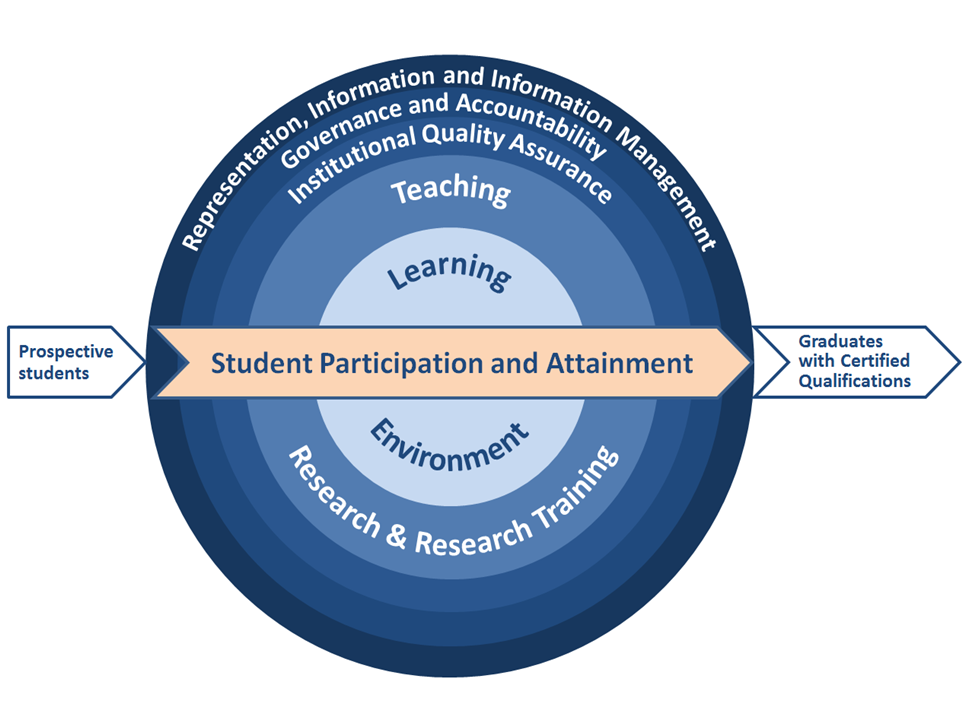
    The 'student lifecycle' of the HES Framework

    The Standards within Part A of the HES Framework encompass the matters that a higher education provider would ordinarily be expected to address in the course of understanding, monitoring and managing its higher education activities and any associated risks, and apply at all times. This is expected to make the various Standards easier to apply for the purposes of providers’ own internal monitoring, reporting and governance activities, as well as for TEQSA’s regulatory processes.

    As a result of their grounding in the nature of a provider’s mission and operations, it is expected that we will more readily be able to use internal reports and information produced during the normal course of a provider’s business, or published on provider websites, as evidence when assessing compliance with the Standards.

    In turn, this will see a reduction, over time, in any regulatory burden on higher education providers that might be attributable to our administration of the Standards.

    Additionally, the Standards: 

    • set out the requirements that a higher education provider must meet – and continue to meet – to be registered by TEQSA to operate in Australia as a provider of higher education. The Standards provide the basis for the regulation of registered higher education providers
    • ensure that the requirements for entry into the higher education sector are set sufficiently high to underpin and protect the quality and reputation of the sector as a whole
    • establish a baseline for operational quality and integrity from which all providers can continue to build excellence and diversity
    • serve other broader purposes including the provision of:
      • an articulation of the expectations for provision of higher education in Australia as:
        • a guide to the quality of educational experiences that students should expect
        • a reference for international comparisons 
        • a reference for other interested parties
    • a model framework which higher education providers can apply themselves for the internal monitoring, quality assurance and quality improvement of their higher education activities.

    Introduction to the HES Framework

    Regulatory Principles

    Our regulatory approach will continue to be guided by the provisions of the Tertiary Education Quality and Standards Agency Act 2011 (TEQSA Act) as amended from time to time, including the objects (Section 3) and the three basic principles for regulation (Section 13):

    • the principle of regulatory necessity
    • the principle of reflecting risk, and
    • the principle of proportionate regulation.

    Form of the HES Framework

    The HES Framework consists of two parts:

    • Part A – Standards for Higher Education (which represent the minimum acceptable requirements for the provision of higher education in or from Australia)
    • Part B – Criteria for Higher Education Providers (which enable categorisation of different types of providers and whether a provider is responsible for self-accreditation of a course(s) of study it delivers). 

    This overview does not include commentary on Part B. Guidance on aspects of Part B can be found in the Application Guide for registration in any university category and in the Guidance Note on Scholarship.

    The first Domain (Student Participation and Attainment) covers the education-related experiences of students from admission through to attainment of certified qualification(s) (or part thereof, such as completion of units of study). The Standards for Student Participation and Attainment focus primarily on a course of study, but apply equally to the completion of units of study. 

    The remainder of the Domains focus on the actions taken by the higher education provider to achieve the educational outcomes expected for students. The second Domain (Learning Environment) focuses on the nature and quality of the learning environment provided, whether physical, on or off campus, virtual or blended. The Standards for Teaching and for Research and Research Training (Domains 3 and 4) focus on the applicable academic activities of the higher education provider that guide and facilitate student learning and, in the case of research and research training, contribute to new knowledge as well. 

    Domains 5 and 6 focus on the mechanisms that are established by the higher education provider to assure itself of the quality of the higher education it provides (Institutional Quality Assurance), and to maintain effective governance of its operations (both Academic and Corporate Governance). Domain 7 (Representation, Information and Information Management) encompasses the higher education provider’s representation of itself and its courses to prospective students and others, the provision of information to prospective and enrolled students to enable informed participation in their educational experience, and the information management systems that support the higher education provider’s higher education operations.

    The Standards in Part A do not seek to encompass all areas of a provider’s activities, such as societal contributions through community engagement. Nor do the Standards seek to directly address some aspects of the experience of students that are not proximate to the provider or realistically under the control of the provider, such as long-term career outcomes.

    Standards statements

    Each ‘Domain’ of the Standards is segmented into ‘Sections’ and these Sections in turn contain a number of ‘Standards statements’. These Standards statements are the actual ‘Standards’; the headings of the Domains and Sections are taxonomic only. 

    The Standards statements in each Section form a related set, although each Standards statement is a stand-alone statement. In some Standards statements the words ‘include’ or ‘including’ precede an elaboration of the Standards statement. The elaboration that follows ‘include’ or ‘including’ is an essential component of the Standards statement, but it does not preclude additional forms of elaboration being used by higher education providers if they choose to do so. 

    Threshold Standards

    For the purpose of defining the Threshold Standards under Section 58 of the TEQSA Act, the applicable Standards are those that are defined in the HES Framework.

    Application of the Standards for internal purposes by higher education providers

    The Standards set out in Part A of the HES Framework are grounded in the core characteristics of the provision of higher education. As a consequence of this foundation, the Standards are intended to be useful to higher education providers as a framework for internal monitoring of the quality of their higher education activities. The Standards encompass the matters that a higher education provider would ordinarily be expected to address in the course of directing and monitoring its higher education activities and managing any associated risks. Each Standards statement addresses an underlying area of risk(s) to be managed. This may be a risk to the sustainability and viability of the provider, to the quality of education provided, to the experiences of students in relation to a higher education provider, to the quality of learning outcomes on graduation, to the reputation of higher education in Australia or a combination of these.

    From the standpoint of internal use by higher education providers, the Standards focus on aspects of a higher education provider’s operations in different but inter-related ways. Domain 1 (Student Participation and Attainment) focuses primarily on the educational experience for students, while Domains 2 to 4 (Learning Environment, Teaching, Research and Research Training) focus on the academic activities of the provider and the environments in which they occur. Together, Domains 2 to 4 address a variety of risks to the quality of higher education and the experiences of students in specific ways.

    Domains 5 and 6 (Institutional Quality Assurance, and Governance and Accountability) are more overarching in nature and draw in part on the other more specific Domains in the Threshold Standards. These Domains encompass the ways in which a higher education provider and its governing and academic bodies would ordinarily maintain oversight of its higher education operations and be able to assure itself, in the normal course of its business and governance activities, that the requirements of the Standards for Higher Education are being met. 

    As a consequence of their overarching focus, the Domains of Governance and Accountability and Institutional Quality Assurance are seen to be the primary locus for internal monitoring of a higher education provider’s activities. Any concerns identified by a higher education provider in seeking to meet the Standards for Institutional Quality Assurance and Governance and Accountability would be expected to cause deeper examination of their compliance with the Standards for Higher Education overall, guided by the risks that have been identified. 

    Applicability of the Standards to particular higher education providers or categories of higher education provider 

    Under the TEQSA Act, it is an obligation of registration that all registered higher education providers meet and continue to meet the Standards of the HES Framework. The Standards are applicable to all registered higher education providers where the provider engages in the activities encompassed by the Standards, irrespective of the category of provider. The Standards for Higher Education (Part A) also cover all modes of participation and delivery, sites of delivery and all categories of students. 

    Some parts of the Standards for Higher Education will not apply to particular higher education providers that do not engage in specific activities. For example, Standards related to delivery arrangements between a registered higher education provider and other parties will not be applicable where such arrangements do not exist. Similarly, the Research Standards are not applicable to higher education providers that do not undertake research. However, if research training is conducted, the Standards for Research and for Research Training are both applicable. 

    Except where particular higher education providers do not engage in all of the higher education activities encompassed by the Standards, such as not undertaking research training, all registered providers are required by the TEQSA Act to meet the Standards for Higher Education in their entirety. We will need to be satisfied that this is the case. The methods used to assure that providers are meeting the Standards will vary from case to case, according to risk. We will provide advice about our approach periodically, directly to providers and through our website.

    Application of the Standards to higher education providers in different stages of development

    The Standards for Higher Education have been drafted to represent the characteristics of provision of higher education by a higher education provider that is an established ‘going concern’. Such a provider would, for example, already have had several cohorts of students graduate from its course(s) of study. Review and improvement activities would also be expected to have been established as part of the provider’s own internal oversight and quality assurance of its higher education operations. Review activities would include mechanisms to provide evidence of achievement of specified expected learning outcomes and student success, and processes for external referencing against other higher education providers or other courses of study.

    To the extent that a higher education provider has not yet reached this level of operational maturity, the provider will need to demonstrate to us that its progress to date in meeting the Standards and its capacity and timetable for meeting the Standards in the future are consistent with the provider’s present stage of development. Some Standards may not be fully applicable at an early stage of a provider’s development, especially when first applying for registration as a higher education provider. For example, a provider launching its first higher education course would be expected to have all arrangements in place for the course to meet the Standards for delivery, but not be expected to have surveyed its students or implemented a course review cycle. However, it should have made provision for such a cycle of feedback and monitoring in its framework of policies procedures and planned practices.

    We will apply the HES Framework taking account of an individual provider’s stage of development. 

    Applicants who have never been registered as a higher education provider are advised to consider carefully beforehand whether they are ready to apply. In particular, they should not consider applying unless they meet the minimum requirements for potential higher education providers, outlined on our Before applying to become a higher education provider. The full set of evidence required at the point of application is outlined in the Application Guides for prospective higher education providers. If an applicant does not provide the full set of evidence required for us to conduct an assessment, we may decide that the application is invalid, and may not proceed to a substantive assessment.

    When an established provider applies for renewal of its registration, or for course accreditation or renewal of course accreditation, we will use a differentiated model of assessment (known as the ‘core+’ model), as explained in the Application Guides for registered higher education providers. The breadth and depth of assessment will be varied on a case-by-case basis. All applicants will be required to submit minimum evidence relating to a set of core Standards. Some providers will be asked to submit evidence against other selected Standards, with reference to risk and regulatory track record.

    Applications of the different types of Standards

    Some of the Standards are more overarching in nature. For example, the Standards relating to governance and internal quality assurance pertain to the governing body’s ability to oversee compliance with all of the other Standards. There is also interdependency among the Standards; for example the Standards on quality assurance ensure the provision of information to support decision making as required by the governance Standards. The different types of Standards in the HES Framework present opportunities for us to ascertain the extent of a provider’s compliance with the Standards in different ways. For example, the Standards in Domain 7 require considerable information to be publicly accessible. As a result, we may be able to form a prima facie view about many of a provider’s operations on the basis of this publicly accessible material without asking for further information.

    Similarly, in an established provider, the internal mechanisms for governance, accountability and quality assurance encompassed by Domains 5 and 6 should produce significant evidence of compliance with the overall Standards in the ordinary course of managing and monitoring the provider’s affairs. The evidence produced in meeting the overarching Standards of Domains 5 and 6 as part of internal monitoring offers significant opportunities for TEQSA (and for the higher education provider) to gain confidence in the provider’s operations. The more we can be confident that an established provider is effectively reviewing its own operations and taking actions to correct variations in quality and implement improvements, the less need we will have to undertake further investigation. We can confine investigations to undertaking a secondary review of the outputs of the provider’s own reviews, where these are comprehensive and reliable, and externally validated. 

    The Standards also differ in the types of evidence required to demonstrate that they have been met. In some cases, the evidence required will be straightforward (e.g. a state of affairs exists or it does not) while in other cases judgment will be required (e.g. the appropriateness of a set of learning outcomes). In the case of judgments, we may refer to authoritative views put by the provider and/or draw on the opinions of others e.g. an external expert, especially where academic judgment is required. 

    Appropriateness and effectiveness of a provider’s approaches

    Where Standards statements specify the existence of a policy and/or procedure, it is implied that such a policy or procedure should be fit for its intended purpose and effective in its implementation. This avoids multiple repetitious references to appropriateness and effectiveness of individual policies/procedures throughout the Standards. However, the intent of fitness for and achievement of an intended purpose remains, whether or not it is stated explicitly, and we will want to see relevant evidence that a provider’s approaches not only exist but are appropriate to their purpose and effective in achieving that purpose. For example, if a provider uses course advisory committees to gather external input into course design, we will want to see that such external advice is indeed gathered and considered in the design of the course. Similarly, if a review is undertaken of an aspect of a provider’s operations, e.g. of a course of study, we will expect to see the findings of the review considered and actions arising in response.

    References to peer review in Standards

    Various Standards in the HES Framework contemplate external referencing, benchmarking and other forms of external review, including peer review. Where peer review is expressed or implied, it is intended as peer review initiated by the provider for internal quality assurance purposes, rather than peer review processes that may be initiated or conducted by TEQSA or another external body, such as a professional accrediting body. External review of a course does not remove the need for providers to undertake their own rigorous review with external input.

    Reference points

    For some Sections of the Standards, we have suggested ‘Reference points’ in this overview. Reference points are significant codes or frameworks that may be helpful to higher education providers in considering how particular Standards may be met or demonstrated. The items listed as Reference points are generally developed and maintained by peak national bodies and agencies. Use of Reference points by higher education providers is not mandatory; neither the Standards nor TEQSA require a provider to consult the Reference points or to comply with practices advocated within the Reference points in general (however some requirements may otherwise be mandatory, within for example the Australian Qualifications Framework (AQF) or the National Code of Practice for Registration Authorities and Providers of Education and Training to Overseas Students 2018 (The National Code).

    However, in recommending the Reference points, we believe they contain material that is likely to benefit all providers in considering how they might address related Standards. Reference points are intended to augment other resources developed for providers such as our guidance notes. Various materials that may be suitable as Reference points may also be available to individual providers by virtue of their membership of professional bodies or the like. Reference points are only recommended if they are available in the public domain.

    Meaning of ‘staff’

    Some of the Standards refer to ‘staff’. For the purpose of regulation, TEQSA takes ‘staff’ to mean people carrying out roles that are relevant to the meaning of the Standard, even if the people concerned are not actually an employee of the provider e.g. an honorary sessional teacher, or workplace supervisors with responsibilities to the provider.

    Last updated:
  • HESF Domain 7: Representation, information and information management

    Content under review

    The content on this page is currently being reviewed to reflect changes in the Higher Education Standards Framework (Threshold Standards) 2021 due to amendments published on 13 July 2026


    Scope and intent of the Domain

    This Domain (Sections 7.1-7.3) of the Higher Education Standards Framework (Threshold Standards) 2021 (HES Framework) encompasses:

    • whether the providers' representations (whether directly or through other parties) about themselves and the course(s) of study they offer are accurate, ethical and not misleading in their claims (Section 7.1)
    • whether there is sufficient publicly available information to assist students in making informed choices about selecting a course of study, to enable effective and informed participation in a chosen course of study and to resolve grievances if necessary, including the particular needs of international students studying in Australia (Section 7.2)
    • the existence of a readily accessible public description of the provider and its operations
    • the requirement that the provider’s information management system meets certain critical requirements concerning content, security and integrity (Section 7.3).

    Our commentary

    7.1 Representation

    TEQSA’s main interest will be in the materials that the provider uses to represent itself and its offerings, whether to particular students or more generally. This can include marketing materials, claims about career outcomes arising from courses of study and the like. Where a provider is represented by agents, we will seek evidence of a formal contractual engagement with the agent(s) that is consistent with the requirements of the Standard, that agents are correctly informed about the provider’s operations and offerings and that the performance of agents is monitored, including that corrective action is taken if necessary. It is expected that much of the evidence required in relation to representation will already be in the public domain (e.g. websites, brochures, prospectuses, advertisements etc.) and that it will be easy for providers to direct us to that material (some materials may be equally applicable to other Sections such as 7.2 and 7.3). We will need to be satisfied that the provider’s representations are accurate, ethical and not misleading.

    In relation to Standard 7.1.4, a short narrative about the provider’s use of agents accompanied by examples of existing contractual arrangements, the resources provided to agents and an outline of monitoring arrangements and any corrective actions undertaken could illustrate that this Standard is met, where required. The Standards also call for providers to have controls in place over the way its courses are represented to prospective and current students by any third party, including through third party websites.

    7.2 Information for Prospective and Current Students

    Standards 7.2.1 and 7.2.2 require the public disclosure of a range of information, aimed largely at informed choices and participation by students (including international students if applicable). Information about the design and structure of courses, factors taken into account in selection (such as the use of ATAR and other requirements), all obligations and liabilities incurred by students (such as fees and charges and HELP liabilities), and the student support and facilities being made available, must be disclosed transparently. Students should be able to readily access all information needed for them to estimate realistic prospects for admission to each course. All information relating to professional accreditation of the course must be disclosed, as discussed in relation to Section 1.1 and Standard 3.1.5.

    TEQSA will need to be satisfied that the information required is indeed publicly available, accessible (including to individuals with special needs) and accurate. While Standard 7.3.1 requires a ‘repository of publicly-available current information about the higher education provider’, we do not require the creation of a dedicated repository that is separate from a provider’s existing sources of information, nor do we seek to prescribe the format of its presentation. For example, a provider may for operational reasons, choose to present its information in groupings or blocks of data that are different from the groupings specified by the Standard, and in various sections of its website. This is not of concern, provided that the information requirements of the Standard are met (providers should note that Standards 7.3.1 and 7.3.2 impose particular requirements on the content of some information required by Section 7.2).

    In relation to Standard 7.2.3, where applicable, we will expect a provider to be able to describe, and illustrate by example, the mechanisms that are in place to monitor achievement of statutory obligations in relation to the Education Services for Overseas Students Act 2000 and the National Code of Practice for Providers of Education and Training to Overseas Students 2018 in relation to international students.

    In relation to Standard 7.2.4, we will expect to see that any formal offer made to students contains warnings of potential changes to fees and charges or other known changes expected in an intended course of study.

    Information in the public domain is subject to monitoring at any time. This may mean that a provider will not always be required to submit evidence in relation to Section 7.2 in submissions for regulatory purposes. On the other hand, monitoring of a provider’s public information may raise concerns that lead to a request for further information/clarification outside of the provider’s normal regulatory cycle.

    7.3 Information Management

    Standard 7.3.1 contains a number of specific requirements for publicly available information. As mentioned in relation to Section 7.2, TEQSA does not seek to specify the form of presentation of this information, however it does expect the requirements of Standard 7.3.1 to be readily accessible, ideally from a single starting point. There could be, for example, a link from a provider’s website home page to another page that will in turn link to all of the types of information listed in 7.3.1 (a to m). 

    The information to be made available about the provider’s financial standing is specified in a separate Guidance note and is designed to give prospective students some assurance that the provider is a going concern. This information is separate to what we require in order to assess the financial risk of a provider, either as part of the annual risk assessment or as part of the assessment for registration, re-registration, course accreditation or re-accreditation. 

    Information about enrolment numbers (7.3.1i) in the list of a provider’s course(s) should give prospective students an indication of the scale of the provider and learning environment. The information should be based on recent actual enrolments in the case of an existing course, or realistic projections in the case of a new course. A range could be used (e.g. ‘we expect to enrol between x and y students’). In the case of nested courses, the numbers should be for the whole course. 

    As long as the requirements of Standard 7.3.2 are met in achieving Section 7.2, we will not require further reiteration in relation to 7.3.2. For Paragraph 7.3.3a, we will require a description and, possibly, a demonstration of the capability of the provider’s information system to meet the requirements of this Standard. Achievement of Paragraph 7.3.3b will require identification of the policies, processes and practices in sufficient detail for us to be satisfied that this Standard is met and that predictable risks are being mitigated as far as is reasonably possible for the nature and scale of the provider’s operations - including the onus on the provider to issue qualifications legitimately (as required by Paragraph 6.2.1h). In relation to Standard 7.3.3d, we will require a description of the systems, processes and reporting that support achievement of this Standard (and support the corporate accountability of the governing body in this respect [Standard 6.1.1]). This may be achieved by reference to mechanisms already described in relation to other Standards (e.g. Institutional Quality Assurance or Governance and Accountability) and, if so, reiteration of the detail for the purpose of demonstrating compliance with this Standard will not be required.

    Once we are satisfied that a provider has demonstrated that its systems meet, and are likely to continue to meet, Standard 7.3.3 (a-c), we may require only limited evidence of continuing compliance with these Standards. However, will always have an interest in reviewing the management of complaints and misconduct (Paragraph 7.3.3c), irrespective of the capability of a provider’s information management systems. 

    Reference points

    • Australian Government, Australian Consumer Laws (Schedule 2 of the Competition and Consumer Act 2010) and the Trade Practices Act 1974
    • Australian Government, National Code of Practice for Registration Authorities and Providers of Education and Training to Overseas Students 2018
    • Australian Government, Privacy Act (1988) and the Australian Privacy Principles
    • Australian Government (July 2009), Using Education Agents
    • British Council, Statement of Principles for the Ethical Recruitment of International Students by Education Agents and Consultants (The London Statement) (2012) released by the British Council
    • International Education Association of Australia, Education Agent Code of Ethics (2016)
    • Web Content Accessibility Guidelines Working Group (WCAG WG), Web Content Accessibility Guidelines Version 2.0

    Relevant guidance notes

    The following guidance notes can be accessed at our Guidance notes page, or from the links below:

    Last updated:
  • HESF Domain 5: Institutional quality assurance

    Content under review

    The content on this page is currently being reviewed to reflect changes in the Higher Education Standards Framework (Threshold Standards) 2021 due to amendments published on 13 July 2026


    Scope and intent of the Domain

    This Domain (Sections 5.1-5.4) of the Higher Education Standards Framework (Threshold Standards) 2021 (HES Framework) encompasses:

    • whether the provider has a credible and effective process for internal approval of all courses of study that is applied consistently and involves competent academic oversight and scrutiny independent of those directly involved in the delivery of the courses of study (Section 5.1)
    • the effectiveness of the policy framework and processes that are applied to maintain academic integrity throughout the provider’s academic activities (including arrangements with other parties) and to address and prevent lapses in academic integrity (Section 5.2)
    • the mechanisms for regular review of the quality of higher education activities and how the findings of such reviews are used to bring about improvements (Section 5.3)
    • how delivery arrangements with other parties are quality assured, including verification of the continuing compliance of those arrangements with the requirements of the HES Framework (Section 5.4).

    Our commentary

    5.1 Course Approval and Accreditation

    TEQSA’s main focus will be on ensuring that the provider has an effective internal process for approval of all courses, which includes rigorous academic scrutiny through the institutional academic governance processes of the provider, independently of those involved directly in delivery of the course of study. All providers are expected to have such an approval process, whether they have self-accrediting authority or their courses are accredited by TEQSA. If we accredit a course of study, the point of departure will be the evidence of rigorous internal approval of the course carried out by the provider prior to making an application for course accreditation. Once we are satisfied that a provider’s approval process is capable and continues to be so, less detailed evidence about the approval process itself may be required for regulatory purposes. Any course of study submitted to us for approval must have been both considered and approved by the responsible internal academic governance body or bodies or it will not be accredited.

    5.2 Academic and Research Integrity

    TEQSA will need to be satisfied that there is an institutional policy framework to maintain and support academic integrity of students and staff that is backed by processes and practices that implement institutional policies effectively. Providers will need processes for detecting and addressing instances of plagiarism and other forms of ‘cheating’. Once a provider is operating, evidence of effectiveness will be provided in part by records of management of incidents as required by Paragraph 7.3.3c. 

    Reference points

    • Australian Government, Australian Code for the Responsible Conduct of Research (2018).
    • Reports of studies on good practice commissioned by the Office for Learning and Teaching and the Australian Learning and Teaching Council (2011-2013).
    • Tertiary Education Quality and Standards Agency, Academic Integrity Toolkit (2020).

    5.3 Monitoring, Review and Improvement

    This Section requires a provider to conduct periodic, comprehensive reviews of all courses (at least every seven years with evidence to be provided as part of the renewal of registration application to TEQSA), backed by more frequent monitoring of the day-to-day delivery of courses of study, for example, periodic reviews of units and annual review of student performance. We will expect to see that such reviews are conducted (or will be conducted in the case of a new provider or course of study) according to the requirements of the Standards as part of the provider’s normal operations, and that the findings of the reviews are evidently used to generate improvements. In demonstrating that it meets this Standard, a provider will need to demonstrate in particular that reviews of courses of study involve considered oversight by the institutional academic governance processes, external referencing (which can include moderation of assessment against other programs, benchmarking of student success and course design against programs at other providers) and feedback from students. 

    5.4 Delivery with Other Parties

    Where a provider delivers courses of study or parts of courses of study through arrangements with other parties, TEQSA will need to be satisfied that the provider remains accountable for such arrangements, that the delivery of the program is monitored and quality assured by the provider and that both the program delivery and the student experience with other parties comply with the requirements of the HES Framework. How this is demonstrated may vary with the circumstances. If in doubt, contact the TEQSA Enquiries Management team at providerenquiries@teqsa.gov.au. However, the starting point will be the terms and conditions of the contract between the registered provider and the third party, and how the registered provider reviews compliance with these.

    Relevant guidance notes

    The following guidance notes can be accessed at our Guidance notes page, or from the links below:

    Last updated:
  • HESF Domain 6: Governance and accountability

    Content under review

    The content on this page is currently being reviewed to reflect changes in the Higher Education Standards Framework (Threshold Standards) 2021 due to amendments published on 13 July 2026


    Scope and intent of the Domain

    This Domain (Sections 6.1-6.3) of the Higher Education Standards Framework (Threshold Standards) 2021 (HES Framework) encompasses:

    • specification of an accountable governing body with some elaboration of its key governance roles
    • specific corporate accountabilities to be demonstrated by the provider, which the governing body also assures itself are met
    • requirements for academic governance oversight of a provider’s higher education activities.

    This Domain represents a collection, at a corporate level, of the provider’s accountabilities, both as a responsible corporate entity and as a provider of quality higher education, including responsibility for compliance with the requirements of the other six Domains of the HES Framework. Some of these accountabilities reside solely with the governing body, although most rely on delegations of authority from the governing body to various parts/officers of the provider. 

    Because of its overarching nature, the extent to which a provider demonstrates its capacity to meet the Standards of this Domain (along with Domains 5 and 7) as part of its ordinary business will be a significant factor in building TEQSA’s confidence about the provider’s capacity to meet and continue to meet the requirements of the HES Framework overall.

    Our commentary

    6.1 Corporate Governance

    This Section requires a provider's governing body to be formally established by a legal instrument (e.g. by a specific Act or under the Corporations Act or State Act unless the provider is an individual operating from a Territory). The Standards do not prescribe the model of governance (e.g. Board/CEO or Board/Executive Director) but at least two members of the body must be independent and, consequently, could not be executive directors (the concept of an independent director is elaborated on in the Guidance Note for Corporate Governance).

    The Standards require the governing body to exercise governance functions and to hold the organisation accountable, which TEQSA would expect to see reflected in the entity’s instrument of establishment, constitution, a board charter or the like and/or delegated authorities put in place by the governing body. Standard 6.1.3 specifies a number of key governance roles for the governing body. Provided these are carried out as contemplated by the Standard, we would not seek to specify how these roles are undertaken. Notable among these roles is the conduct of periodic independent reviews of the effectiveness of the governing body and the academic governance processes the provider has implemented. For an established provider, we will require reports of these reviews and evidence of improvements arising, or planned to arise, from them. In addition, we will also need to be satisfied that arrangements to meet contingencies including cessation as a provider are available and likely to be effective.

    Reference point

    • Tertiary Education Quality and Standards Agency Fit and Proper Person Determination 2018. 

    6.2 Corporate Monitoring and Accountability

    This Section of the Standards specifies a series of critical accountabilities that the provider must be able to demonstrate, and that the governing body, as part of its governance role, must be able to satisfy itself are being met. The governing body should set in place delegated authorities required for effective governance, and TEQSA will review these (including their effectiveness). The governing body must also be able to demonstrate that it has assured itself that these accountabilities are being met as part of its ordinary business, for example, as recorded in its business agendas, confirmed minutes and actions arising such as compliance monitoring, risk management and monitoring of delegated authorities.

    Management of risks must include risks to quality. We will expect the provider to be able to demonstrate how the governing body remains abreast of any occurrences of academic misconduct, serious complaints, critical incidents and actual or potential lapses in relation to the HES Framework (see Paragraphs j and k of Standard 6.2.1) through its reporting framework. The evidence required to demonstrate financial viability and the financial capability to meet the Standards and sustain the quality of higher education is detailed in the Application guide for new providers.

    Reference points

    • ASX Corporate Governance Council (July 2014, or as amended), Corporate Governance Principles and Recommendations (3rd Edition)
    • Universities Australia (July 2011), Voluntary Code of Best Practice for the Governance of Australian Universities.

    6.3 Academic Governance

    This Domain represents the highest level of academic governance oversight mechanisms established by the provider. Neither the Standards nor TEQSA prescribe the structures that may be employed (such as an Academic Board or Senate). However, the outcomes that are to be achieved are specified by the Standards and we will expect a provider to demonstrate that its chosen mechanisms for academic governance achieve these outcomes. A provider’s academic governance systems represent a critical oversight link between the provider’s detailed internal quality assurance arrangements (see Domain 5), the accountability of the governing body for the quality of the higher education it offers and for meeting the requirements of the HES Framework (see Domain 6).

    We will expect to see evidence of high level academic oversight (e.g. policy development and review, performance analyses, review findings and actions arising) as contemplated by Standards 6.3.1-6.3.3 as part of the provider’s normal business, including reports and analyses presented to the governing body. A provider’s capacity to maintain effective academic oversight of its higher education activities will be critical to our confidence in the provider and their ability to meet the rest of the Standards.

    Relevant guidance notes

    The following guidance notes can be accessed at our Guidance notes page, or from the links below:

    Last updated: