• Guidance notes

    The Higher Education Standards Framework (Threshold Standards) 2021 (HES Framework) has applied since 1 July 2021.  

    From a regulatory perspective, all applications made: 

    • before 1 July 2021 will be assessed against the HES Framework 2015
    • on or after 1 July 2021 will be assessed against the HES Framework 2021.

    Guidance notes

    Guidance notes are concise documents designed to provide high-level, principles-based guidance on interpretation and application of specific standards of the Higher Education Standards Framework (Threshold Standards) 2021. They also draw attention to other interrelated standards and highlight potential risks to compliance.
     

    TEQSA is working to enhance its suite of guidance notes and will keep providers updated on our progress through our monthly e-News (subscribe here) and our social media channels.
     

    We recognise and value the importance of drawing on knowledge of lived experience in the higher education sector.
     

    Please view our Consultation page to learn more about present opportunities to provide feedback.

    The resources published on this page are not instructional or ‘how to’ documents for compliance with the new HES Framework.

    TEQSA publishes guidance notes to provide greater clarity for providers in the interpretation and application of selected standards. Guidance notes draw on our regulatory experience and knowledge of experts in the higher education sector.

    Guidance notes usually focus on a single topic (such as academic leadership, for example). The guidance note typically outlines:

    • the nature of the topic
    • the relevant standards in the Higher Education Standards Framework (HESF) that relate to the topic
    • the underlying intent of those standards
    • the risks to the quality of education if the topic is not addressed sufficiently by a provider
    • the evidence that TEQSA is likely to look for to be satisfied that the requirements of the HESF are being met.   

    Comments and feedback on guidance notes can be emailed to standards@teqsa.gov.au.

    Current guidance notes

    Guidance note Last updated
    Academic Governance 30 November 2023
    Academic and Research Integrity  2 February 2024
    Academic Leadership (beta version) 18 June 2019
    Academic Monitoring, Review and Improvement 19 March 2024
    Academic Quality Assurance 11 October 2017
    Admissions (coursework) 4 May 2022
    Changes in a Course of Study that may lead to Accreditation as a New Course 6 March 2017
    Corporate Governance (discontinued) 19 October 2026 (discontinued)
    Course Design (including Learning Outcomes and Assessment) 11 October 2017
    Credit and Recognition of Prior Learning 7 July 2023
    Delivery with Other Parties 7 July 2023
    Determining Professional Equivalence – [full title: Determining Equivalence of Professional Experience and Academic Qualifications] 11 October 2017
    Diversity and Equity 11 October 2017
    Facilities and infrastructure 30 November 2023
    Financial Assessment 11 April 2019
    Financial Standing  11 April 2019
    Grievance and Complaint Handling (discontinued) 5 November 2026 (discontinued)
    Joint and Dual Awards 11 October 2017
    Learning resources and educational support 11 June 2025
    Monitoring and Analysis of Student Performance (beta version) 6 January 2020
    Nested Courses  13 August 2019
    Research and Research Training 11 December 2024
    Research Requirements for Australian Universities 30 April 2024
    Scholarship 4 May 2022
    Staffing 11 June 2025
    Technology-Enhanced Learning  11 April 2019
    TEQSA and the Australian Qualifications Framework 27 August 2019
    Transnational Higher Education - Inbound [full title: Transnational Higher Education into Australia (including international providers seeking to offer higher education in Australia)] 11 October 2017
    Varying a Period of Registration or Accreditation 26 August 2019
    Wellbeing and Safety 8 January 2018
    Work-Integrated Learning 4 May 2022

    Statements of Regulatory Expectations

    A Statement of Regulatory Expectations (SRE) is a regulatory tool TEQSA uses to address systemic ongoing or acute emerging risks to compliance with the Higher Education Standards Framework (Threshold Standards) 2021.

    Good practice notes

    Guide to determining the fitness and propriety of a person

    This guidance sets out the principles and considerations that TEQSA will have regard to when assessing fitness and propriety for the purposes of the TEQSA Act. 

    Independent Experts engaged by providers 

    This document provides guidance to providers on selecting a suitable independent expert to conduct a review or seek expert advice as part of their internal quality assurance processes.

    Glossary of terms

    Last updated:
  • Lawful disruption of access to online services policy

    Body

    Documents

    Purpose

    This document sets out TEQSA’s policy regarding requests by TEQSA for the lawful disruption of access to online locations under s313(3) of the Telecommunications Act 1997 (Telecommunications Act) that appear to show content that amounts to, or involves, contraventions of relevant serious offence or civil penalty provisions in the Tertiary Education Quality Standards Agency Act 2011 (Cth) (TEQSA Act).

    TEQSA’s role and responsibilities

    Please refer to this website for information about TEQSA’s role and responsibilities.

    In particular, TEQSA will apply this policy as part of its efforts to protect academic integrity. For more information about TEQSA’s efforts in this regard, please refer to the relevant page on this website.

    The power to disrupt online locations

    Section 313(3) of the Telecommunications Act requires that carriage service providers, in connection with their operation of telecommunications networks and facilities or the supply of carriage services, give officers and authorities of the Commonwealth, states and territories any help reasonably necessary to, amongst other things, enforce the criminal law and laws imposing pecuniary penalties.

    It enables government agencies to request internet service providers (ISPs), as carriage service providers, to provide such assistance as is reasonably necessary to disrupt the operation of online services by blocking access to online services and locations (including websites).

    In line with the Commonwealth’s relevant guidelines , the following serious offence or civil penalty provisions in the TEQSA Act may form the basis of a request by TEQSA under s313(3) of the Telecommunications Act:

    1. offence provisions that impose a maximum prison term of at least two years
    2. civil penalty of at least 120 Commonwealth penalty units.

    Principles

    When considering whether to make a disruption request, TEQSA will take into account relevant factors and follow certain processes (see below) to:

    1. determine whether a disruption is warranted and necessary
    2. obtain the necessary approval at TEQSA
    3. once the disruption request is made and implemented, monitor, evaluate and report on the outcome of the disruption.

    When making a disruption request, TEQSA will take steps to ensure that the request is as targeted as possible (by reference to the relevant offence or civil penalty provision in the TEQSA Act), effective and executed appropriately.

    Factors for TEQSA to consider

    Before making a disruption request, TEQSA will consider a range of factors to determine whether the request is warranted and necessary, including:

    1. whether TEQSA or any other agency is conducting an investigation into a possible breach of an offence or civil penalty provision in the TEQSA Act covered by this policy
    2. the availability of other enforcement tools, such as injunctions (and the legal costs and time involved in using those tools by reference to the benefit(s) TEQSA would secure by using them)
    3. the range of services on the site that may be the subject of a disruption request, including whether there is a risk that the disruption request would affect services made available on the site that do not involve contraventions of a relevant offence or civil penalty provision in the TEQSA Act
    4. the harm being done by the online location
    5. the likely effectiveness of the proposed disruption
    6. the view(s) of the relevant internet service provider(s) who TEQSA intends to send the request(s) to
    7. technical feasibility and costs involved in the proposed disruption
    8. potential consequences for, or damage to, the work of other Commonwealth or State government agencies or institutions in their pursuit of their respective objectives
    9. potential consequences or damage to a higher education provider
    10. the nature and seriousness of the offence or contravention
    11. whether there is a public interest in disrupting access.

    Consultation

    TEQSA will consult with the relevant ISPs, as carriage service providers, at an early stage about the proposed disruption, unless there is a material risk that doing so will compromise any relevant investigation. TEQSA will consult to obtain their views on the proposed disruption, the best means of complying with requests for assistance and the management of associated costs in respect of ISPs’ compliance with requests.

    Complaints or concerns about the disruption of access to an online location

    The owner of an affected online location can complain about the disruption by following the instructions at Protect yourself from illegal commercial cheating services (under the heading “Complain or raise concerns about the blocking of a website”). Concerns about the disruption that impact upon any person other than the owner of the affected online location can be raised in the same way.

    If TEQSA receives a complaint about a disruption, it will initially determine whether the disruption should remain in place and respond to the complaint accordingly, including by informing the complainant of the outcome of its determination (if the complainant provided contact details when lodging the complaint). Any concerns raised with TEQSA will be dealt with by reference to the concerns raised.

    TEQSA may use any information it receives from any person who contacts it about the disruption of access to an online location in taking enforcement action (including in the pursuit of civil penalty or criminal penalty proceedings pursuant to sections 114A and 114B of the TEQSA Act, either independently or in conjunction with other agencies.

    Review and monitoring following request

    TEQSA will monitor and evaluate each disruption request. If TEQSA becomes aware that a disruption is inappropriate (or no longer appropriate) or has unintended consequences, then TEQSA will consider taking appropriate remedial action.

    TEQSA will note contact from any person regarding any disruption.

    TEQSA may use any information it receives from any person who contacts it about the disruption of access to an online location in taking enforcement action (including in the pursuit of civil penalty or criminal penalty proceedings pursuant to sections 114A and 114B of the Tertiary Education Quality and Standards Act 2011), either independently or in conjunction with other agencies.

    Informing the public about requests

    TEQSA will take reasonable steps to notify the owner of an online location covered by a request under s313(3) of the Telecommunications Act, unless doing so could compromise an investigation either TEQSA or any other agency is conducting. 

    The Commonwealth’s relevant guidelines state that agencies should publish each disruption request and include why the request has been made to promote transparency and public awareness about requests made under s313(3) of the Telecommunications Act. The guidelines, however, also state that agencies are not required to publish requests if the report may jeopardise ongoing or planned investigations, interfere with operational activities, or give rise to other law enforcement or national security concerns.

    Wherever practical and reasonable in the circumstances, TEQSA will inform the public each time it makes a disruption request by:

    1. publishing a notice on the disrupted website advising that access to a particular site has been stopped (a ‘stop page’). The stop page will advise that TEQSA has requested the disruption and the reason(s)
    2. notifying the public of the fact that the power has been used and why on TEQSA’s website.

    The stop page will include details of how adversely affected parties may complain to TEQSA if they feel aggrieved by the disruption.

    In accordance with the guidelines, TEQSA will report annually to the Australian Communications and Media Authority (ACMA) on the number of disruption requests the agency has made during the year: see p. 6 of the guidelines.

    ACMA is responsible for reporting annually to Parliament on all requests made by government agencies during the year. Further, TEQSA will provide information about the number of requests for assistance we made each year in TEQSA’s annual report.

    Contact

    Any enquiries about TEQSA’s approach to the lawful disruption of access to online locations can be directed to: enquiries@teqsa.gov.au.

    1.  See Guidelines for the use of section 313(3) of the Telecommunications Act 1997 by government agencies for the lawful disruption of access to online services
       
    Subtitle
    Version 1.1
    Stakeholder
    Publication type
  • Procedures for determining breaches of the Code of Conduct and for determining sanction

    Body

    Documents

    I, Dr Mary Russell, as Chief Executive Officer of the Tertiary Education Quality and Standards Agency (the 'Agency'), establish these procedures under subsection 15(3) of the Public Service Act 1999 ('the Act').

    These procedures commence on the date signed.

    These procedures supersede the previous procedures dated 26 April 2022 made for the Agency under subsection 15(3) of the Act.

    1. Application of procedures

    1.1 These procedures apply in determining:

    • Whether an APS employee in the Agency has breached the APS Code of Conduct (the Code') in section 13 of the Act.
    • What sanction, if any, should be imposed on an APS employee in the Agency for a breach of the Code.

    1.2 Unless the contrary intention appears, a reference to an APS employee includes a reference to a former APS employee who is suspected of having breached the Code while an employee in TEQSA.

    1.3 In these procedures, a reference to a breach of the Code by an APS employee includes a reference to a person engaging in conduct set out in subsection 15(2A) of the Act in connection with their engagement as an APS employee.

    Note: Not all suspected breaches of the Code need to be dealt with by way of a process which results in a determination. In particular circumstances, another way of dealing with a suspected breach of the Code may be more appropriate.

    2. Breach decision-maker and sanction delegate

    2.1  As soon as practicable after a suspected breach of the Code has been identified and the Chief Executive Officer, or person authorised by the Chief Executive Officer, has decided to deal with the suspected breach under these procedures, the Chief Executive Officer or authorised person will appoint a decision-maker to make a determination under these procedures.

    2.2 The role of the breach decision-maker is to determine whether a breach of the Code has occurred.

    2.3 The breach decision-maker may undertake the investigation or seek the assistance of an investigator. The investigator may investigate the alleged breach, gather evidence and make a report of recommended findings of fact to the breach decision-maker.

    2.4 The person who is to decide what, if any, sanction is to be imposed on an APS employee who is found to have breached the Code will be a person holding a delegation of the powers under the Act to impose sanctions.

    2.5 These procedures do not prevent the breach decision-maker from being the sanction delegate in the same matter.

    3. Person or persons making breach determination and imposing any sanction to be independent and unbiased

    3.1 The Chief Executive Officer must take reasonable steps to ensure that the breach decision-maker and the sanction delegate are, and appear to be, independent and unbiased.

    3.2 The breach decision-maker and the sanction delegate must advise the Chief Executive Officer in writing if they consider that they may not be independent and unbiased or if they consider that they may reasonably be perceived not to be independent and unbiased; for example, if they are a witness in the matter.

    4. The determination process

    4.1 The process for determining whether an APS employee has breached the Code must be carried out with as little formality, and with as much expedition, as a proper consideration of the matter allows.

    4.2 The process must be consistent with the principles of procedural fairness.

    Note: Procedural fairness generally requires that:

    • the APS employee suspected of breaching the Code is informed of the case against them (i.e. any material that is before the decision-maker that is adverse to the APS employee or their interests and that is credible, relevant and significant)
    • the APS employee is given a reasonable opportunity to respond and put their case, in accordance with these procedures, before any decision is made on breach or sanction
    • the decision maker acts without bias or appearance of bias.

    4.3 A determination may not be made in relation to a suspected breach of the Code by an APS employee unless reasonable steps have been taken to:

    a)  inform the APS employee of:

    • the specific details of the suspected breach of the Code, including any subsequent variation of those details; and
    • where the person is a current APS employee, the sanctions that may be imposed on them under subsection 15(1) of the Act; and

    b) give the APS employee a reasonable opportunity to make a statement in relation to the suspected breach.

    4.4 The statement may be written or oral statement and should be provided within 7 calendar days or any longer period that is allowed by the decision-maker.

    4.5 An APS employee who does not make a statement in relation to the suspected breach is not, for that reason alone, to be taken to have admitted to committing the suspected breach.

    4.6 For the purpose of determining whether an APS employee has breached the Code, a formal hearing is not required.

    Note: this clause is designed to ensure that by the time the breach decision-maker comes to make a determination, reasonable steps have been taken for the APS employee suspected of breach to be informed of the case against them. It will generally also be good practice to give the APS employee notice at an early stage in the process of a summary of the details of the suspected breach that are available at that time and notice of the elements of the Code that are suspected to have been breached.

    5. Sanctions

    5.1 The process for imposing a sanction must be consistent with the principles of procedural fairness.

    5.2 If a determination is made that a current APS employee has breached the Code, a sanction may not be imposed unless reasonable steps have been taken to:

    a) inform the APS employee of:

    • the determination; and
    • the sanction or sanctions that are under consideration; and
    • the factors that are under consideration in determining any sanction to be imposed; and

    b) give the APS employee a reasonable opportunity to make a statement in relation to the sanction or sanctions under consideration.

    5.3 The statement may be a written or oral statement and should be provided within 7 calendar days or any longer period that is allowable by the sanction delegate.

    6. Record of determination and sanction

    6.1 If a determination is made in relation to a suspected breach of the Code by an APS employee, a written record must be made of:

    a) the suspected breach; and

    b) the determination; and

    • any sanctions imposed as a result of a determination that the APS employee has breached the Code; and

    c)    any statement of reasons given to the APS employee regarding a determination made under these procedures.

    Subtitle
    Version 4
    Stakeholder
    Publication type
  • TEQSA’s approach to consultation

    Body

    Documents

    Why does TEQSA consult?

    TEQSA takes a partnership approach to regulation of the higher education sector. As part of this approach, TEQSA will seek to consult stakeholders when we consider or propose changes that may meaningfully inform or impact regulation of the higher education sector.

    TEQSA values feedback from stakeholders and recognises consultation and engagement supports improvements in regulation and providers’ capacity for self-assurance.

    Principles of consultation

    TEQSA’s approach to consultation is consistent with its overall regulatory philosophy of partnership with the sector. It is also guided by the principles of reflecting risk, proportionality, and necessity.

    1. Broad consultation

    TEQSA endeavours to consult with the full range of stakeholders within the Australian higher education system, including providers, students, staff, peak bodies and representative groups such as unions. Our approach to consultation recognises that the sector is diverse and the views and interests of stakeholders may vary. TEQSA’s approach to consultation aims to capture the breadth and diversity of views.

    2. Clear purpose and scope

    TEQSA will clearly explain the objectives of a consultation process. The focus and scope of consultation will be directly linked to meeting the objects of the Tertiary Education Quality and Standards Agency Act 2011 (TEQSA Act). This includes monitoring provider compliance with the Higher Education Standards Framework (Threshold Standards) 2021. Consultation documents will clearly set out the consultation process, what is being proposed, the scope to influence and benefits of the proposal.

    3. Enough time

    TEQSA believes consultation on proposals should start early and continue at key stages in the development of a proposal when there is scope to influence the outcome. TEQSA will aim to put sufficient information in the public domain to allow stakeholders to provide an informed view. TEQSA will also allow enough time for consideration of the potential outcome of the proposal.

    The duration of a consultation process will be appropriate for each proposal’s purpose and scope. If a consultation extends over a holiday period, TEQSA will take this into consideration when setting the response cut-off date. If a shorter consultation period is unavoidable, TEQSA will make clear the reasons for this.

    4. Accessible

    TEQSA is aware of the importance of ensuring consultation processes and documents can be easily accessed by stakeholders. Channels of communication may include direct email, correspondence, website, survey tools, forums, use of reference groups, or a combination of these. If a stakeholder has difficulty accessing any of TEQSA’s published documents, TEQSA will address this in a timely manner.

    5. Minimal burden

    Where possible, TEQSA appreciates that keeping the potential impact of consultation to a minimum is essential to effective consultation. Wherever possible, TEQSA will make best use of existing data and will ask stakeholders to add to or validate this information. Where feasible, TEQSA may ‘join up’ consultation exercises to reduce the administrative burden associated with multiple consultation processes.

    Where possible, TEQSA will consider of the timing of any other consultations with the sector that are being planned by other Australian Government regulatory or policy agencies (e.g. the Department of Education or the Australian Skills Quality Authority). This is to avoid a situation where providers are overloaded with requests to contribute to government consultations or are asked for the same or similar information by different agencies.

    6. Trust and transparency

    TEQSA recognises the importance of being open and transparent. TEQSA will publish submissions to consultation or a summary of submissions where doing so is appropriate. In some situations, such as when consulting on sensitive issues, TEQSA will not publish submissions or summaries. TEQSA will consider the benefits of transparency against supporting open and frank input from stakeholders and ensuring stakeholder trust in the consultation process. The intention to publish submissions will be made known to stakeholders at the time submissions are sought. If TEQSA decides to publish submissions, permission will be sought prior to publication.

    7. Improvement

    TEQSA will regularly review the consultation process to identify ways of making future consultations more effective and efficient. This process will consider any views expressed by stakeholders on particular aspects of the process and/or by external experts.

    8. Confidentiality

    TEQSA will consider all requests to keep information collected during consultation confidential. While TEQSA has statutory obligations of confidentiality under the TEQSA Act, it also operates within a public accountability framework. This includes obligations:

    • to provide information to Ministers, the Parliament or Parliamentary Committees
    • under the Freedom of Information Act 1982, the Auditor-General Act 1997 and the Ombudsman Act 1976
    • to provide reasons for TEQSA’s decisions or details about TEQSA’s activities, including in the context of court or tribunal proceedings.

    At times TEQSA may be obliged to share confidential information. In these situations, TEQSA will endeavour to consult with affected stakeholders and afford them an opportunity to make a submission about whether the information should be released. However, in certain cases it may not be possible to consult the affected stakeholders.

    9. Privacy

    TEQSA is obliged to protect any personal information about individuals in accordance with the provisions of the Privacy Act 1988. TEQSA will provide information about the collection, use and disclosure of personal information where it is likely that personal information will be collected in consultations.

    Stakeholder
    Publication type
  • Preparing an ESOS registration renewal application (Stage 1)

    Stage 1: the provider prepares a CRICOS renewal application

    Legislative requirements

    Your application should demonstrate that your governing body is assured of your institution’s current, and continuing, compliance with the requirements of the:

    Evidence requirements

    TEQSA has revised its approach to the evidence required for applications to renew ESOS registration. We have done this to reduce the volume and scope of evidence required to demonstrate compliance with the National Code.

    Applications to renew ESOS registration should include the following evidence:

    1. A self-assurance report
    Outlining how the governing body manages key sector risks, how it assures itself of the quality of its higher education operations and that it is compliant with the National Code.
    1. An index of supporting evidence
    Referenced throughout the report.
    1. An independent external audit report or additional supporting evidence

    The report of a recently conducted independent external audit of the effectiveness of the provider’s internal mechanisms for self-assurance and compliance with the National Code (including planned and completed actions arising from these reviews).
     

    Or, if the provider does not have self-accrediting authority, and chooses not to provide a recently commissioned independent external audit, additional supporting evidence.

    1. For providers with a Foundation Program – an additional self-assurance report
    Focused on the requirements for renewing a Foundation Program.
    1. For providers with an ELICOS course – an additional self-assurance report
    Focused on the requirements for renewing an ELICOS course.
    1. For providers with an under 17 exemption – additional supporting evidence
    Satisfying the requirements to renew exemptions to enrol students under the age of 17 in Foundation Programs.

    ESOS registration renewal: Self-assurance report

    A self-assurance report provides an opportunity to demonstrate the effectiveness of your self-assurance mechanisms.

    The self-assurance report for applying to renew ESOS registration should be a maximum of 10 pages. It should outline how your governing body assures itself of the quality of your education operations, and your current and continued compliance with the requirements of the ESOS Act, the National Code 2018, and where relevant, the ELICOS Standards, and the Foundation Program Standards.

    When applying to renew ESOS registration, your self-assurance report should include:

    1. Evidence of how risks have been identified, managed and mitigated, and how your institution will manage these risks going forward (including areas for continuous improvement and any associated actions and measures which are in place to monitor success).
    2. Demonstration of how you manage key sector risks in the following areas:
    Student recruitment and admission

    TEQSA recommends considering our:

    Student participation, support and experience

    TEQSA recommends considering:

    Student attainment

    TEQSA recommends considering:

    1. Where applicable, the findings, actions (planned and completed) and outcomes of at least one external audit. This audit should have been undertaken, by a suitably qualified discipline expert, no more than 18 months before applying to renew ESOS registration. A copy of the audit should be included, as an attachment, to the self-assurance report.
    2. The findings, actions and outcomes of the most recent review report on recruitment performance, including the performance of agents (e.g. student numbers enrolled and succeeded, meetings with agents and terminations of agents). The following attachments should be included with the self-assurance report:
      • policies and procedures regarding recruitment and management of agents
      • an example of a written agreement between your institution and an education agent.
    3. A copy of an example agreement used where third-party providers are engaged to provide welfare and/or accommodation arrangements to students under the age of 18.
    4. Evidence of a culturally and age-appropriate orientation program, including the presentation used for overseas students.
    5. Details of any third-party arrangements for the delivery of a course or courses to overseas students.

    Note: All claims made in the self-assurance report must be substantiated by evidence, with reference to specific supporting documents in-text. 
     

    Where possible, supporting evidence should be directly accessible via in-text hyperlinks, included as attachments to the report, or listed in the index and available for later submission on request.

    Index of supporting evidence

    Your application should include an index of all supporting evidence referenced in the self-assurance report. At a minimum, the index should include:

    Items to be listed with hyperlinks to their location on your website
    • Policies and procedures regarding:
      • marketing and recruitment
      • credit and recognition of prior learning (RPL)
      • admission
      • assessment of English language proficiency
      • fee refunds
      • students under the age of 18
      • critical incidents
      • student support
      • orientation
      • staff development
      • health and safety
      • overseas student transfers
      • monitoring, recording and assessing course progress, including intervention strategies for students at risk
      • monitoring and recording attendance (where applicable)
      • assessing, approving and recording deferment, suspension and cancellation
      • complaints and appeals.
    • Current marketing and promotional material for current and prospective students, including sample course brochures and promotional material published on social media
    • Overseas student handbooks
    • A current list of education agents engaged to formally represent the provider
    • Samples of information given to students under the age of 18 outlining emergency contacts and how to seek assistance and report on incidents of actual or alleged sexual, physical or other abuse.
    Items may be listed without hyperlinks and TEQSA may request copies of these items at any time
    • Details of marketing materials provided to agents
    • A register of students granted credit within the last 24 months
    • An example of a Letter of Offer and a written agreement between your institution and a student for a course of study
    • Details of any training and development programs provided to agents
    • Evidence demonstrating that the suitability of accommodation for students under the age of 18 has been verified, prior to the accommodation being approved and at least every 6 months thereafter
    • Policies and procedures for selecting, screening and monitoring any third parties your institution has engaged to organise and assess welfare and accommodation arrangements (where applicable)
    • Evidence of compliance with Commonwealth, state and territory legislation, or other regulations regarding child welfare and protection requirements
    • A copy of the Working with Children Check register
    • A copy of the critical incident register, or other written record, for at least the last 2 years
    • Details of ESOS training and ongoing professional development undertaken by staff
    • A description of student services for overseas students, including:
      • legal services
      • emergency and health services
      • academic and English language student support
      • welfare support services
      • other student support services.
    • Examples of correspondence sent by your institution to overseas students when you:
      • intend to refuse a transfer request
      • intend to report the student for unsatisfactory course progress or attendance
      • are notifying the intention to suspend or cancel the student’s enrolment
      • are notifying that a deferral, suspension or cancellation has taken place
      • are notifying the outcome of an internal appeal process for both favourable and adverse decisions.
    • A report of all decisions to defer, suspend or cancel the enrolment of overseas students in the preceding 12 months, with a description of reasons and outcomes
    • A report of all student complaints and appeals received in the preceding 12 months, with evidence of processes implemented and a description of outcomes and actions taken
    • Evidence of quality assurance and monitoring arrangements between your institution and any third party engaged for the delivery of a course
    • An outline of changes to current third-party arrangements for course delivery and a copy of the amended contract if, since being approved by TEQSA, any of the following areas have been impacted:
      • roles and responsibilities of each party
      • delivery site location
      • duration of contract length.
    • A report of all refund requests and outcomes from the previous 12 months, with evidence that refunds provided were reported in PRISMS within the required timeframe (where applicable)
    • Where relevant, evidence your institution is meeting its obligation to maintain the ‘Protected Amount’ (all pre-paid tuition fees must be held in a designated bank account which is separate to day-to-day operating expense accounts)
    • A copy of relevant policies and procedural documents that ensure your institution has robust mechanisms for maintaining the Protected Amount.

    Independent external audit

    Standard 11.4 of the National Code requires providers who are self-accrediting to undertake an independent external audit within 18 months of their registration’s expiry.

    TEQSA strongly encourages all providers (including those who do not have self-accrediting authority) to undertake an independent external audit of their compliance with the ESOS Framework in the second half of their registration period.

    An independent audit is an opportunity for your institution to have a person, or persons, with significant expertise evaluate the effectiveness of your internal mechanisms for self-assurance, to ensure they align with contemporary practice and support continuous improvement.  TEQSA’s ability to efficiently assess your application to renew your ESOS registration is greatly assisted by a high-quality independent audit report.

    If your institution does not have self-accrediting authority, and you do not submit a recently conducted independent external audit report with your application, you will need to provide additional supporting evidence (see the guidance on preparing additional supporting evidence below).

    A guide for providers undertaking an independent external audit is available. The audit report should be accompanied by your institution’s response, including any completed or in-progress actions which look to address issues the report identified and when they have been, or will be, undertaken.

    Additional supporting evidence

    If your institution does not have self-accrediting authority, and you do not submit a recently conducted independent external audit report, you are required to submit the following items with your application:

    • examples of credit and recognition of prior learning (RPL) decisions, with copies of relevant records and correspondence
    • examples of admissions with copies of relevant records and correspondence, capturing a variety of student cohorts, for example:
      • recruited onshore
      • recruited offshore
      • recruited via a pathway
      • recruited via an agent
      • recruited without an agent
      • admitted with academic qualifications
      • admitted with professional qualifications
      • admitted with prior study at an Australian provider
      • admitted with English language proficiency
      • admitted with an English language waiver.
    • examples of assessment of English language proficiency, with copies of relevant records and correspondence
    • examples of care arrangements for students under the age of 18 and their monitoring, with copies of relevant records and correspondence
    • examples of intervention strategies for managing students at risk and the outcomes of these, with copies of relevant records and correspondence
    • examples of deferments, suspensions and cancellations, with copies of relevant records and correspondence
    • examples of complaints and appeals by students and the outcomes of these, with copies of relevant records and correspondence
    • evidence demonstrating that the suitability of accommodation for students under the age of 18 has been verified before the accommodation was approved and at least every 6 months after its approval
    • policies and procedures for selecting, screening and monitoring any third-parties engaged by the provider to organise and assess welfare and accommodation arrangements (if applicable)
    • a copy of the Working with Children Check register
    • a copy of the critical incident register, or other written record, for at least the last 2 years
    • a description of student services for overseas students, including:
      • legal services
      • emergency and health services
      • academic and English language student support
      • welfare support services
      • other student support services.
    • evidence of quality assurance and monitoring arrangements between the provider and any third-party engaged for the delivery of a course
    • an outline of changes to current third-party arrangements for course delivery and a copy of the amended contract if, since being approved by TEQSA, any of the following areas have been impacted:
      • roles and responsibilities of each party
      • delivery site location
      • duration of contract length.
    • a report of all refund requests and outcomes from the previous 12 months, with evidence that refunds provided were reported in PRISMS within the required timeframe (where applicable)
    • where relevant, evidence that the provider is meeting its obligation to maintain the ‘Protected Amount’ (all pre-paid tuition fees must be held in a designated bank account which is separate to day-to-day operating expense accounts)
    • a copy of relevant policies and procedural documents that ensure that the provider has robust mechanisms for maintaining the Protected Amount.

    Foundation Program renewal

    TEQSA requires CRICOS-registered providers who deliver Foundation Programs to apply for re-accreditation of their Foundation Program(s) at the same time they apply to renew their ESOS registration. For these providers, the application to renew Foundation Program(s) is integrated into the application to renew ESOS registration.

    These providers will submit an additional self-assurance report as part of their CRICOS renewal focused on the Foundation Program requirements.

    In instances where a Foundation Program has been added within 2 years of applying to renew ESOS registration, the provider may limit their Foundation Program renewal application to: a self-assurance report; and, an index of supporting evidence (focused on the Foundation Program requirements), omitting any other attachments.

    ELICOS renewal

    TEQSA requires CRICOS-registered providers who deliver ELICOS courses to apply for re-accreditation of their ELICOS course(s) at the same time they apply to renew their ESOS registration. For these providers, the application to renew ELICOS course(s) is integrated into the application to renew ESOS registration.

    These providers will submit an additional self-assurance report as part of their CRICOS renewal, focused on the ELICOS course requirements.

    In instances where an ELICOS course has been added within 2 years of applying to renew ESOS registration, the provider may limit their ELICOS renewal application to: a self-assurance report; and, an index of supporting evidence (focused on the ELICOS requirements), omitting any other attachments.

    Under 17 exemption renewal

    TEQSA requires providers who have existing exemptions to enrol students under the age of 17 in Foundation Programs, to apply to renew their exemption when they apply to renew their ESOS registration.

    To renew exemptions to enrol students under the age of 17 in Foundation Programs, you will need to submit the following evidence as an appendix to your CRICOS renewal application:

    • policies and procedures which are in place to manage the provision of welfare arrangements for students under the age of 17, including critical incident policies and procedures
    • details of appropriate arrangements which are in place for student accommodation and wellbeing, including evidence demonstrating that the suitability of accommodation for students under the age of 17 was verified before the accommodation was approved and at least every 6 months after its approval
    • an example of any agreements with third-party providers who have been engaged to provide welfare and/or accommodation arrangements to students under the age of 17
    • policies and procedures for selecting, screening and monitoring any third party your institution has engaged to organise and assess welfare and accommodation arrangements (if applicable)
    • details of appropriate arrangements which are in place for the orientation of students that are under the age of 17, including samples of information given to them relating to emergency contacts and how to seek assistance and report on incidents of actual or alleged sexual, physical or other abuse
    • evidence of appropriate arrangements which are in place for academic progress review of students that are under the age of 17
    • evidence of compliance with Commonwealth, state and territory legislation, or other regulations, regarding child welfare and protection requirements
    • a copy of the Working with Children Check register
    • evidence staff receive training in child protection principles, as part of the staff induction process.
    Last updated:
  • How to apply – ESOS change student capacity

    Changing student capacity on CRICOS

    ESOS registered providers are required to ensure that the maximum number of overseas students for a location (student capacity) reflects the appropriateness of the staff, education resources, and facilities for the delivery of courses.

    Providers seeking to change the student capacity at a location or to reallocate capacity between locations, should submit an ESOS change student capacity application through the provider portal.

    An application must demonstrate that the space, staff and education resources are adequate to support the requested student capacity, in accordance with Standard 11.2 of the National Code 2018.

    Your application should consider your total student capacity across all locations registered on CRICOS. If the application is concurrent with an Intention to relocate or add new delivery site application, you may request to transfer some of your existing student capacity from an existing location to the new location. This reflects the reallocation of staff and/or resources between registered locations.

    TEQSA will also consider a provider’s capacity to identify and mitigate key risks in the recruitment of overseas students.

    Providers applying to increase their total student capacity should expect that TEQSA will look closely at their effectiveness in managing risks associated with the recruitment of overseas students. This will involve analysis of data from PRISMS and other sources in relation to student outcomes and the performance of contracted education agents.

    TEQSA will only approve a change to student capacity where it is satisfied that all relevant criteria have been met and that the provider is effectively managing risks associated with the recruitment of overseas students.

    Processing times

    Standard 11.3 of the National Code of Practice for Providers of Education and Training to Overseas Students 2018 (National Code 2018) requires providers to apply at least 30 days prior to the time at which the change to the provider’s capacity at a location(s) or total capacity is proposed to take effect.

    TEQSA recognises that providers have operational and commercial interests in seeking an outcome on their request to change student capacity as soon as is practicable. While we endeavour to complete assessments as efficiently as we can, assessment times can vary considerably, depending on the:

    • complexity of the application
    • regulatory history of the provider
    • risks identified by TEQSA
    • volume of applications being assessed by TEQSA’s ESOS team
    • quality and completeness of your application and supporting materials.

    TEQSA strongly encourages providers to ensure that their application contains all the information TEQSA requires to make its decision.

    Given these matters, we recommend that providers allow at least 60 days from the date they make their application for TEQSA to assess and approve your application.

    There are no fees to submit the ESOS change student capacity application. For more information regarding fees providers must pay in relation to other applications made to TEQSA, refer to our application-based fees page.

    Evidence requirements

    Self-assurance report

    TEQSA requires that providers seeking to change capacity at a location registered on CRICOS or to reallocate capacity from an existing delivery location submit a self-assurance report.

    A self-assurance report is an opportunity for providers to demonstrate the effectiveness of their self-assurance mechanisms.

    The self-assurance report should outline how the provider’s governing body assures itself of the quality of its education operations, and that it meets and will continue to meet the requirements applicable to maintaining adequate and appropriate space, staff, and resources for students at its locations, of the Education Services for Overseas Students Act 2000 (ESOS Act), the National Code 2018 and, where relevant, the ELICOS Standards 2018 (ELICOS Standards) and the Education Services for Overseas Students (Foundation Program Standards) Instrument 2021 (Foundation Program Standards).

    The self-assurance report for an ESOS change student capacity application should consist of no more than 5 pages, and address the requirements set out below.

    Note: All claims made in the self-assurance report must be substantiated by evidence, with reference to specific supporting documents in-text. Wherever possible, supporting evidence should be directly accessible via in-text hyperlinks, included as attachments to the report where specified, or otherwise listed in an index for later submission on request.

    Key considerations

    As part of the self-assurance report, providers wishing to change capacity at a location or to reallocate capacity from an existing delivery location on CRICOS should:

    1. Provide evidence of how risks have been identified, managed and mitigated, and how the provider will manage these risks going forward, including areas for continuous improvement, and associated actions and measures to monitor success.
    2. Demonstrate how the provider manages key sector risks in the following areas:
    Student recruitment and admission

    TEQSA recommends that providers consider:

    Student participation, support and experience

    TEQSA recommends that providers consider:

    Workforce capability

    TEQSA recommends that providers consider:

    1. If the provider is applying to change capacity within 12 months of their most recent application, provide evidence that the change has been approved by the provider’s governing body, and that the provider has assured themselves there will be appropriate space, staffing and resources to accommodate the change.
    2. Outline how the provider is maintaining robust oversight of the effectiveness of its mechanisms for monitoring the performance of its education agents.
    3. Outline how the governing body is currently assuring itself that the mechanisms it has in place are effectively managing the risk that it is recruiting non-genuine students.

    To demonstrate appropriate space

    1. State the number of domestic students expected to attend the campus.
    2. If the space will be used by any other provider, outline how the space will be shared.
    3. If the location has previously been approved for delivery to overseas students and registered on CRICOS, include details of the previous provider registered at the location.
    4. Outline security arrangements for the location during operating hours, including library hours or after hours.
    5. Include as an attachment to the self-assurance report:
      • a current signed lease for the location
      • evidence of the approved maximum occupancy for the location; if evidence of an approved maximum occupancy is unavailable, include floor plans showing dimensions of all spaces
      • a draft timetable, demonstrating how the requested student capacity will be accommodated in the space, including appropriate time for student cohorts to change between classes without exceeding the location's maximum capacity, staff at the location, and an allocation for students using common spaces at the location
      • evidence the location is approved for education purposes (9B classification)
      • floor plans that show teaching spaces, amenities, student breakout areas, meeting and staff rooms, library, counselling rooms and any specialist teaching facilities required for any course.

    To demonstrate appropriate staff

    Note: If your application to change capacity is concurrent with an application to relocate or add a new delivery site and is for the reallocation of capacity (no increase to overall capacity), and you are moving all existing academic and non-academic staff from your previous location to your location, please state this clearly in your application. If TEQSA has previously assessed the appropriateness of staff, no further evidence will be required to assess the appropriateness of staff.

    1. State the number of full-time and casual academic staff and non-academic staff (e.g. librarian, admin, IT) and any supporting evidence to show that the number of staff will be appropriate for the projected student numbers.
    2. Include data outlining the number of projected overseas and domestic students at the location over the next 3-5 years and supporting evidence to show that the number of staff, and associated resources and support will be appropriate for the projected student numbers, including student to staff ratios. Please use the following template to help communicate your workforce planning and student growth projections: SSR calculation template
    3. Include as an attachment to the self-assurance report:
      • a current workforce plan, highlighting plans for recruitment of new staff, staff training and induction.

    To demonstrate appropriate student resources and support

    Note: If your application is concurrent with an application to relocate or add a new delivery site, and all current student resources and supports will be available at your new location, please state this clearly in your application. If TEQSA has previously assessed the appropriateness of these student resources, no further evidence will be required to assess the appropriateness of resources.

    1. Describe IT resources and library resources and facilities available at the location.
    2. Outline whether the library is accessible and open for extended hours for ease of student access.
    3. List student support services available at the location.
    4. Include evidence that student support services including academic support will be sufficient to service the number of students at the location.
    5. Include as an attachment to the self-assurance report:
      • the provider’s critical incident policy, including emergency contacts.

    Further evidence

    When assessing an application to increase overall student capacity, TEQSA considers the extent to which the provider has effective systems for identifying and mitigating key risks in the recruitment of overseas students. This is primarily achieved through the integrity of admissions and student support processes and procedures, and the robust oversight of the effectiveness of mechanisms for monitoring the performance of education agents.

    Where a provider meets one or more of the following risk factors, their application will include further evidence demonstrating how it is managing risks associated with overseas student recruitment and admission and management of education agents, and how its governing body is currently assuring itself that the mechanisms it has in place are effective.

    Providers should provide further evidence where they:

    • are in their first registration cycle, OR
    • have an Agency Incompletion Rate or Agency Visa Refusal Rate greater than 5% over the median for all agencies (based on the PRISMS Agency Dashboard), OR
    • have received an overall ‘high’ risk to students rating or a ‘high’ rating for student attrition in the most recent TEQSA Provider Risk Assessment, OR
    • have a condition imposed on their ESOS registration.

    Frequently asked questions (FAQs)

    Can I transfer student capacity between registered locations on CRICOS?

    Student capacity is not automatically transferrable between registered locations. TEQSA conducts individual assessments of each registered location to determine suitability of the facilities, including the capacity of the premises in line with its existing approved capacity limits.

    If a location is removed from CRICOS, its capacity will be deducted from the provider’s total overseas student capacity. Should a provider wish to increase the capacity of a location on CRICOS to accept students from locations removed from CRICOS, an ESOS change student capacity application must be submitted. This application should include sufficient evidence to demonstrate that the space, staff and resources at the location are adequate to accommodate the increase in students.

    Further information

    For more information or assistance with your application, please contact the ESOS team at esos@teqsa.gov.au.

    Last updated:
  • Statement of Regulatory Expectations: Adopting a definition of Islamophobia

    This statement sets out the Tertiary Education Quality and Standards Agency’s (TEQSA’s) regulatory expectations of registered higher education providers to ensure they are meeting their obligations under the amended Higher Education Standards Framework (Threshold Standards) 2021 (Threshold Standards).

    Islamophobia cannot be tolerated and must be prevented and responded to in higher education settings. Research and lived experience testimony has demonstrated that Islamophobia in higher education can have a serious and lasting impact on the wellbeing and safety of students and staff. Islamophobia negatively impacts the ability of students to pursue their educational goals and can impact the careers of staff in institutions. Identifying, preventing, responding to, and mitigating the harms posed by Islamophobia requires the governing body and executive leadership teams of all providers to commit to addressing Islamophobia across their operations, and to cultivating an institutional culture in which all forms of racism and discrimination are not tolerated.

    Considerations when adopting a definition of Islamophobia

    Standard 6.4.1 of the Threshold Standards requires that the provider develops and maintains a safe and inclusive institutional environment for staff, students and visitors that prevents and responds to racism, and other discriminatory conduct. This includes having a definition of Islamophobia which is specific to the needs of the provider’s community.

    In adopting a definition of Islamophobia, providers should consider the advice outlined by Australia’s Special Envoy to Combat Islamophobia in The Challenges of Defining Islamophobia.

    The requirement to adopt and implement a definition of Islamophobia intersects with Threshold Standards relating to governance, academic freedom, and student and staff wellbeing. In considering the suitability of a potential definition, providers should consider the types of teaching and research undertaken and the characteristics and concerns of their community. The definition must be implemented in conjunction with the provider’s policy framework. In particular, the definition should enable the provider to set expectations about what does and does not constitute racism in scholarship and conduct, and also to apply the definition in grievance, complaints and conduct policies when allegations of Islamophobia arise.

    The decision to adopt a definition of Islamophobia should also consider the integration of a definition of Islamophobia with the provider’s obligations for Diversity and Equity (Standard 2.2), and Wellbeing and Safety (Standard 2.3), and to protect and uphold academic freedom.

    TEQSA understands that in anticipation of the 1 January 2027 implementation date, many providers have work underway to ensure compliance with Threshold Standard 6.4. Providers are not expected to repeat consultation or remake a decision to adopt a definition but should assure themselves that any definition adopted meets the expectations set out in this statement.

    TEQSA will not require bespoke reporting in relation to the expectations set out in this document. However, TEQSA will monitor compliance with these expectations and may require individual providers to provide information on their compliance with the Threshold Standards in relation to adopting and implementing a definition of Islamophobia.

    TEQSA’s regulatory expectations

    Governance and accountability

    TEQSA expects a provider’s governing body to exercise competent oversight of, and accountability for, the process for adopting and implementing a definition of Islamophobia (Standard 6.1). Expectations for governance and accountability include the following:

    1. The governing body approves a plan, relevant delegations of responsibility, resourcing and oversees the process for:
      1. the choice of a definition of Islamophobia that the provider will use to mitigate the risks posed by Islamophobia
      2. the integration of the chosen definition into the provider’s processes, plans and procedures to prevent and respond to racism and other discriminatory conduct as required under Threshold Standard 6.4.
    2. The governing body has oversight of processes for working through potential contradictions or conflicts between the definition and other institutional obligations, such as definitions of other forms of racism required by the Threshold Standards, policies relating to academic freedom, freedom of speech, codes, by-laws, statutes and rules (Standard 6.1.1), and any other relevant legislative requirements.
    3. The governing body maintains records of its discussions and decisions, including a risk assessment in relation to adopting or rejecting a particular definition (Standard 6.2.1). That the assessment and the decision is supported by information and advice (Standard 6.1.3.a) including:
      1. the feedback gathered through the consultation process (see Consultation and engagement)
      2. advice from relevant committees and roles with relevant delegated responsibilities (such as student experience and human resources) on the impact proposed definitions may have on the institution's operations
      3. advice from the academic governing body to understand the impact definitions under consideration may have on academic and research operations (Standard 6.3.2)
      4. advice on implementing the definition in its policy framework, including for conduct and disciplinary decisions.

    Definition of Islamophobia

    1. The provider adopts a definition of Islamophobia that is:
      1. sufficiently robust and specific to identify and support a response to conduct that is Islamophobic by being:
        • conduct-focused
        • supportive of equal participation and safety
        • legally compatible
        • operationally usable
        • supportive of procedural fairness and neutrality in institutional decision-making and complaints handling (Standards 6.4.1.b and 6.4.1.d)
      2. relevant to the institutional context (Standard 6.4.1)
      3. compatible with the provider’s requirement to protect and uphold academic freedom and freedom of speech.
    2. When adopting a definition, or evaluating the efficacy of a definition already adopted, providers consider:
      1. advice provided by Australia’s Special Envoy to Combat Islamophobia in The Challenges of Defining Islamophobia, including consideration of:
        1. the relationship between the definition of Islamophobia adopted by the provider and other closely associated forms of discrimination and harassment, such as anti-Palestinian racism and anti-Arab racism (Standard 6.4.1.a, 6.4.1.c)
        2. if the definition can be effectively used to identify, mitigate and respond to the risks Islamophobia poses to Muslim women, Muslim men, groups perceived as Muslim, international students and staff, and students living in provider owned or controlled accommodation (Standard 6.4.1.a, 6.4.1.b, 6.4.1.c)
      2. whether existing definitions, such as the example definitions identified by Australia’s Special Envoy to Combat Islamophobia, are appropriate for a provider’s community that may come from considering the suitability of existing definitions supported by Muslim organisations whose work includes preventing and responding to Islamophobia or anti-Muslim hate (Standard 6.4.1.a).

    Consultation and engagement

    TEQSA expects that all providers engage in a consultation process with their communities as part of the process of adopting and implementing a definition of Islamophobia. Consultation processes should have regard to the following:

    1. Consultation practices:
      1. are trauma-informed and endeavour to protect participants from re-traumatisation
      2. protect participants from reprisal when expressing their views on the institution’s response to Islamophobia
      3. support diverse participation from across the provider’s community
      4. include provisions for confidentiality and transparency
        1. transparency measures should include informing consultation participants when and how information obtained through consultation would be used or disclosed
      5. are appropriately documented to support governing body decision-making as outlined under expectation 3a.
    2. The provider may work with like-institutions or peak bodies to coordinate and collaborate on consultation
      1. when this occurs, this process is outlined in the documentation requirements listed under expectation 3a.
    3. The provider may run consultation on Islamophobia within a broader consultation process relating to racism, so long as there are targeted opportunities for Muslim staff and students to contribute and that Islamophobia is specifically addressed in the consultation.

    Consideration of implementation

    Consideration of implementation includes that the corporate and academic governing bodies, and the senior leadership team anticipate dealing with complex complaints and instances of alleged racism.

    1. The governing body identifies a senior executive role with appropriate delegated accountability for implementation of Standard 6.4.1. This can be an existing role, which has relevant responsibilities within the current governance structure.
    2. A program of work will be needed over time, to effectively prevent and respond to racism. This will likely include training, setting expectations for academic freedom in scholarship while preventing and responding to racism, considering how to develop an organisational culture in which racism is not tolerated.

      While this broader work will take time to develop and embed, early priority must be given to ensuring the definition of Islamophobia can be effectively applied to responding to instances or allegations of Islamophobia.
       
    3. Responsibility for investigating and making decisions on allegations of Islamophobia can be delegated to a person or committee with appropriate expertise and capabilities. Consideration should be given to:
      1. appropriate training in the impact of Islamophobia and complex case resolution
      2. appropriate training in trauma-informed management of complaints
      3. adequate resourcing, including to engage independent or external advice when required to resolve complex matters
      4. regularly reporting to the governing body on issues arising in the implementation, the steps taken to resolve them, and the decision-making process.
    4. The provider should consider the following areas of implementation in developing and maintaining an inclusive institutional environment that prevents and responds to racism:
      1. planning for the integration of the definition of Islamophobia into the institution’s policy framework (Standard 6.4.1.b, 6.4.1.c)
      2. how the definition will support processes to ensure conduct that may be Islamophobic is identified, reported and managed effectively through student grievance and complaints mechanisms (Standards 2.4.3.a and b, 6.4.1.d)
        1. providers should consider the advice, Handling racism complaints, released by the National Student Ombudsman when implementing the definition in student grievance and complaints mechanisms
      3. training and development for relevant staff, students, members of the governing body and third-party contractors (such as security staff) on the definition of Islamophobia and its role in maintaining a safe, respectful and inclusive environment (Standards 2.2 and 2.3.4).

    Monitoring, review and improvement

    TEQSA expects monitoring, review and improvement mechanisms to be embedded in the process for adopting and implementing a definition of Islamophobia. Expectations include the following:

    1. The provider establishes periodic review cycles that consider the effectiveness of the definition of Islamophobia to respond to evolving manifestations of Islamophobia relevant to the provider’s community (Standards 6.4.1.a). Periodic reviews consider whether the definition:
      1. is effective in identifying and supporting a response to conduct that is Islamophobic
      2. is subject to change or updates in recommendations about its use
      3. supports the safety, wellbeing and inclusion of Muslim staff, students and visitors (Standards 2.3.4 and 6.1.4)
      4. remains responsive to the needs of the provider’s community and shifting contexts and triggers for racism in Australia or globally
      5. can be applied within the provider’s policy framework consistently and fairly, taking into account obligations for freedom of speech and academic freedom, when applied to individual incidents of Islamophobia (Standards 2.2.1, 2.3.4, 2.4.3.b, and 6.1.4).

    Application of this statement

    This Statement of Regulatory Expectations applies to all providers.

    It recognises that an effective response to prevent and respond to racism will need to include a definition of Islamophobia that is meaningfully and systematically implemented into the provider’s policies and processes, including into complaints processes. Furthermore, it makes clear the expectation that governing bodies are ultimately responsible for ensuring effective implementation and embedding of responses.

    TEQSA expects that all providers will actively work to demonstrate self-assurance in line with the expectations.

    TEQSA’s regulatory expectations are consistent with the amendments to the Threshold Standards made by the Higher Education Standards Framework Amendment (Threshold Standards) Instrument 2026 (Threshold Standards Amendment). The relevant amendments commence from 1 January 2027.

    The amendments to the Threshold Standards will be integrated into TEQSA’s regulatory activities, including registration and re-registration processes, and compliance activities.

    As part of any regulatory activity, including re-registration or compliance assessments, TEQSA may require evidence of demonstrable progress towards implementation of, and compliance with, the new standards.

    Review

    This statement will be reviewed by TEQSA no later than 30 June 2028.

    Last updated:
  • TEQSA Conference

    The TEQSA Conference is a must-attend event for anyone with an interest in higher education regulation, quality assurance and emerging risks and trends.

    Our attendees include:

    • higher education professionals and quality practitioners interested in current and future trends within the sector
    • institutes of higher education, university colleges, TAFEs and universities
    • higher education students
    • representatives from higher education peak bodies and industry professional accreditation bodies.

    2026 TEQSA Conference

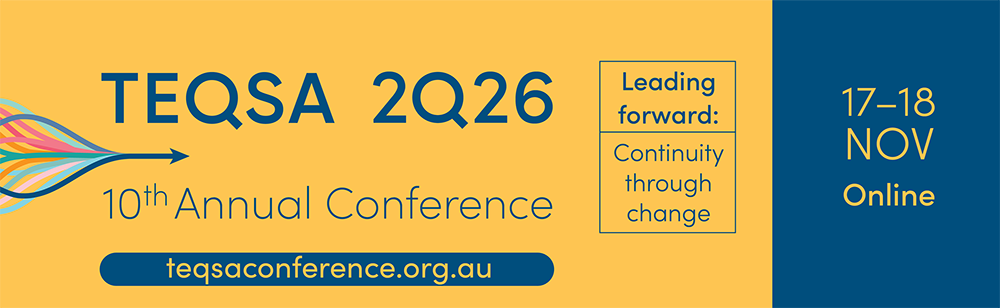
    Leading forward: Continuity through change

    Decorative only

    Our 2026 conference will be delivered as a fully virtual event on 17 and 18 November from 10:00am to 3:30pm (AEDT). 

    Registrations and further details are available through the conference website: www.teqsaconference.org.au.

    Previous TEQSA Conferences

    TEQSA 2025: Trust, Transparency, Transformation

    18-19 November 2025, Sofitel Melbourne on Collins and online

    TEQSA 2024: Navigating tomorrow – anticipating challenges, embracing change

    12-13 November 2024, Sofitel Melbourne on Collins and online

    TEQSA 2023: Reshaping higher education

    22–23 November 2023, Melbourne Convention and Exhibition Centre and online

    TEQSA 2022: Fit for the Future – Leadership, Quality, Integrity

    23–24 November 2022, Sofitel Melbourne on Collins and online

    TEQSA 2021: Hard Lessons, Valuable Learnings, Heightened Expectations

    25 November 2021, Virtual

    TEQSA 2019: Partnerships Driving Quality

    27-29 November 2019, Sofitel Melbourne on Collins

    TEQSA 2018: Innovation, Excellent, Diversity

    28-30 November 2018, Grand Hyatt, Melbourne

    TEQSA 2017: Students, Quality, Success

    29 November – 1 December 2017, Grand Hyatt Melbourne

    TEQSA 2016: Sharing Excellence: Assuring Quality

    9 November 2016, Park Royal Hotel, Melbourne Tullamarine Airport 

    Our inaugural conference, held in collaboration with Higher Ed Services (HES), attracted huge support from the sector with 420 people from 95 institutions attending.

    Last updated:

    Related links