• Annual report

    The annual report outlines our activities and performance during each financial year. The TEQSA Act requires that the report is presented to Parliament.

    2025-26

    TEQSA’s Annual Report for 2025-26 was tabled in Parliament on Wednesday 21 October 2026.

    Previous annual reports

    2024-25

    TEQSA’s Annual Report for 2024-25 was tabled in Parliament on Friday 3 October 2025.

    2023-24

    TEQSA’s Annual Report for 2023-24 was tabled in Parliament on Thursday 10 October 2024.

    2022-23

    TEQSA’s Annual Report for 2022-23 was tabled in Parliament on Friday 20 October 2023.

    2021-22

    TEQSA’s Annual Report for 2021-22 was tabled in Parliament on Tuesday 25 October 2022.

    2020-21

    TEQSA’s Annual Report for 2020-21 was tabled in Parliament on Tuesday 19 October 2021.

    2019-20

    TEQSA’s Annual Report for 2019-20 was tabled in Parliament on Tuesday 6 October 2020.

    2018-19

    TEQSA's Annual Report for 2018-19 was tabled in Parliament on Monday 21 October 2019.

    2017-18

    TEQSA's Annual Report for 2017-18 was tabled in Parliament on Monday 15 October 2018.

    2016-17

    TEQSA's Annual Report for 2016-17 was tabled in Parliament on Tuesday 31 October 2017.

    2015-16

    TEQSA's Annual Report for 2015-16 was tabled in Parliament on 26 October 2016.

    2014-15

    TEQSA's Annual Report for 2014-15 was tabled in Parliament on 21 October 2015.

    2013-14 

    TEQSA's Annual Report for 2013-14 was tabled in Parliament on 23 October 2014.

    2012-13 

    TEQSA's Annual Report for 2012-13.

    2011-12 

    TEQSA's Annual Report for 2011-12.

    Last updated:
  • Annual child safety statement of compliance

    All children and young people have the right to be safe from sexual abuse. We all have a role to play in creating safe environments for children and young people and preventing abuse. 

    In response to the Royal Commission into Institutional Responses to Child Sexual Abuse, the Australian Government implemented the Commonwealth Child Safe Framework (the Framework) to ensure minimum standards for child safe behaviours and practices are in place at Commonwealth entities.

    The Tertiary Education Quality Standards Agency (TEQSA) is Australia’s independent national quality assurance and regulatory agency for higher education. Our purpose is to safeguard student interests and the reputation of Australia’s higher education sector by assuring the quality of higher education providers through a proportionate, risk-reflective approach to regulation.

    Although TEQSA’s business activities do not directly involve interaction with children, our agency remains proactive in identifying and mitigating any potential risks associated with its operations, roles or business interactions. We are committed to fostering a culture of awareness, accountability, and continuous improvement in child safety. TEQSA does not fund third-party providers to deliver services to children.

    TEQSA is compliant with the Framework’s four key requirements. The agency maintains a position of zero tolerance for child abuse, neglect, and exploitation. TEQSA evaluates risks to child safety in relation to its activities and operations and monitors the effectiveness of strategies implemented in managing identified risks.

    In 2026, TEQSA conducted its annual child safety risk assessment. The assessment found no material changes to the agency’s overall risk profile compared to 2025. However, the assessment identified further opportunities to strengthen existing controls and processes, including implementing a more robust Child Safety Risk Register and making more child safety information available internally. The overall risk rating is low, and controls remain effective and proportionate to the nature of TEQSA’s activities.

    TEQSA has reviewed and updated its Child Safety Policy and will continue to regularly review the policy to ensure the agency remains aligned with current best practice child safety measures. TEQSA incorporates the National Principles for Child Safe Organisations into its culture and practices where these apply.

    TEQSA continues to embed the Framework and National Principles into its culture and practices by:

    • incorporating the Framework into its mandatory annual training performance development processes
    • building staff capability through online training modules
    • reviewing roles during recruitment activities to determine whether they involve potential interactions with children and, if so, classifying them as child safe positions
    • maintaining a comprehensive register of child-safe positions and Working with Children Checks (WWCC).

    TEQSA will continue to monitor its risk environment, strengthen its child safety governance, and promote a culture of shared responsibility to ensure the highest standards are upheld across all areas of the agency’s work.

    Last updated:
  • Acts and standards

    The following acts and standards govern Australian higher education.

    Tertiary Education Quality and Standards Act 2011

    The TEQSA Act established us as Australia’s national quality assurance and regulatory agency for higher education. It applies for regulation of higher education through a standards-based quality framework with principles relating to regulatory necessity, risk and proportionality.

    Higher Education Standards Framework (Threshold Standards) 2021 (HES Framework)

    The Threshold Standards apply to all higher education providers. Set by the Minister for Education on the advice of the Australian Tertiary Education Commission, they are the minimum level of achievement that a provider must meet and maintain to be registered to deliver higher education courses of study.

    The Threshold Standards were amended in July 2026 to incorporate new requirements relating to racism and governance. These new requirements will apply to higher education providers at different times (either from 1 January 2027 or 1 July 2027), depending on the provider type.

    Education Services for Overseas Students Act 2000 (ESOS Act)

    The ESOS Act applies to providers offering courses to students in Australia on student visas. These include higher education courses, Foundation Programs (except those delivered by schools), and ELICOS programs delivered by higher education providers.

    National Code of Practice for Providers of Education and Training to Overseas Students 2018 (National Code 2018)

    The National Code 2018 is a set of nationally consistent standards that protect international students. The National Code governs courses registered on the Commonwealth Register of Institutions and Courses for Overseas Students (CRICOS). Only CRICOS courses can be offered to international students studying in Australia on a student visa.

    Australian Qualifications Framework (AQF)

    The AQF is the national policy for regulated qualifications in Australian education and training. It is delivered through the Australian Government Department of Education in consultation with the states and territories.

    Last updated:
  • Annual Report 2025-26 is available

    TEQSA’s Annual Report 2025-26 is now available.

    The report outlines our progress throughout the 2025-26 year to assure the quality of Australian higher education.  

    It provides insight into TEQSA’s performance throughout the 2025-26 financial year, including our regulatory activities, strategic achievements and challenges.  

    The 2025-26 year saw continuing evolution in the Australian higher education sector's policy and regulatory landscape. TEQSA continued to work collaboratively across the sector and the Australian Government and, in addition to our critical registration, accreditation and compliance activities, made valuable contributions in the areas of:

    • Social cohesion and assuring the safety, inclusion and wellbeing of students and staff, including supporting whole-of-government efforts to uplift expectations for student complaints and grievance handling, empower student voices and address emerging risks.
    • Governance including by representation on the Expert Council on University Governance and establishing annual reporting requirements for Australian universities under the Statement of Regulatory Expectations: Compliance with workplace obligations.
    • Regulatory reform to deliver a risk-based, proportionate approach while focusing on improving transparency, consistency and TEQSA’s service.

    TEQSA’s Annual Report 2025-26 is available on our website and the Australian Government’s Transparency Portal.   
     

    Date
    Last updated:
    Featured image
    Students at table outside
  • Key considerations for prospective providers preparing a self-assurance report (initial registration)

    The self-assurance report is an opportunity for you to articulate and evidence the effectiveness of your systems of self-assurance as they relate to your operational context and the course accreditation application, thereby demonstrating how you have assured yourself of compliance with the requirements of the Higher Education Standards Framework (Threshold Standards) 2021 (Threshold Standards).

    In preparing your self-assurance report, TEQSA highly recommends demonstrating how your institute manages key sector risks in the following areas:

    Corporate governance TEQSA expects proposed providers will review its guidance on corporate governance.
    Academic governance

    TEQSA expects proposed providers will review its guidance on academic governance and engage with the higher education good practice hub. 
     

    Academic governance should consider threats to academic integrity including from contract cheating.

    Financial viability and sustainability

    TEQSA expects proposed providers review the guidance on financial assessment. 
     

    Where applicable, TEQSA expects that prospective providers have considered the National Planning Level for new overseas student commencements and relevant Ministerial Directions. This includes, but is not limited to, the assumptions relied upon described in relevant business plans, strategic plans, student enrolment targets and financial planning and forecasting. Please refer to the managed system for international education published by the Department of Education.

    Institutional quality assurance

    TEQSA expects proposed providers review its guidance on:

    Student wellbeing and safety

    TEQSA expects proposed providers will review its guidance on:

    Cyber security and foreign interference TEQSA expects proposed providers review the Australian Signals Directorate’s Strategies to mitigate cyber security incidents and TEQSA’s Compliance in focus: Cyber security.
    Course accreditation  Refer to the key considerations for providers preparing a self-assurance report for course accreditation.
    Statements of Regulatory Expectations TEQSA expects proposed providers review any current Statements of Regulatory Expectations.

    In preparing your self-assurance report you are also expected to self-identify and address any significant risks or opportunities for improvement specific to your individual circumstances. These may include, but not be limited to risks associated with:

    • emerging challenges across the higher education sector and within your operational context
    • issues identified by other government and regulatory bodies (ASQA, the Department of Home Affairs, etc), or professional accreditation bodies.

    Further information

    For further information when preparing your application for registration, please contact TEQSA’s Initial Registration team at new.registration.enquiries@teqsa.gov.au.

    Last updated:
  • Supporting partnerships with our Southeast Asian counterparts

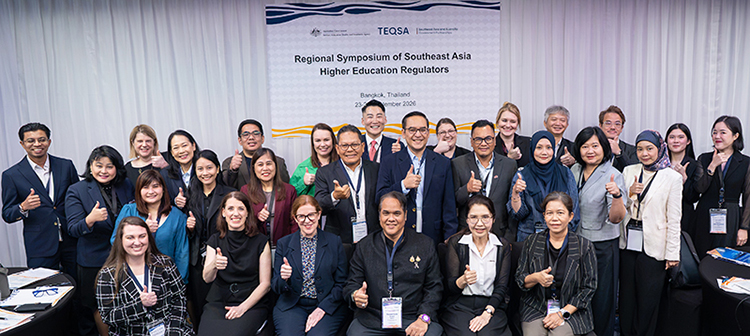
    Photo showing participants at SEAG2G

    In September, TEQSA representatives travelled to Thailand to participate in bilateral discussions with our Thai counterparts and lead a multilateral symposium on higher education quality.

    The exchange offered an opportunity to share information and exchange learnings with our Southeast Asian counterparts, including colleagues in the Thai Ministry of Higher Education, Research, Science and Innovation and the Council of University Presidents of Thailand.

    The multilateral and bilateral event was supported by the Australian Government’s Southeast Asia and Australia Government Partnerships program (SEAG2G). SEAG2G seeks to develop deeper institutional partnerships between Australia and Southeast Asia. It aims to increase awareness and understanding of the common opportunities and challenges faced by Australia and our Southeast Asian neighbours and share institutional knowledge and expertise.  

    The event was a valuable opportunity to exchange regulatory experience with regional partners, while also supporting our engagement with, and support for, Australian higher education providers who are delivering transnational education into the region.  

    In March, TEQSA representatives visited the Philippines, to share information and exchange learnings with colleagues from the Philippines’ Commission of Higher Education, also as part of the SEAG2G program.

    During the recent visit to Thailand, TEQSA shared knowledge on topics including governance, self-assurance, risk-based regulation and quality assurance, while always placing the student experience at the centre of our discussions.

    TEQSA thanks the Department of Foreign Affairs and Trade for sponsoring the SEAG2G initiative, and our Thai Ministry of Higher Education, Research, Science and Innovation and the Council of University Presidents of Thailand colleagues for hosting the event and welcoming us with warm hospitality.

    More information

    Southeast Asia and Australia Government to Government Partnerships Program

    Date
    Last updated:
    Featured image
    SEAG2G
  • Indicative timeframes for registration as a higher education provider (TEQSA and ESOS)

    Guidance for prospective providers

    When preparing an application for registration as a higher education provider, prospective providers must submit operational plans and projections to allow TEQSA to assess the financial viability and sustainability of the applicant. In preparing these plans and projections, prospective providers should consider the timeframes for registration by TEQSA. In addition, if a provider is considering delivery to overseas students, these projections should also consider the time to be registered on the Commonwealth Register of Institutions and Courses for Overseas Students (CRICOS), the time to recruit overseas students, and sufficient time for those students to obtain visas and to make travel and accommodation arrangements, prior to the commencement of delivery.

    Key steps

    1. Initial engagement with TEQSA and preparation of applications

    At least 6 months before submitting an application, and after reviewing the relevant guidance materials, prospective providers should contact TEQSA (new.registration.enquiries@TEQSA.gov.au) to advise of an intention to apply for registration. If intending to deliver to overseas students, prospective providers are also encouraged to contact TEQSA’s CRICOS team (cricos@teqsa.gov.au) for guidance.

    2. Preliminary assessment of application for initial registration

    Once an application is received, TEQSA must complete a preliminary assessment and notify you of the outcome within 30 days. During this assessment, TEQSA will check if you have provided all of the required evidence, including whether the application for registration in a particular provider category is appropriate, and whether an application is required for a course of study to be accredited, as per Section 19(1) of the TEQSA Act. Please note, if an application is not in the approved form, does not include all information, documents and assistance requested by TEQSA, or is not accompanied by the application fee, it will not progress to a substantive assessment.

    3. Substantive assessment of application for initial registration

    If TEQSA’s preliminary assessment finds that an application is appropriate (valid), the applicant may continue with its application by providing any further information requested by TEQSA and by paying the application fee. Once these have been received, the substantive assessment of an application commences.

    TEQSA must make a decision on the application within 9 months of the commencement of the substantive assessment. However, if, for reasons beyond TEQSA’s control, a decision cannot be made within 9 months, a longer period not exceeding a further 9 months may be applied, as per Section 21(2-3) of the TEQSA Act.

    4. Notification and publication of decision

    Once a decision has been made, TEQSA must advise the applicant within 30 days of that decision and, if TEQSA rejects the application, the reasons for the decision.

    5. Preparation of application for ESOS registration

    On average, providers submit their application for ESOS registration 3 months following notification of their initial registration as a higher education provider. TEQSA encourages providers to consider the requirements of the Education Services for Overseas Students Act 2000 (ESOS Act) and National Code of Practice for Providers of Education and Training to Overseas Students 2018 (National Code) in the development of all policies and procedures if intending to deliver to overseas students.

    Further information to assist providers preparing an application for ESOS registration can be found on TEQSA’s How to apply for ESOS registration page.

    6. Assessment of application for ESOS registration

    Once an application for ESOS registration is received, TEQSA will assess whether the requirements of the ESOS Act and National Code have been met. If the application is of a high-quality, and the applicant responds promptly to TEQSA’s requests, a decision is usually made within 3 to 6 months. Where the application does not include all of the required evidence, or where there are delays in responding to TEQSA’s requests, the assessment process will take longer.

    7. CRICOS provider code issued by Department of Education

    Once ESOS registration is granted, it can take a further 2 to 4 weeks for a CRICOS provider code to be issued and the newly registered provider listed on the CRICOS register.

    8. Commence recruitment of overseas students

    Providers cannot advertise courses to overseas students or begin recruiting overseas students until registered on CRICOS and issued with a CRICOS provider code by the Department of Education. Generally, providers will need to commence recruitment activities at least 3 months prior to engaging the last students for a study period or 5 months prior to the commencement of delivery, noting the need for offshore intending students to obtain a student visa.

    9. Offshore overseas students apply for student visa

    Currently, the Department of Home Affairs advises students outside of Australia to apply for their visa at least 8 weeks before their course starts. Further information can be found on the Department of Home Affairs’ Subclass 500 student visa page.

    10. Delivery commences

    In total, prospective providers should plan for delivery to commence at least 35 months after first engaging with TEQSA, or 29 months after submitting an application for initial registration. Please note that these are indicative timeframes and are largely conditional on a high-quality applications and minimal delays in the preparation and submission of responses to TEQSA’s requests.

    Timeframe

    Description

    6 months

    Initial engagement with TEQSA and preparation of application

    30 days

    Preliminary assessment of application for initial registration

    9 months

    Substantive assessment of application for initial registration

    30 days

    Notification and publication of decision

    3 months

    Average time to apply for ESOS registration

    3-6 months

    Assessment of application for ESOS registration

    2-4 weeks

    CRICOS provider code issued by Department of Education

    3 months

    Provider commences recruitment of overseas students

    8 weeks

    Offshore students apply for visa

    Approximately 35 months from first engagement with TEQSA

    Delivery commences

    Last updated:
  • How to apply – ESOS registration renewal

    Under the Education Services for Overseas Students Act 2000 (ESOS Act), TEQSA is the ESOS agency for:

    • all higher education providers registered under the Tertiary Education Quality and Standards Agency Act 2011 (TEQSA Act)
    • English Language Intensive Course for Overseas Students (ELICOS) courses delivered by, or in entry arrangements with, registered higher education providers
    • all providers of Foundation Programs.

    Institutions must be registered on the Commonwealth Register of Institutions and Courses for Overseas Students (CRICOS) to enrol and deliver education services to students who are in Australia on a student visa.

    TEQSA registers providers on CRICOS for a specific period, up to a maximum of 7 years. Registration periods are recorded in PRISMS under the ‘Summary’ tab.

    Applications for ESOS registration renewal can be made using the form in TEQSA’s provider portal.

    Providers must make a CRICOS renewal of registration application at least 90 days before their current registration period lapses.

    Application timeframes for CRICOS renewal are specified by TEQSA through a legislative instrument, as per section 10D of the ESOS Act. Providers can request a shorter application period by emailing the ESOS team.

    Providers with ELICOS or Foundation Programs, or an exemption to enrol students under the age of 17 in Foundation Programs, will need to apply for renewal of these course accreditations and exemptions as part of their ESOS registration renewal. The application guide for ESOS registration renewal provides more information.

    Once a renewal application is submitted ESOS registration remains active, with no restrictions in place, until TEQSA makes a decision.

    Processing times

    To support TEQSA in assessing applications as promptly as possible, we encourage providers to check they have included all required information to make a decision.

    While TEQSA endeavours to complete assessments as efficiently as possible, assessment times can vary considerably. Factors which impact assessment times include:

    • application quality and completeness
    • risks identified by TEQSA and complexity of the assessment
    • the volume of applications TEQSA is assessing.

    As part of the assessment, TEQSA may request additional or revised evidence, if the application is incomplete or if instances of or risks of non-compliance are identified. If this occurs, TEQSA will let the applicant know what is missing and when it needs to be submitted.

    Key stages

    Applications for ESOS registration renewal have 3 key stages:

    • Stage 1: The provider prepares an ESOS registration renewal application
    • Stage 2: TEQSA assesses the application
    • Stage 3: TEQSA decides on the application

    Application guidance

    Before starting an application, TEQSA encourages providers to read the application guide for ESOS registration renewal. This guide supports providers by:

    • explaining the process
    • outlining what evidence and documents are required
    • providing guidance on preparation.

    Further information

    For more information, or assistance with your application, please email the ESOS team.  
     

    Last updated:
  • How to apply – ESOS registration

    To deliver higher education courses to overseas students, you first need to apply to TEQSA to be registered on the Commonwealth Register of Institutions and Courses for Overseas Students (CRICOS).

    Applications for ESOS registration usually take 3 to 6 months for TEQSA to assess. This timeframe is dependent on a high-quality application with minimal delays in responding to TEQSA’s requests. Information on the entire registration process and timeframes can be found here. Once ESOS registration is granted, it can take a further 2 to 4 weeks for a CRICOS provider code to be issued and the newly registered provider listed on the CRICOS register. Providers are unable to advertise courses to overseas students or begin recruiting overseas students until ESOS registration is granted and a CRICOS provider code has been issued by the Department of Education.

    Key steps

    1. Be registered as a higher education provider under the TEQSA Act

    Before applying for ESOS registration with TEQSA you must first be registered as a higher education provider under the TEQSA Act. TEQSA will not accept applications for ESOS registration unless your institute has been registered as a higher education provider, except for providers seeking only to deliver English Language Intensive Course for Overseas Students (ELICOS) courses or Foundation Programs.

    2. Prepare your application

    Once registered as a higher education provider by TEQSA, you may begin to prepare your application for ESOS registration. Please lodge your intention to apply for ESOS registration by contacting the CRICOS team at cricos@teqsa.gov.au.

    TEQSA highly recommends that you closely review the requirements of the Education Services for Overseas Students Act 2000 (ESOS Act) and National Code of Practice for Providers of Education and Training to Overseas Students 2018 (National Code) to understand your obligations. Your application should demonstrate how you meet, or will meet, each of these obligations. The evidence requirements for applications for ESOS Registration can be found in TEQSA’s Confirmed Evidence Table (CET).

    3. Submit your application

    Once all evidence has been prepared, you can submit your application through TEQSA's provider portal. TEQSA will initially determine whether the application is complete and includes all required evidence. If not, TEQSA will notify you of what evidence is missing and provide an opportunity to submit this evidence to complete the application.

    4. TEQSA assesses the application

    Once your application includes all required evidence, TEQSA will begin its assessment. TEQSA assesses the evidence to determine whether the provider will comply with all requirements of the ESOS Act, the National Code, and any other relevant legislation within the ESOS Framework.

    If TEQSA identifies any areas where the application is not compliant with these legislative requirements, or at risk of non-compliance, TEQSA will outline its findings in a proposed decision. You will be afforded an opportunity to respond to these concerns and submit additional or revised evidence to demonstrate compliance, usually within 28 days.

    5. TEQSA’s decision

    TEQSA may approve or reject your application. In doing so, TEQSA will notify you of its decision and the reasons for the decision in writing.

    If TEQSA approves the application, it may decide to approve a period of registration less than the maximum 7 years. TEQSA may also decide to impose conditions on your registration to manage any risks that have not been fully addressed in the application.

    If TEQSA decides to reject the application, or if you are dissatisfied with TEQSA’s decision, you may seek a review of that decision. Information on your options for review are outlined on our Review of TEQSA Decisions page.

    Further information

    For more information or assistance applying for ESOS registration, please contact the ESOS team at esos@teqsa.gov.au. 
     

    Last updated:

    Related links