

Authors: Professor Ruth Greenaway, Dr Zachery Quince, Southern Cross University
Focus area: Governance
Southern Cross University (SCU) took a first principles approach to policy development, supporting a strategic goal of ubiquitous gen AI use and positioning gen AI as an educational tool. An initial, binary model, where academics either permitted or prohibited gen AI use, overlooked disciplinary needs, causing confusion for staff and students, and limiting meaningful engagement.
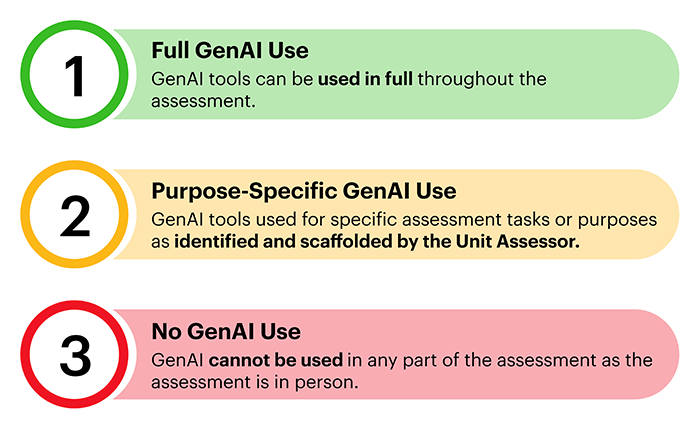
Seeking greater inclusivity and flexibility, SCU transitioned to a five-tier gen AI model, informed by the AI Assessment Scale and supporting the assessment principles of the Southern Cross Model. It mapped a continuum from prohibiting use to open collaboration, specifying permissible uses. The model, though pedagogically robust, proved complex in practice, presenting challenges to staff adoption and consistent implementation. In 2025, SCU introduced the Gen AI Tool Use Descriptors, a pragmatic three-level model of assessment security levels. Assessments now explicitly indicate their gen AI stance at Level 1, 2 or 3.
This approach is designed to normalise gen AI as part of academic practice while promoting accountability and meeting the learning and teaching objectives. It is embedded in formal assessment protocols, with specific gen AI guidelines available for each task, evidentiary requirements and a compulsory student declaration, fostering openness and ethical engagement.
Implementation of the Gen AI Tool Use Descriptors is underpinned by the Gen AI Descriptor Use Staff Guidelines, which provide assessment specific scaffolding, best practice examples and clear, structured support tailored to different assessment types, enabling academics to confidently integrate gen AI tools into their teaching and evaluation processes.
Grounded in robust research on ethical considerations and student learning behaviours, the guidelines help staff define task expectations, document gen AI use and navigate the complexities of balancing gen AI’s benefits and risks. These measures strengthen academic integrity by promoting ethical engagement with gen AI and fostering a culture of transparency, consistency and accountability.
Key lessons or points for implementation
- Establish a structured approach introducing models of gen AI use with clear guidelines for staff and students.
- Adopt proactive educative strategies that provide comprehensive resources, and examples to support both staff and students, to ensure confidence and clarity in implementation.
- Encourage a culture of ongoing adaptation in response to gen AI advancements and evolving industry practices.
References
- Perkins, M., Furze, L., Roe, J., & MacVaugh, J. (2024). The Artificial Intelligence Assessment Scale (AIAS): A framework for ethical integration of generative AI in educational assessment. Journal of University Teaching and Learning Practice, 21(06)
- Quince, Z., & Nikolic, S. (2025). Student identification of the social, economic and environmental implications of using Generative Artificial Intelligence (GenAI): Identifying student ethical awareness of ChatGPT from a scaffolded multi-stage assessment. European Journal of Engineering Education. Advance online publication.
 Academic integrity toolkit