

Authors: Dr Amy Milka and Amanda Janssen, Adelaide University
Focus area: Developing and benchmarking policies and procedures
The merger of the University of Adelaide and University of South Australia presented a unique opportunity to shape academic integrity policy and procedure for a new institution. In approaching this task, we leveraged the mature policies of both institutions and benchmarked emerging approaches from other leaders in this space.
The resulting Adelaide University policy and procedure1 adopted some tried and tested approaches of the foundation universities, including different levels of committees, decision-making and resourcing for issues of different severity, and more recent innovations such as an ‘early resolution’ which offers a quicker, educative resolution in certain cases. Looking across the sector, we found that leaders in academic integrity were moving towards publishing matrices and clear rubrics for misconduct outcomes to ensure transparency and consistency.2
Student and stakeholder consultation and feedback identified key features of the policies and procedures which were important to learners. These included:
- clear and informative definitions of different types of misconduct
- transparency about possible outcomes
- efficient processes and timelines to allow student input and minimise impacts on academic progress and student wellbeing.
Students were involved in co-creating and providing feedback on communications about the policy and procedure, including the letters sent during misconduct investigations.
A unique challenge for our merged institution is the communication of changes to the policy and procedure to transitioning staff and student cohorts, who have awareness of historic policies and approaches. We have carefully considered this challenge in developing our academic integrity messaging.
Clear and timely communication on policy changes is crucial to ensuring a shared culture of integrity as well as minimising misconduct issues based on lack of awareness or understanding.
Building awareness of policies, practices and expectations is a cornerstone of academic integrity work at any institution to ensure a shared understanding among students and staff with different educational and institutional backgrounds, and different approaches to integrity. Successful policy implementation requires co-creation, visibility and clarity in the institutional message.
Key lessons or points for implementation
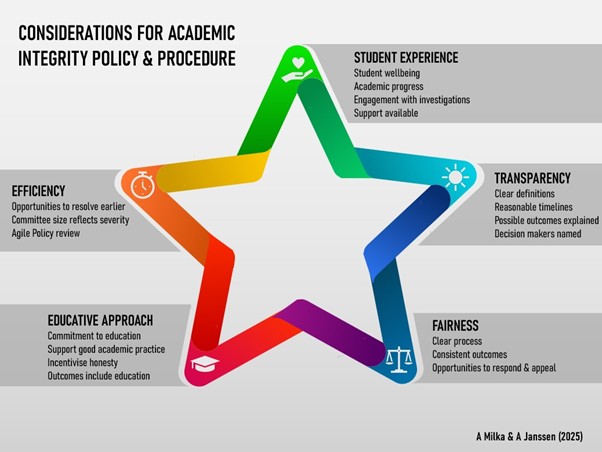
- Policies and procedures need to balance a range of competing considerations, namely transparency, fairness, efficiency, student experience and an educative approach (see image below).
- Policies and procedures need to balance strategic goals with operational effectiveness, and consider issues such as workloads, systems and processes in procedural design.
- An agile academic integrity policy and procedure requires a regular schedule for review.
Notes
- Academic integrity policy
- For example, Deakin University and the University of Southern Queensland.
 Academic integrity toolkit