This glossary explains some of the terms that may be encountered when dealing with TEQSA and is presented in alphabetical order.
A
Academic governance
A subset of the overall governance of a higher education provider. Academic governance deals with the framework that regulates providers’ academic decisions and quality assurance. Academic governance includes the policies, processes, definitions of roles, relationships, systems, strategies and resources that ensure academic standards and continuous improvement in academic activities. It is concerned with the integrity and quality of the core higher education activities of teaching, research and scholarship.
Academic standards
An agreed specification (such as a defined benchmark or indicator) that is used as a definition of a level of performance or achievement, rule or guideline. Standards may apply to academic outcomes, such as student or graduate achievement of core discipline knowledge and core discipline skills (known as learning outcomes), or to academic processes such as student selection, teaching, research supervision, and assessment.
Academic staff
A member of staff of a higher education provider who is appointed wholly or principally to undertake a teaching and/or research function. For definition of ‘member of staff’ refer to the Department of Education's Tertiary Collection of Student Information (TCSI) glossary.
Articulation arrangements
Create a defined pathway that enables a student to progress from a completed course of study to another course of study with admission and/or credit.
Assessment
A process to determine a student’s achievement of identified learning outcomes and may include a range of written and oral methods and practice or demonstration.
Attrition
See Student attrition rates below.
Australian Higher Education Graduation Statement
A supplementary statement to a testamur and record of results that provides additional information to enhance understanding of the qualification by students, employers, industry and professional associations both locally and internationally.
Australian Skills Quality Authority (ASQA)
The national regulator for Australia’s vocational education and training sector. ASQA regulates courses and training providers to ensure nationally approved quality standards are met.
For more information visit ASQA’s website.
Australian Qualifications Framework (AQF)
Australia‘s national policy for regulated qualifications. The AQF encompasses higher education, vocational education and training and school education. It provides for national recognition and a consistent understanding of what defines each qualification type.
The Qualification Standards enshrined in the TEQSA Act strongly reflect the AQF which requires awards issued to be quality assured, protected against fraudulent use and to serve as pathways for further learning. The Qualification Standards incorporate by reference the following AQF policy documents:
- AQF Levels Criteria and AQF Qualification Type Descriptors
- AQF Qualifications issuance Policy
- AQF Qualifications Pathways Policy
- AQF Qualifications Register Policy
- AQF Qualification Type Addition and Removal Policy.
More information on the AQF is available on from the AQF website, or our Australian Qualifications Framework page.
Australian Universities Quality Agency (AUQA)
Prior to the establishment of TEQSA, AUQA was the principal national quality assurance agency in higher education with the responsibility of providing public assurance of the quality of Australia’s universities and other institutions of higher education. AUQA also assisted in enhancing the academic quality of these institutions.
B
Benchmarking
A means by which an entity can:
- demonstrate accountability to stakeholders
- improve networking and collaborative relationships
- generate management information
- develop an increased understanding of practice, process or performance
- garner insights into how improvements might be made.
For example, in the context of course accreditation, benchmarking involves comparing performance outcomes and/or processes of similar courses of study delivered by other providers. ‘Internal benchmarking’ against other relevant courses offered by the provider may also be undertaken.
C
Campus
The physical location from where a course of study is being delivered. This location may or may not be owned by the higher education provider which enrols the student. For e-learning (online) or other distance education courses this would be the location at where the electronic course material is maintained.
Casual staff
Staff who are engaged and paid on an hourly or sessional basis, and who have no entitlement to paid annual, sick or long service leave.
Commencing student
See definition on the Department of Education's TCSI glossary.
Course completion
The successful completion of all the academic requirements of a course of study. This includes any required attendance, assignments, examinations, assessments, dissertations, practical experience and work experience in industry. Where a combined course automatically leads to two separate awards, a course completion will only occur when the requirements of both awards have been satisfied.
Commonwealth Register of Institutions and Courses for Overseas Students (CRICOS)
A searchable database, run by the Australian Government, which lists all Australian education providers (and their courses) for people studying in Australia on student visas. The CRICOS database operates under the Education Services for Overseas Students (ESOS) legislative framework.
NOTE: TEQSA is responsible for assessing applications for inclusion on CRICOS.
Course with a major research component
A course of study where the student load is comprised of two-thirds or more research leading to a thesis/dissertation. Examples include:
- Bachelor Honours Degree
- Masters Degree (Research)
- Masters Degree (Extended)
- Doctoral Degree.
Credit arrangements
Formal negotiated agreements within and between issuing organisations or accrediting authorities regarding student entitlement to credit. They may also be formal arrangements made between issuing organisations and students. Credit can be given in the form of block, specified or unspecified credit (as provided by Qualification Standard 3.3).
Credit transfer
A process that provides students with agreed and consistent credit outcomes for completed components of a course of study based on identified equivalence in content and learning outcomes between matched courses of study.
D
Department of Education
The Australian Government department with responsibility for developing and administering higher education policy and programs and administering funding under the Higher Education Support Act 2003.
Dual awards
See Joint awards
E
Education Services for Overseas Students (ESOS)
The legal framework which governs the delivery of education to overseas students studying in Australia on a student visa. The framework sets out clear roles and responsibilities for providers of education and training to international students and complements Australia’s student visa laws. For more information visit the Department of Education’s website.
eLearning
Use of any digital technology or resources to deliver and support specific teaching and learning aims/outcomes. Also referred to as ‘online learning’ or 'technology enhanced learning'.
For more information see our Guidance Note: Technology-Enhanced Learning.
English Language Intensive Courses for Overseas Students (ELICOS)
Courses offered to students studying in Australia on student visas. ‘Intensive’ denotes full-time study load (20 scheduled course contact hours per week).
An information sheet about our regulation of ELICOS is available on our Application forms and guides page.
English language proficiency
The ability of students to use the English language to make and communicate meaning in spoken and written contexts while completing their course of study.
Enquiries Management team
First point of contact for registered providers with enquiries that sit outside current application assessments.
EFTSL
One Equivalent Full-Time Student Load. This is a measure of the study load, for a year, of a single student undertaking a course of study on a full time basis.
F
Field of education
The classification system (split in to three levels) used by higher education providers to classify courses of study, specialisations and units of study. Field of education groupings of courses and specialisations are on the basis of similarity of potential professions, rather than similarity of content, while units of study are coded on the basis of a likeness in terms of their subject matter.
For more information visit the Department of Education's TCSI website.
Field of study
See Field of education above.
Financial viability
Financial resources and financial management capacity to sustain higher education provision consistent with the requirements of the Provider Registration Standards outlined in the Higher Education Standards Framework (Threshold Standards) 2021.
FTE
Full-time equivalence, as defined on the Department of Education's TCSI glossary.
G
Governing body
The body with ultimate decision-making authority over the higher education provider and its operations.
Government Accreditation Authority (GAA)
State and territory government accrediting authorities who were previously responsible for accrediting higher education qualifications and authorising non-self-accrediting higher education providers.
NOTE: these functions are now conducted by TEQSA.
Grade distributions
Set by each higher education provider, they involve analysing the aggregation of final grades using data by subject, course of study, student cohort or other grouping. Grade distributions may be determined using norm-referencing methods, criterion-referencing methods, or a combination of both. Criterion-referencing requires a focus on identified learning outcomes and provides transparency for students.
Graduate attributes
Generic learning outcomes that refer to transferable, non-discipline specific skills that a graduate may achieve through learning that have application in study, work and life contexts.
H
Higher education award
- a diploma, advanced diploma, associate degree, bachelor degree, graduate certificate graduate diploma, masters degree or doctoral degree
- a qualification covered by level 5, 6, 7, 8, 9 or 10 of the Australian Qualifications Framework
- an award of a similar kind, or represented as being of a similar kind, to any of the above awards
- other than an award offered or conferred for the completion of a vocational education and training course.
Higher education provider (provider/HEP)
Defined in the TEQSA Act as:
- a constitutional corporation that offers or confers a regulated higher education award
- a corporation that:
- offers or confers a regulated higher education award
- is established by or under a law of the Commonwealth or a Territory
- a person who offers or confers a regulated higher education award for the completion of a course of study provided wholly or partly in a Territory.
Higher education services
Includes functions such as:
- delivery of teaching and learning services (including student assessment)
- student learning support (such as access to library materials, academic learning support, and English language support)
- personal student support services (such as career services, advocacy, counselling, accommodation services, health and welfare services)
- marketing, advertising and promotion of course(s) of study
- student recruitment
- maintenance of and/or access to electronic resources and/or websites to support higher education operations
- maintaining student records and data
- student admission services
- provision of teaching and learning or research facilities
- student complaint management; and research supervision.
Higher Education Standards Panel (HESP)
A legislative advisory body, established under the Tertiary Education Quality and Standards Agency Act 2011 (TEQSA Act), with responsibility related to the standards for delivery of higher education in Australia.
More information is available on the Department of Education’s HESP page.
Higher Education Support Act 2003 (HESA Act)
The HESA Act provides for the Commonwealth to give financial support for higher education and certain vocational education and training through:
- grants and other payments made largely to higher education providers
- financial assistance to students (usually in the form of loans).
Higher Education Standards Framework (Threshold Standards) 2021 (HES Framework)
Set by the Minister for Education and Training on the advice of a panel with expertise in the delivery of higher education, the HES Framework is the minimum level of achievement that a provider must meet and maintain to registered to deliver higher education courses of study.
More information is available on our Higher Education Standards Framework page.
J
Joint awards
Courses offered through collaborative or cooperative arrangements between two or more higher education providers. Find out more at our Guidance note: joint and dual awards.
K
Key personnel
Includes senior executive officers such as:
- the Principal/Chief Executive Officer
- Academic Director (or other senior executive officer with primary responsibility for academic operations)
- and others who will:
- make decisions about the governance, management or direction of the academic and corporate operations of a higher education provider
- exercise a notable degree of control or influence over the decision making about the governance, management or direction of the academic and corporate operations of a higher education provider.
L
Learning outcomes
The expression of the set of knowledge, skills and the application of the knowledge and skills a person has acquired and is able to demonstrate as a result of learning.
M
Material Change
Under section 29(1) of the Tertiary Education Quality and Standards Agency Act 2011, a registered higher education provider is required to notify TEQSA if any of the following events occur or are likely to occur:
- an event that will significantly affect the provider’s ability to meet the Threshold Standards
- an event that will require the National Register to be updated in respect to the provider.
Material changes to an accredited course of study or to the operations of a higher education provider may lead TEQSA to take regulatory action. Any action we take will be mindful of not discouraging change, innovation and continuous improvement.
Moderation of assessment
Quality assurance, control processes and activities such as peer review that aim to assure:
- consistency or comparability, appropriateness, and fairness of assessment judgments
- the validity and reliability of assessment tasks, criteria and standards.
Moderation of assessment processes establish comparability of standards of student performance across, for example, different markers, locations, subjects, providers and/or courses of study.
Mode of delivery
See Mode of study below.
Mode of study
The range of options for study available to students. Examples include:
- attendance face-to-face in a classroom
- supervised study on a higher education provider’s campus
- eLearning (online learning)
- distance or independent learning
- work-integrated learning
- fast track
- intensive delivery
- block release
- and mixed (or blended) delivery.
N
The National Code of Practice for Providers of Education and Training to Overseas Students 2018 (National Code 2018)
Provides nationally consistent standards for the conduct of registered providers and the registration of their courses. These standards set out specifications and procedures to ensure that registered providers of education and training courses can clearly understand and comply with their obligations.
For more information visit our National Code page.
National Protocols for Higher Education Approval Processes
Developed in 2000 and revised in 2007, these protocols were a key element of the national quality assurance framework for Australian higher education. The National Protocols were drafted as guidelines rather than standards and did not contain measures of performance. Aspects of the National Protocols were incorporated into the Higher Education Standards Framework (Threshold Standards) 2021.
National Register of Higher Education Providers (National Register)
The authoritative source of information on the status of registered higher education providers in Australia. The National Register was established and maintained under section 198 of the Tertiary Education Quality and Standards Agency Act 2011.
Nested courses
Course of study leading to higher education awards that include articulation arrangements from a lower level higher education award into a higher level higher education award. Nested courses also enable multiple entry and exit points.
Non-AQF award
A course leading to a qualification or an award not covered by the Australian Qualifications Framework (AQF). Registered higher education providers can apply to TEQSA for accreditation of a non-AQF course where the award or qualification is similar to a qualification covered by level 5, 6, 7, 8, 9 or 10 of the AQF (other than an award offered or conferred for the completion of a vocational education and training course).
In line with this, non-award short courses, for example, do not fall within our regulatory functions under the TEQSA Act as they would not be regarded as similar. Non-AQF qualifications or awards must not use AQF terminology.
P
Pathways
Allow students to move through Australian Qualifications Framework (AQF) qualification levels with full or partial recognition for the completed course of study and/or learning outcomes they already have.
Provider Category
Relates to a category of provider outlined in the Higher Education Standards Framework (Threshold Standards) 2021.
R
Recognition of prior learning
An assessment process that involves assessment of an individual’s relevant prior learning (including formal, informal and non-formal learning) to determine the credit outcomes of an individual’s application for credit.
Record of results
A record of all learning leading to an Australian Qualifications Framework (AQF) qualification or an accredited unit in which a student is enrolled. This may be called a
- transcript of results
- academic transcript
- record of achievement
- or statement of results.
Registered higher education provider
See Higher education provider above.
Registered Training Organisation
Means a training organisation that is listed as a Registered Training Organisation on the National Register referred to in section 216 of the National Vocational Education and Training Regulator Act 2011.
Regulated higher education award
Section 6 of the TEQSA Act: Meaning of regulated higher education award
- A regulated higher education award is:
- an Australian higher education award offered or conferred for the completion of an Australian course of study; or
- an overseas higher education award offered or conferred for the completion of an overseas course of study provided wholly or mainly from Australian premises related to the award.
- The course of study does not need to be provided by the person that offers or confers the award.
- Paragraph 1a does not apply to an Australian higher education award to the extent that it is offered or conferred by:
- a foreign corporation; or
- a person (other than an individual) established outside of Australia who conducts activities in a Territory; or
- an individual, who is not an Australian resident, who conducts activities in a Territory.
Regulatory risk
Actual or potential risk events (regarding providers’ operations and performance) which indicate that they may not meet the Higher Education Standards Framework (Threshold Standards) 2021 – either currently or in the future.
NOTE: this definition is in the context of our regulatory operations.
Relevant public material
Considering B1.1.3 of the Threshold Standards, TEQSA expects the diligent provider would consider ‘relevant public information’ to include its website and any written or online material it disseminates or makes publicly available for the purposes of:
- providing or offering to provide a course to a student
- inviting a student to undertake or apply for a course, or
- indicating the provider is able or willing to provide a course to students.
Risk Assessment Framework
Previously Regulatory Risk Framework describes our regulatory risk management policy and processes. It enables us to give effect to the principle of reflecting risk in our regulatory activities, as required under the Tertiary Education Quality and Standards Agency Act 2011.
For more information visit our Risk Assessment Framework page.
Reviewable decision
A decision covered by section 183 of the Tertiary Education Quality and Standards Agency Act 2011.
Risk assessment
The overall process of risk identification, risk analysis and risk evaluation.
S
Statement of Attainment
Recognition that one or more accredited subjects have been achieved.
Student attrition rates
The proportion of students commencing a course of study in a given year who neither complete nor return in the following year. It does not identify those students who defer their study or transfer to another institution. The ‘drop out’ rate from providers represents one dimension of the effectiveness of the delivery of educational services.
NOTE: The Risk Assessment Framework is a key reference explaining measures such as attrition rates. Appendices 1 and 2 provide detailed descriptions of key measures and elements used and their calculations.
Student cohort
All students commencing a course of study in a particular year with a higher education provider. Student cohorts may be classified by:
- entry pathway
- mode of study
- place of study
- other groupings.
Student contact hours
Time spent by students in timetabled teaching and learning activities, such as:
- face-to-face lectures
- tutorials
- supervised study
- field trips
- work-integrated learning activities
- clinical and other placements.
Student completion rates
The rate of completion for a cohort of students completing in minimum time. The Risk Assessment Framework does not currently measure completion rates due to limitations in trend data across the sector.
A guide for completion rates is provided below. Some approaches to completion rates allow for a longer period for completion beyond the minimum timeframe, for example taking into account no more than one consecutive year of deferment.
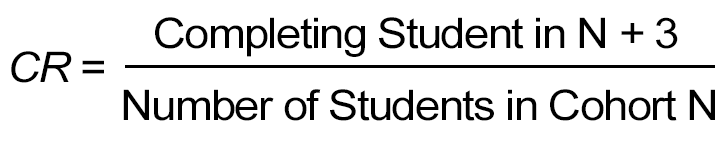
Completion rates are defined as the number of completions of students in a course as a proportion of the total number of students who commenced in a course in a given year. The rate may be defined as completing in minimum time or minimum time plus one year. For a three year bachelor degree for students undertaking the course full-time the calculation would be:
- number of completing students in year N+3 (2010)/Base students in Year N (2008)
- where based students are the number of students commencing a course in 2008
Student progress rates
A measure of educational achievement and the effectiveness of educational delivery. The student progress rate measures successful student subject load.
NOTE: The Risk Assessment Framework is a key reference explaining measures such as student progress rates. Appendices 1 and 2 provide detailed descriptions of key measures and elements used and their calculations.
Subject
A separate unit of study and a combination of subjects make up a course of study.
Support staff
A member of staff of a higher education provider without an academic staff classification who provides support functions for teaching and/ or research activities. Examples of support functions include:
- management
- academic learning support
- English language support
- student counselling
- librarian
- IT support
- laboratory assistance
- technical assistance
- general administrative functions
- student administration functions such as provision of student advice, student admissions, student enrolments and student graduations.
T
Testamur
An official certification document that confirms a qualification has been awarded to an individual. In Australia this may be called an award, parchment, laureate or certificate.
Third party, agent or partner arrangements
Where a higher education provider has, or intends to have, aspect of its course(s) of study carried out by a partner, agent or third party arrangement. These arrangements may include:
- partnerships with other institutions, higher education providers, or entities
- the formation of joint ventures or special purpose companies
- sub-contracting of services
- franchising arrangements.
For more information, view the Third party arrangements guidance note on our Guidance notes page.
Threshold Standards
Threshold Standards are defined as:
(a) the Provider Standards, which are:
- the Provider Registration Standards; and
- the Provider Category Standards; and
- the Provider Course Accreditation Standards;
and
(b) the Qualification Standards.
Further information on the Threshold Standards can be found at the Higher Education Standards Panel website.
U
Unit
See Subject above.
W
Work integrated learning
Where structured and purposefully designed learning and assessment activities integrate theory with the practice of work.
Work-integrated learning includes service learning, and activities normally involve students interacting with industry and community within a work context or similar situation. This may be simulated and generally allows students to learn, and apply/demonstrate skills and knowledge applicable to the course of study being undertaken (Adapted from ALTC, The WIL (Work Integrated Learning) Report, Patrick, et al, 2009).

 Provider enquiries help and support