
Diversity and inclusion strategy
TEQSA’s committed to fostering a diverse, respectful, psychologically safe and inclusive workplace. We also recognise the importance and value our people’s diverse backgrounds, perspectives and experiences bring to our regulatory work and to supporting positive outcomes for students, providers and stakeholders.
The Diversity and inclusion strategy 2026-29 identifies 3 key focus areas for the coming years: attraction and retention, culture and purposeful leadership.
Acknowledgement of Country
TEQSA acknowledges the Traditional Owners of Country throughout Australia and recognises their continuing connection to land, sea, culture and community. We pay our respects to their Elders past, present and emerging.
As Australia’s higher education regulator, we recognise that education did not begin with our institutions. We are committed to a system grounded in quality, integrity and equity, one that respects and values Aboriginal and Torres Strait Islander knowledge, perspectives and cultures. We acknowledge our responsibility to ensure higher education in Australia is inclusive, accountable and worthy of the communities it serves, now and into the future.
Message from the Chief Executive Officer
I am proud to introduce the Tertiary Education Quality and Standards Agency’s (TEQSA) first Diversity and Inclusion Strategy (2026–2029). This strategy reflects TEQSA’s commitment to fostering a diverse workforce and creating a positive, respectful, psychologically safe and inclusive workplace where everyone can contribute and feel valued.
This strategy is the result of a year-long, employee-led effort. Our People and Capability team, supported by the Diversity and Inclusion Working Group, have shaped TEQSA’s first coordinated approach to strengthening diversity and inclusion. Their collective insight and contribution reflect our core values and mark an important milestone in building a stronger sense of belonging across our agency.
A diverse and inclusive workforce helps us better understand and serve the higher education sector and the broader Australian community. By embracing the different backgrounds, experiences and perspectives of our people, we are better placed to deliver quality regulation and support positive outcomes for students, providers and stakeholders.
Strengthening diversity and inclusion at TEQSA requires ongoing and shared commitment. Through this strategy, we will focus our efforts on tangible and measurable actions over the coming years to further embed inclusion into our culture and everyday practice.
This is a journey we take together, and one that will help build an even more connected and inclusive TEQSA.
Dr Mary Russell
Chief Executive Officer
September 2026
Our vision is for a safe and inclusive workplace culture aligned to TEQSA’s values, where diversity is highly regarded and all employees are supported to contribute and grow.
Trust
We recognise individual differences and build trust through openness, fairness and psychological safety.
Respect
We listen with intent, value diverse perspectives, and respect differences in background, experience, beliefs and opinions.
Accountability
We lead by example, challenge exclusion and bias, and contribute to a culture where everyone is treated fairly.
Collaboration
We work collaboratively to achieve shared outcomes, valuing diverse perspectives to solve problems and strengthen TEQSA’s capability.
Strategic objective
TEQSA’s Diversity and Inclusion Strategy aims to strengthen an engaged, capable and inclusive workforce that reflects the diversity of the Australian higher education sector and the communities we serve. TEQSA is committed to a workplace where people are treated with respect and where diverse perspectives support effective regulation and informed decision‑making.
The strategy provides an integrated framework to embed diversity and inclusion across TEQSA’s culture, leadership and people practices, aligned with TEQSA’s values, purpose and regulatory responsibilities. While inclusive of all employees, the strategy recognises that some groups have experienced historical disadvantage and remain underrepresented.
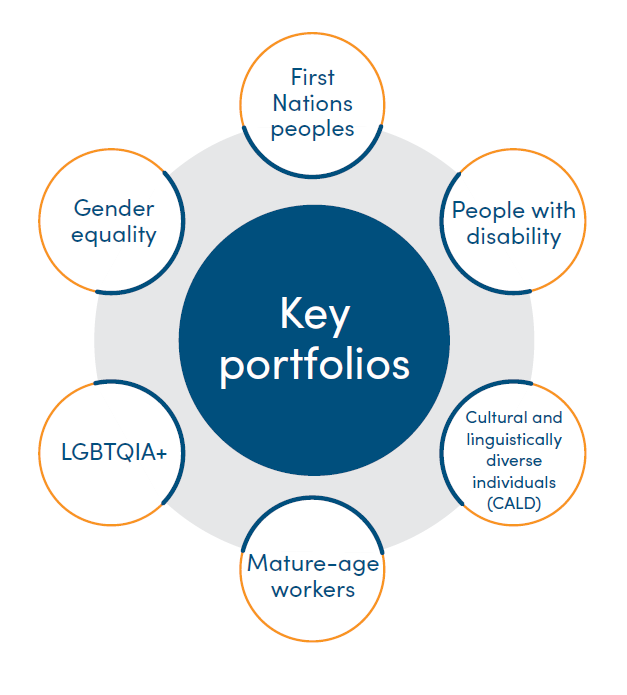
Accordingly, the strategy prioritises targeted action across 6 key diversity portfolios to reduce barriers, promote equity and support fair access to opportunities, fostering a workplace where all employees are supported to contribute, develop and thrive.
Strategic alignment
This strategy is underpinned by the Public Service Act 1999 requirement to foster workplace diversity, as reflected in the Australian Public Service (APS) Employment Principles and supported by the APS Values and Code of Conduct. It aligns with TEQSA’s corporate objectives and internal policies and frameworks.
The Australian Government is committed to building a workforce that reflects the diversity of the communities it serves. While representation across APS employees is improving, including among women, First Nations peoples, people with disability and culturally and linguistically diverse (CALD) groups, there remain opportunities to strengthen diversity, particularly in senior and specialised roles.
TEQSA supports this commitment by progressing gender equality; improving the experience of First Nations employees; supporting LGBTQIA+, CALD, mature‑age staff and people with disability; and ensuring a safe, equitable and respectful workplace free from discrimination, bullying and harassment.
This strategy is informed by key APS and Commonwealth frameworks, including:
- APS Culturally and Linguistically Diverse Employment Strategy and Action Plan
- APS Disability Employment Strategy
- APS Gender Equality Strategy
- Commonwealth Aboriginal and Torres Strait Islander Workforce Strategy
The strategy is anchored in TEQSA’s values of trust, respect, accountability and collaboration, and should be read alongside TEQSA’s internal policies, procedures, frameworks and guides.
Our diverse workforce
As at 1 January 2026, many TEQSA employees identified as a member of one or more of the listed diversity groups. More than 55% of employees were born overseas, reflecting the significant cultural diversity within our workforce. This breadth of backgrounds and experiences strengthens TEQSA’s capability as a national regulator and reinforces the importance of inclusive practices that support belonging and equitable participation for all employees.
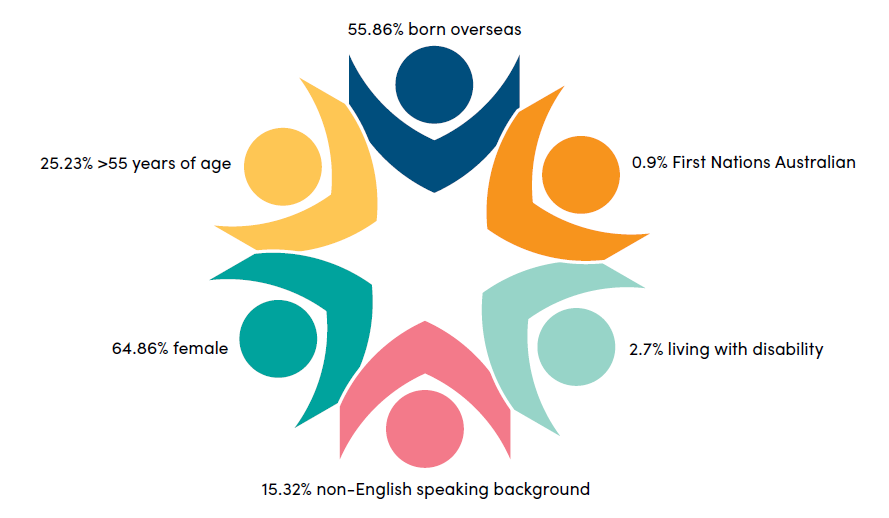
The above figures do not include employees who identify as LGBTQIA+, as this data is only collected anonymously in the APS Employee Census and cannot be attributed back to individual employees.
Our diversity and inclusion journey
TEQSA is on a journey to foster a diverse and inclusive workplace. Since 2022 we have achieved the following milestones:
2022
- Established a wellbeing room, prayer room and breastfeeding friendly space.
- Introduced voluntary gender pronouns in email signature blocks.
- Developed and implemented a Flexible Work Framework.
2023
- Embedded mandatory Diversity and Inclusion training.
- Began advertising roles nationally (where possible), making roles flexible by default.
- Developed and implemented TEQSA’s Culture Plan.
- Began capturing equity and diversity data in Aurion Employee Self-Service.
2024
- Established a Diversity and Inclusion working group.
- Incorporated gender-neutral language to the TEQSA Enterprise Agreement.
- First annual celebration of International Women’s Day.
- Commenced membership with the Diversity Council Australia.
2025
- Commenced review of people policies and procedures to ensure inclusive language and practice.
- Reviewed and updated ‘Candidate information packs’ to have inclusive language.
- Began collaborating with the Australian Skills Quality Authority (ASQA) on several diversity and inclusion initiatives.
- Worked with our Employee Assistance provider (EAP) provider to ensure all diversity dimensions are supported.
- Signed up to Translating and Interpreting Services (TIS) to help people with limited English proficiency communicate with TEQSA.
Definitions
TEQSA’s Diversity, Inclusion and Reconciliation Action Plan (RAP) working group and information from external sources has informed the following definitions.
Inclusion
In the workplace occurs when a diversity of people are welcomed, valued, respected and connected — enabling everyone to feel comfortable to share their unique perspectives, skills and experiences, and fully contribute to organisational success.
Diversity
Refers to differences, and the personal, professional and social characteristics that make us unique and shape views and perspectives, including but not limited to, our cultural backgrounds, socio-economic factors, life experiences, gender and gender identity, age, disability, neurodiversity, sexual orientation, relationship/family status, and caring responsibilities.
Equity
Means achieving fairness and equal access to opportunities by making adjustments to remove barriers to ensure everyone can fully participate — irrespective of their background or identity. Understanding equity means recognising that we don’t all start on an even playing field, due to pre-existing barriers and unconscious bias.
Intersectionality
Refers to the ways in which different aspects of a person’s identity can expose them to overlapping forms of discrimination and marginalisation. Aspects of a person’s identity include wide ranging social characteristics and can interact to create inequality and result in exclusion when combined with attitudes, systems and structures in society.
First Nations Peoples
Are the first peoples of Australia. There is great diversity within Aboriginal and Torres Strait Islander peoples, comprising of hundreds of groups of people who have their own distinct set of languages, histories and cultural traditions.
Inclusive language
Is language that is respectful and promotes the acceptance and value of all people. It is language which is free from words, phrases or tones that demean, insult, exclude, stereotype, infantilitse or trivilaise people based on their membership of a certain group or because of a particular attribute.
Culturally and linguistically diverse (CALD)
Is a broad concept with no single definition. CALD can refer to people who identify as having a cultural background other than or in addition to Anglo-Australian culture and heritage, for example in their cultural or ethnic identity, language, country of birth, parent’s country of birth, heritage or ancestry, religion, nation of origin, race or colour.
Disability
Can refer to a long-term physical, mental, intellectual or sensory impairment that a person may have, which in interaction with various barriers may hinder their full and effective participation in society on an equal basis with others.
Neurodiversity
Is an umbrella term to describe diversity in thinking, feeling and functioning. The concept of neurodiversity is often associated with placing value on the strengths and benefits associated with diversity in brain functioning. The term ‘neurodiverse’ describes unique ways of experiencing the world and processing information, it includes neurotypical and neurodivergent individuals.
LGBTQIA+
Is an acronym to refer to the community of people who identify as lesbian, gay, bisexual, transgender, queer or questioning, intersex, asexual or ace, or other diverse genders or sexual identities. The ‘+’ sign recognises that language about gender and sexuality is dynamic and is not intended to be exclusionary. ‘Pride’ and ‘Rainbow’ community also refer to diverse sexuality and gender identify.
Our focus areas
To support continued progress toward a diverse and inclusive workplace, TEQSA has identified 3 key focus areas. These align with TEQSA’s Corporate Plan, particularly the priority of building organisational resilience through a capable and inclusive workforce and supporting the intent of the Culture Plan by reinforcing respectful and inclusive behaviours. As the Culture Plan is currently under review, this strategy will continue to align with future cultural priorities as they evolve.
Attraction and retention
Attract, recruit and retain employees with a diversity of backgrounds, life experiences, expertise and viewpoints.
Culture
Foster an inclusive workplace through education, collaboration, identifying and removing barriers.
Purposeful leadership
Embed inclusion, accountability and diverse thinking into everyday leadership practice.
Across each focus area, TEQSA is committed to progressing clear and achievable actions that strengthen inclusion, address barriers, and support a positive, capable and high‑performing workplace.
How we will work
The success of this strategy relies on the support and contribution of everyone in TEQSA.
We all contribute by:
- Always treating each other with respect, courtesy and kindness.
- Factoring in other people’s views and the diversity of views and experience in the community when contributing to research, reporting and inquiries.
- Being aware of personal biases or potential for bias to influence us.
- Being curious and open to learning more about diversity and inclusion, including by accessing information resources and training, and participating in inclusion and diversity, and cultural events and activities.
- Discussing with our manager ways we can contribute to a respectful and inclusive workplace and team, and including these in our performance agreement.
- Considering opportunities to join committees, workgroups and employee networks, including as an ally.
- Respectfully challenging and/or reporting behaviour which may constitute harassment, discrimination or racism.
Leaders at all levels contribute by:
- Leading by example.
- Pursuing learning opportunities to enhance inclusive leadership capabilities.
- Fostering and building diverse, high-performing teams where all members are valued, connected and able to contribute their best.
- Enabling diverse opinions and perspectives to be heard.
- Promoting and encouraging participation in activities and initiatives designed to support a respectful and inclusive workplace culture.
- Recognising employees who demonstrate respectful and inclusive behaviours.
Senior leaders contribute by:
- Championing the strategy.
- Setting clear standards and expectations - and holding themselves and other leaders to account.
- Ensuring a diversity of perspectives are considered in decision-making.
Key outcomes and actions
1. Attraction and retention
Commitment
TEQSA is committed to attracting, recruiting and retaining a diverse workforce by creating equitable opportunities and removing barriers for underrepresented groups. We aim to strengthen diversity across all classification levels and work areas, supporting a workforce that reflects the sector and communities we serve.
Actions
- Deliver inclusive, merit‑based recruitment training for hiring managers, with a focus on bias mitigation, accessibility and reasonable adjustments.
- Apply APS affirmative measures and RecruitAbility initiatives where appropriate, including for people with disability and First Nations Peoples.
- Refresh the TEQSA Careers webpage and Temporary Employment Registers to clearly signal flexible work practices, accessibility and inclusive workplace facilities.
- Promote the APS Academy Multicultural Capability Program (Part 1 for all staff; Part 2 for leaders) and building an understanding of the Antisemitism module.
- Partner with diverse community organisations, professional networks and APS programs to broaden attraction pathways.
- Introduce structured onboarding practices and ongoing employee feedback mechanisms that support connection, inclusion and belonging and retention throughout the employee lifecycle.
- Analyse exit survey data to identify and address inclusion related themes and retention risks.
Outcomes
- Recruitment, promotion and development opportunities are fair, inclusive and free from bias, with barriers to entry, participation and progression identified and addressed.
- Employees feel valued, respected and supported throughout their employee lifecycle, contributing to retention and engagement.
- Improved retention of employees from historically underrepresented or disadvantaged groups.
- TEQSA’s inclusive culture and values aligned employment practices strengthen its reputation as an employer of choice.
- Employees have equitable access to development, acting opportunities and career progression.
2. Culture
Commitment
TEQSA is committed to fostering an inclusive and respectful workplace culture where people feel safe, valued and supported to be themselves. We will strengthen cultural awareness, embed inclusive behaviours, and create visible and meaningful practices that reflect and celebrate the diversity of our workforce.
Actions
- Review workplace policies, practices and systems to identify and address barriers to equity and inclusion.
- Recognise and celebrate cultural events and days of significance in ways that build awareness and support learning and connection.
- Develop and implement a Reconciliation Action Plan (RAP).
- Refresh and embed TEQSA’s Culture Plan to reinforce inclusive and respectful behaviours, promote awareness of expectations and challenge and report harassment, discrimination and racism.
- Pursue Breastfeeding Friendly Workplace accreditation.
- Explore opportunities to establish diversity ally networks and employee led initiatives that support inclusion and belonging.
- Create voluntary and well supported opportunities for employees to share lived experiences and stories, where appropriate, to build understanding and connection without placing a burden on individuals to educate others.
Outcomes
- Workplace policies, practices and systems are inclusive, equitable and consistently applied.
- Employees experience a strong sense of belonging and feel that their diversity is respected and valued.
- Cultural awareness and inclusion capability increase across the organisation.
- A workplace culture that supports wellbeing, respect and psychological safety.
- TEQSA is recognised as a respectful and inclusive regulator by employees and stakeholders.
3. Purposeful leadership
Commitment
TEQSA is committed to purposeful leadership at all levels, where leaders consistently model inclusive and respectful behaviours, hold themselves and others accountable, and embed diversity and inclusion into decision making to strengthen wellbeing, performance and organisational outcomes.
Actions
- Design and deliver a high quality learning, awareness and skills development framework to build inclusive leadership capability over time.
- Provide leaders with practical guidance, tools and resources to support inclusive behaviours and the development of high performing, diverse teams.
- Review position descriptions and leadership expectations to ensure inclusive and respectful leadership behaviours are clearly articulated across all leadership roles.
- Recognise and promote leadership behaviours that demonstrate a strong commitment to diversity and inclusion, build capability in others and support meaningful career development opportunities for employees.
- Embed inclusive leadership behaviours into performance expectations and development conversations for leaders.
- Embed diversity and inclusion considerations into decisions relating to external representation, including the composition of event panels, advisory groups, working groups and speaking opportunities.
Outcomes
- Leaders at all levels demonstrate strong inclusive leadership capability, consistently modelling inclusive behaviours and holding themselves and others accountable.
- Diverse perspectives are actively encouraged and integrated into planning and decision-making.
- Inclusive leadership contributes to improved wellbeing, performance, productivity and innovation.
- Leadership commitment to diversity and inclusion is visible, consistent and sustained.
Monitoring, reporting and measuring success
People and Capability, with support from the Diversity, Inclusion and RAP Working Group, will monitor implementation of the strategy and assess its effectiveness using a mix of quantitative and qualitative measures. Progress will be tracked against identified actions and informed by workforce data, recruitment and retention trends, employee experience insights and relevant APS Employee Census results.
Success will be evidenced through improved perceptions of inclusion and belonging, increased confidence in fair and inclusive people practices and progress toward a more representative and capable workforce. The strategy will be reviewed annually, with a progress report provided to the Senior Executive Team and the Accountable Authority outlining outcomes, emerging themes and areas for continued focus. Key achievements, priorities and progress updates will also be shared with employees to support transparency, accountability and ongoing engagement with the strategy.
Supporting legislation
The following federal and state legislation covers workplace diversity and equal opportunity in Australia, and underpin the actions identified in this strategy:
- Age Discrimination Act 2004
- Anti-Discrimination and Human Rights Legislation Amendment (Respect at Work) Act 2022
- Australian Human Rights Commission Act 1986
- Disability Discrimination Act 1992
- Fair Work Act 2009 and the National Employment Standards (NES)
- Privacy Act 1988
- Public Service Act 1999
- Racial Discrimination Act 1975
- Racial Hatred Act 1995
- Workplace Gender Equality Act 2012
Supporting documents
The following frameworks, policies and procedures support the delivery of this strategy:
- Australian Public Service Disability Employment Strategy 2020–25
- Australian Public Service Gender Equality Strategy 2021–26
- Australian Public Service Values, Employment Principles and Code of Conduct
- Commonwealth Aboriginal and Torres Strait Islander Workforce Strategy 2020–2024
- Culturally and Linguistically Diverse (CALD) Employment Strategy and Action Plan
- Delivering for Tomorrow: APS Workforce Strategy 2025
- Multicultural Access and Equity Policy for Australian Government departments and agencies
- Principles of Flexible Work in the APS
- TEQSA Culture Plan
- TEQSA Enterprise Agreement
- TEQSA Flexible Work Framework
- TEQSA Values